LEARN · PRACTICE · EXPLORE
Texas Grade 3 Math
Texas Grade 3 Math: explore grade-level lessons, worksheets, and learning references. Check the curriculum source and choose practice for your next skill.
Focused lessons · Useful practice · Clear next steps
Standards source: Texas Essential Knowledge and Skills (TEKS), Texas Education Agency.
Start with Grade 3 Math Practice
Use this general Grade 3 math practice test to check your skills, then review the missed topics below. It is independent practice, not an official state assessment or a replica of its timing, scoring, or question types.
Open the Grade 3 practice test Explore Grade 3 lessons and worksheetsTexas Grade 3 Math Resource Snapshot
Use the topic directory below for grade-level skills and linked standards. The general practice test is an independent learning tool, not an official state test. Timing and calculator rules depend on your school or testing program.
Texas Grade 3: connect practice to a classroom target
Use Texas curriculum source to check the expectation your class is studying. The topic directory provides general lessons; it is not a complete state alignment. These selected learning references give you more precise ideas to compare with an assignment. Common Core-style codes are Common Core references, and other codes come from the existing planning reference. Confirm current state wording and placement before treating either as an official local requirement.
- 3.1(B)
- use a problem-solving model that incorporates analyzing given information, formulating a plan or strategy, determining a solution, justifying the solution, and evaluating the problem-solving process and the reasonableness of the solution
- 3.2(A)
- compose and decompose numbers up to 100,000 as a sum of so many ten thousands, so many thousands, so many hundreds, so many tens, and so many ones using objects, pictorial models, and numbers, including expanded notation as appropriate
- 3.3(A)
- represent fractions greater than zero and less than or equal to one with denominators of 2, 3, 4, 6, and 8 using concrete objects and pictorial models, including strip diagrams and number lines
- 3.4(A)
- solve with fluency one-step and two-step problems involving addition and subtraction within 1,000 using strategies based on place value, properties of operations, and the relationship between addition and subtraction
- 3.5(A)
- represent one- and two-step problems involving addition and subtraction of whole numbers to 1,000 using pictorial models, number lines, and equations
- 3.6(A)
- classify and sort two- and three-dimensional figures, including cones, cylinders, spheres, triangular and rectangular prisms, and cubes, based on attributes using formal geometric language
Choose practice from the explanation
Ask the student to explain one of the ideas above with a drawing, model, table, or short calculation. If the explanation is unclear, open the related lesson before assigning a mixed test. If the idea is understood but the calculation is unreliable, choose a focused worksheet and review the strategy afterward.
Keep the classroom target, the resource used, and the next step together in a study note. A topic quiz can guide review; its score is not an official state performance level. Revisit the skill in a new context after a few days.
Texas Grade 3 Math Topics
Student-friendly Grade 3 math skills, with a focused lesson, practice resources where available, and a topic quiz. Displayed codes are broad reference groups, not a certified state crosswalk.
Standards source: Texas Essential Knowledge and Skills (TEKS), Texas Education Agency.
Place Value & Number Sense
Addition & Subtraction
Multiplication
Division
Problem Solving & Patterns
Fractions
Measurement, Time & Data
Best Texas STAAR Grade 3 Math Books
Each book has a job: start from scratch, drill weak skills, or build pacing with full tests. All of them pair with the free tools on this page.
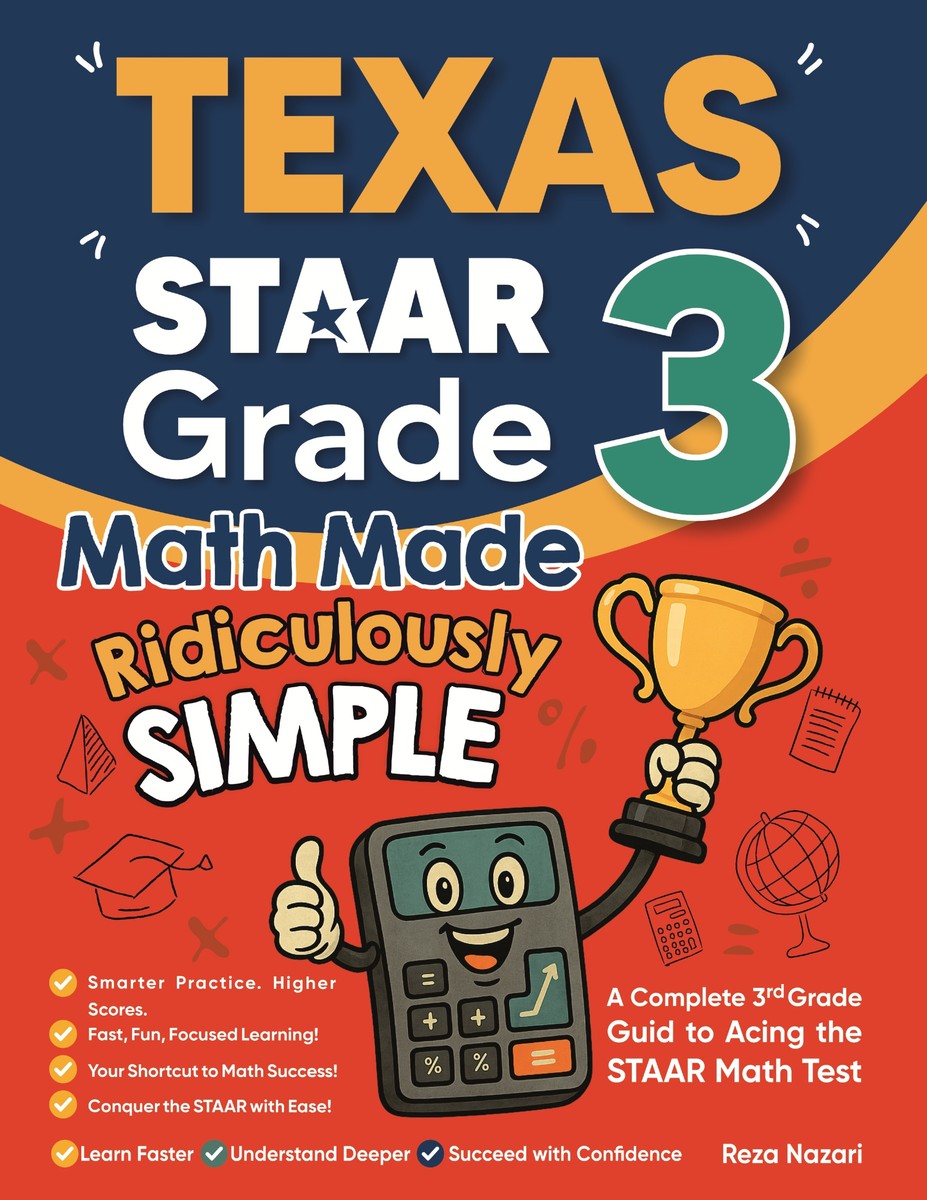
Texas STAAR Grade 3 Math Made Ridiculously Simple
A step-by-step STAAR Grade 3 math book that rebuilds every tested skill clearly and in order, built to match the Texas standards.
- Best starting point for the STAAR math test
- Pairs with Texas flashcards and worksheets
- Use it before full timed practice tests
- Organized for students who need examples before drills
Step-by-step lessons
Short explanations show the move before the student practices it.
✍Worked examples
Examples translate STAAR-style wording into clear math steps.
Targeted practice
Rebuild one skill at a time instead of jumping around.
Test-day bridge
After each topic, connect to formulas, flashcards, and practice questions.
How to use it
- Read one lesson and copy the worked example.
- Do a short worksheet set on the same topic.
- Review the matching flashcards or formulas.
- Try a mixed quiz and mark every miss.
Pair it with free tools
Choose the right Texas Grade 3 math book
Texas STAAR Grade 3 Math Made Ridiculously Simple
Start here for Texas Grade 3 math, step by step.
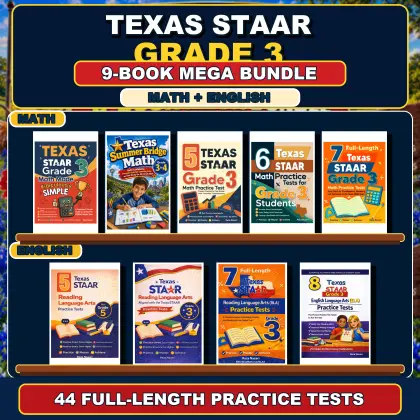
Texas STAAR Grade 3 Math & ELA Mega Bundle
9 books and 44 full-length practice tests in one TPT bundle.
Texas STAAR Grade 3 Math FAQ
What is the STAAR Grade 3 math test?
The STAAR (State of Texas Assessments of Academic Readiness) is Texas’s Grade 3 mathematics assessment. The linked activities are independent Grade 3 practice. Their question count, timer, scoring, and item types may differ from the official assessment. Use the directions inside each activity.
Can I use a calculator?
Texas’s standard STAAR policy does not permit calculators on grades 3–7 mathematics, except eligible accommodations. Check the STAAR calculator policy with your school before testing.
How long is each practice test?
Read the timer and question count shown in the practice activity you open. These are practice settings, not a statement of the official assessment’s duration or scoring.
Is it free?
The linked general practice and topic resources are available separately from optional books. Check each activity’s directions and access requirements. The study guide and bundle are optional next steps.
Grade 3 Math in Other States
Explore Grade 3 math standards, practice tests, and worksheets for every state.
- Alabama
- Alaska
- Arizona
- Arkansas
- California
- Colorado
- Connecticut
- Delaware
- Florida
- Georgia
- Hawaii
- Idaho
- Illinois
- Indiana
- Iowa
- Kansas
- Kentucky
- Louisiana
- Maine
- Maryland
- Massachusetts
- Michigan
- Minnesota
- Mississippi
- Missouri
- Montana
- Nebraska
- Nevada
- New Hampshire
- New Jersey
- New Mexico
- New York
- North Carolina
- North Dakota
- Ohio
- Oklahoma
- Oregon
- Pennsylvania
- Rhode Island
- South Carolina
- South Dakota
- Tennessee
- Utah
- Vermont
- Virginia
- Washington
- West Virginia
- Wisconsin
- Wyoming
- District of Columbia
Make This Your Texas STAAR Starting Point
Take a timed practice test, find your weakest topic, and study it with the linked lessons, worksheets, and the STAAR study guide.
Start a practice testA USEFUL NEXT STEP
Texas Grade 3 Math: study questions
How should I choose a Grade 3 math study target?
Choose a current classroom target, find the matching learning reference, and use a lesson or available practice resource to check understanding. State documents control local wording and placement; shared reference codes are not a certified crosswalk.
Official source ↗Are these activities official state assessments?
These are independently published learning resources. A practice score does not predict or replace an official state score. Use the directions in each activity and consult your school for official testing and accommodation rules.
Resources from Effortless Math · Editorial standards