


LEARN · PRACTICE · EXPLORE
Pennsylvania Grade 3 Math
Solve a Grade 3 elapsed-time example across an hour with a timeline, a worked explanation, Pennsylvania references, lessons, and printable math practice.
Focused lessons · Useful practice · Clear next steps
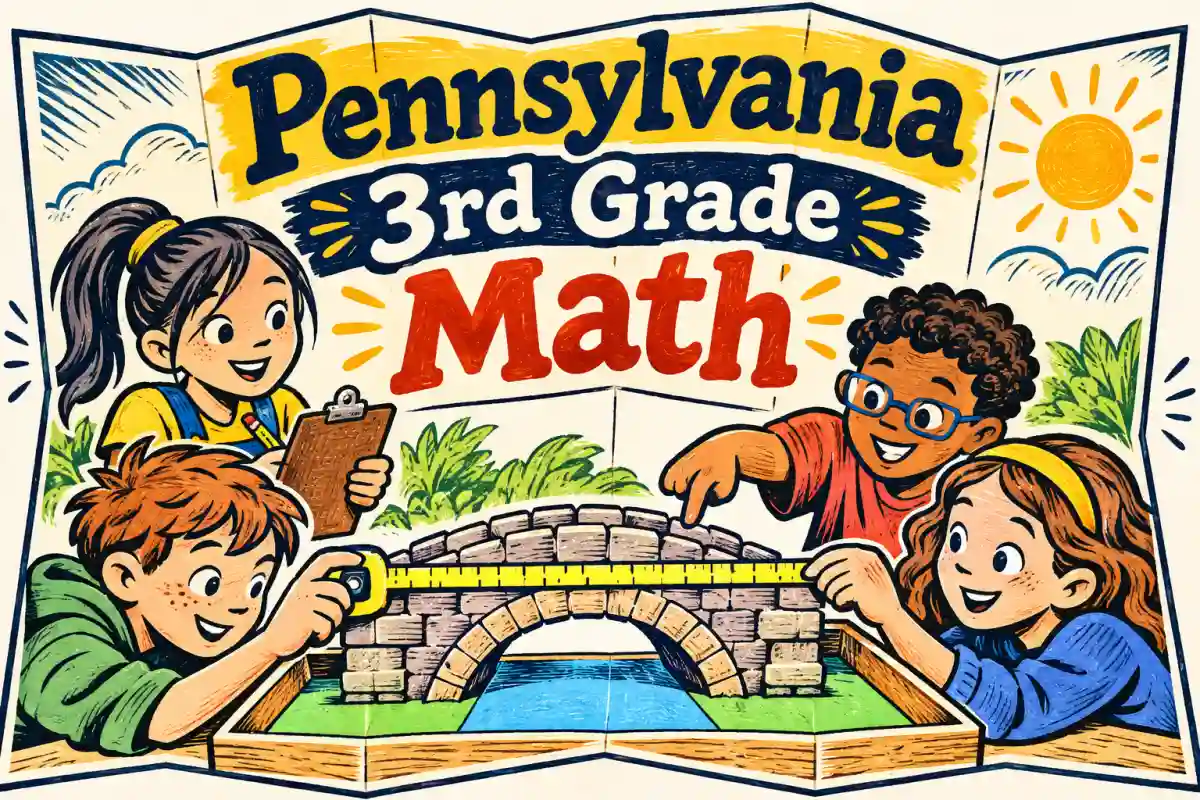
What do Pennsylvania 3rd graders learn in math?
In 3rd grade, Pennsylvania math centers on multiplication and division within 100, fractions on a number line, area and perimeter, and rounding. Students take the PSSA grade 3 math test in the spring. This page explains each Pennsylvania grade 3 math standard and pairs it with short lessons, skill quizzes, printable worksheets and a full-length practice test.
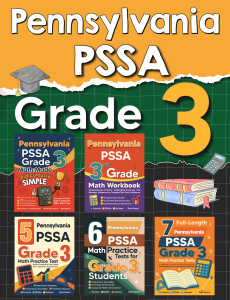
Printable Pennsylvania grade 3 math books:
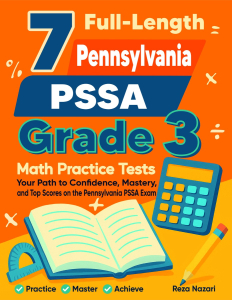
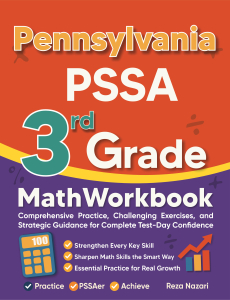
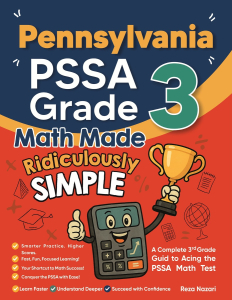
PSSA Grade 3 Math: Test Facts and Scores
Every Pennsylvania student in grades 3 through 8 takes the PSSA in English language arts and math each spring. The Grade 3 Mathematics test is based on the Pennsylvania Core Standards, and a scale score of 1000 or higher is Proficient.
| Test | Pennsylvania System of School Assessment (PSSA), Grade 3 Mathematics |
|---|---|
| 2027 testing window | ELA: April 26–30, 2027; mathematics and science: May 3–7, 2027 (optional make-up week May 10–14, 2027) |
| Question types | Multiple choice, technology-enhanced and open-ended items |
| Official samples | PSSA item and scoring samplers (free) |
Grade 3 math performance levels
| Performance level | Scale score |
|---|---|
| Below Basic | 600 to 922 |
| Basic | 923 to 999 |
| Proficient | 1000 to 1109 |
| Advanced | 1110 and above |
Practice on this page: Practice testsSkill quizzesPennsylvania standardsTopics and lessons
Facts from the Pennsylvania Department of Education, checked November 23, 2026: PDE: Pennsylvania System of School Assessment (PSSA), including 2026–27 testing windows; State Board of Education: PSSA scale score ranges (PA Core ELA and math); PDE: PSSA Mathematics test design.
All 41 Pennsylvania Grade 3 Math Eligible Content
Every Grade 3 mathematics eligible content statement in Pennsylvania’s PSSA Assessment Anchors, grouped by reporting category. These are the PA Core Standards skills the Grade 3 PSSA in math tests. Open a group to see them.
Numbers and Operations in Base Ten (4)
| M03.A-T.1.1.1 | Round two-and three-digit whole numbers to the nearest ten or hundred, respectively. |
|---|---|
| M03.A-T.1.1.2 | Add two-and three-digit whole numbers (limit sums from 100 through 1,000) and/or subtract two-and three-digit numbers from three-digit whole numbers. |
| M03.A-T.1.1.3 | Multiply one-digit whole numbers by two-digit multiples of 10 (from 10 through 90). |
| M03.A-T.1.1.4 | Order a set of whole numbers from least to greatest or greatest to least (up through 9,999, and limit sets to no more than four numbers). |
M03.A-F (5)
| M03.A-F.1.1.1 | Demonstrate that when a whole or set is partitioned into y equal parts, the fraction 1/y represents 1 part of the whole and/or the fraction x/y represents x equal parts of the whole (limit denominators to 2, 3, 4, 6, and 8; limit numerators to whole numbers less than the denominator; and no simplification necessary). |
|---|---|
| M03.A-F.1.1.2 | Represent fractions on a number line (limit denominators to 2, 3, 4, 6, and 8; limit numerators to whole numbers less than the denominator; and no simplification necessary). |
| M03.A-F.1.1.3 | Recognize and generate simple equivalent fractions (limit the denominators to 1, 2, 3, 4, 6, and 8 and limit numerators to whole numbers less than the denominator). |
| M03.A-F.1.1.4 | Express whole numbers as fractions, and/or generate fractions that are equivalent to whole numbers (limit denominators to 1, 2, 3, 4, 6, and 8). |
| M03.A-F.1.1.5 | Compare two fractions with the same denominator (limit denominators to 1, 2, 3, 4, 6, and 8), using the symbols >, =, or <, and/or justify the conclusions. |
Operations and Algebraic Thinking (14)
| M03.B-O.1.1.1 | Interpret and/or describe products of whole numbers (up to and including 10 × 10). |
|---|---|
| M03.B-O.1.1.2 | Interpret and/or describe whole-number quotients of whole numbers (limit dividends through 50 and limit divisors and quotients through 10). |
| M03.B-O.1.2.1 | Use multiplication (up to and including 10 × 10) and/or division (limit dividends through 50 and limit divisors and quotients through 10) to solve word problems in situations involving equal groups, arrays, and/or measurement quantities. |
| M03.B-O.1.2.2 | Determine the unknown whole number in a multiplication (up to and including 10 × 10) or division (limit dividends through 50 and limit divisors and quotients through 10) equation relating three whole numbers. |
| M03.B-O.2.1.1 | Apply the commutative property of multiplication (not identification or definition of the property). |
| M03.B-O.2.1.2 | Apply the associative property of multiplication (not identification or definition of the property). |
| M03.B-O.2.2.1 | Interpret and/or model division as a multiplication equation with an unknown factor. |
| M03.B-O.3.1.1 | Solve two-step word problems using the four operations (expressions are not explicitly stated). Limit to problems with whole numbers and having whole-number answers. |
| M03.B-O.3.1.2 | Represent two-step word problems using equations with a symbol standing for the unknown quantity. Limit to problems with whole numbers and having whole-number answers. |
| M03.B-O.3.1.3 | Assess the reasonableness of answers. Limit problems posed with whole numbers and having whole-number answers. |
| M03.B-O.3.1.4 | Solve two-step equations using order of operations (equation is explicitly stated with no grouping symbols). |
| M03.B-O.3.1.5 | Identify arithmetic patterns (including patterns in the addition table or multiplication table) and/or explain them using properties of operations. |
| M03.B-O.3.1.6 | Create or match a story to a given combination of symbols (+, –, ×, ÷, <, >, and =) and numbers. |
| M03.B-O.3.1.7 | Identify the missing symbol (+, –, ×, ÷, <, >, and =) that makes a number sentence true. |
Geometry (3)
| M03.C-G.1.1.1 | Explain that shapes in different categories may share attributes and that the shared attributes can define a larger category. |
|---|---|
| M03.C-G.1.1.2 | Recognize rhombi, rectangles, and squares as examples of quadrilaterals and/or draw examples of quadrilaterals that do not belong to any of these subcategories. |
| M03.C-G.1.1.3 | Partition shapes into parts with equal areas. Express the area of each part as a unit fraction of the whole. |
Measurement and Data (15)
| M03.D-M.1.1.1 | Tell, show, and/or write time (analog) to the nearest minute. |
|---|---|
| M03.D-M.1.1.2 | Calculate elapsed time to the minute in a given situation (total elapsed time limited to 60 minutes or less). |
| M03.D-M.1.2.1 | Measure and estimate liquid volumes and masses of objects using standard units (cups [c], pints [pt], quarts [qt], gallons [gal], ounces [oz.], and pounds [lb]) and metric units (liters [l], grams [g], and kilograms [kg]). |
| M03.D-M.1.2.2 | Add, subtract, multiply, and divide to solve one-step word problems involving masses or liquid volumes that are given in the same units. |
| M03.D-M.1.2.3 | Use a ruler to measure lengths to the nearest quarter inch or centimeter. |
| M03.D-M.1.3.1 | Compare total values of combinations of coins (penny, nickel, dime, and quarter) and/or dollar bills less than 5.00 dollars. |
| M03.D-M.1.3.2 | Make change for an amount up to 5.00 dollars with no more than 2.00 dollars change given (penny, nickel, dime, quarter, and dollar). |
| M03.D-M.1.3.3 | Round amounts of money to the nearest dollar. |
| M03.D-M.2.1.1 | Complete a scaled pictograph and a scaled bar graph to represent a data set with several categories (scales limited to 1, 2, 5, and 10). |
| M03.D-M.2.1.2 | Solve one- and two-step problems using information to interpret data presented in scaled pictographs and scaled bar graphs (scales limited to 1, 2, 5, and 10). |
| M03.D-M.2.1.3 | Generate measurement data by measuring lengths using rulers marked with halves and fourths of an inch. Display the data by making a line plot, where the horizontal scale is marked in appropriate units—whole numbers, halves, or quarters. |
| M03.D-M.2.1.4 | Translate information from one type of display to another. Limit to pictographs, tally charts, bar graphs, and tables. |
| M03.D-M.3.1.1 | Measure areas by counting unit squares (square cm, square m, square in., square ft, and non-standard square units). |
| M03.D-M.3.1.2 | Multiply side lengths to find areas of rectangles with whole-number side lengths in the context of solving real-world and mathematical problems, and represent whole-number products as rectangular areas in mathematical reasoning. |
| M03.D-M.4.1.1 | Solve real-world and mathematical problems involving perimeters of polygons, including finding the perimeter given the side lengths, finding an unknown side length, exhibiting rectangles with the same perimeter and different areas, and exhibiting rectangles with the same area and different perimeters. Use the same units throughout the problem. |
Codes and wording from the PDE Assessment Anchors and Eligible Content document (main statement; examples and limits are in the official document). Checked November 23, 2026: PDE: PSSA Assessment Anchors and Eligible Content, Mathematics Grade 3.
Count Minutes Across an Hour
A reading session crosses the hour
In this invented classroom schedule, reading begins at 10:47 a.m. and ends at 11:12 a.m. How long does the session last? Explain why subtracting 47 from 12 without accounting for the hour does not answer the question.
Follow the reasoning
There are 13 minutes from 10:47 to 11:00, because 47 + 13 = 60. From 11:00 to 11:12 there are another 12 minutes. The full interval is 13 + 12 = 25 minutes. Count forward from the start to check: 10:47 plus 13 minutes reaches 11:00, and another 12 reaches the stated end. The minute numbers belong to different hours, so 12 − 47 alone ignores the hour boundary. The timeline splits one continuous interval into two adjoining parts; it does not count 11:00 as an extra minute.
Check a common error
A student says the session lasts 65 minutes because “11:12 minus 10:47 is 65.” That result treats the clock as though an hour contained 100 minutes. An hour has 60 minutes. Adding 65 minutes to 10:47 reaches 11:52, which does not match 11:12. Checking an answer against the end time is a useful way to identify the error.
Try the next step
Change the end time to 11:08 a.m., keeping the start at 10:47 a.m. Explain your new interval before reading the check: 13 minutes to 11:00 and 8 more gives 21 minutes. Then use a teacher-approved analog clock to show each stated time to the nearest minute. Practice reading the clock and calculating an interval as related skills.
Use the school’s actual schedule for another example. Write start and end times with a.m. or p.m. and choose a same-day interval first. These invented times do not describe a Pennsylvania test session or its duration.
Selected Pennsylvania mathematics reference
The Pennsylvania Standards Aligned System download directory links the March 1, 2014 PA Core mathematics document. It includes mathematical content and practices and guides locally developed curricula. The state board directory identifies March 1, 2014 as the effective date. The selected label below identifies this activity’s focus; read the complete requirement and the school’s sequence.
| State reference | Activity focus | Official document |
|---|---|---|
| CC.2.4.3.A.2 | Tell time to the minute and calculate time intervals | Read PDF page 9 |
This original activity and the broader lesson directory are starting points for practice, not a complete Pennsylvania curriculum crosswalk.
Connect the model with the next task
Use the lesson, worksheet, and quiz directory to review the skill that caused difficulty. Keep the student’s explanation beside the result: a correct answer with unclear reasoning may need a model, while a sound explanation with a calculation error may need another short example. Follow each independent resource’s directions.
Pennsylvania’s PSSA overview includes mathematics and English in Grades 3–8, including Grade 3. Its 2026–2027 calendar lists English for April 26–30, 2027 and mathematics, science, and make-ups for May 3–7, with an optional May 10–14 extension. Science is assessed in Grades 5 and 8; the combined calendar is not a list of subjects taken by every grade. Confirm the school’s actual assigned dates, pathway, and current directions. Independent practice has its own timing, tools, question count, and scoring; its result does not predict a state performance level. Read the current PSSA overview and calendar.
Sources checked October 6, 2026. Use the current standards and school assignments when planning practice.
Standards source: Pennsylvania Standards Aligned System downloads.
Start with Grade 3 Math Practice
Use this general Grade 3 math practice test to check your skills, then review the missed topics below. It is independent practice, not an official state assessment or a replica of its timing, scoring, or question types.
Open the Grade 3 practice test Explore Grade 3 lessons and worksheetsClassroom practice and state assessment
Pennsylvania’s PSSA overview includes mathematics and English in Grades 3–8, including Grade 3. Its 2026–2027 calendar lists English for April 26–30, 2027 and mathematics, science, and make-ups for May 3–7, with an optional May 10–14 extension. Science is assessed in Grades 5 and 8; the combined calendar is not a list of subjects taken by every grade. Confirm the school’s actual assigned dates, pathway, and current directions. Independent practice has its own timing, tools, question count, and scoring; its result does not predict a state performance level. Read official PSSA guidance.
Pennsylvania Grade 3 Math Topics
Choose a related lesson, printable practice resource, or quiz. This broader directory includes review and enrichment; compare each task with the school’s current learning goals. Read the separately linked PA reference for the worked activity above.
Official references: Pennsylvania Standards Aligned System downloads.
Place Value & Number Sense
Addition & Subtraction
Multiplication
Division
Problem Solving & Patterns
Fractions
Measurement, Time & Data
Pennsylvania Grade 3 Math Books and Resources
Each book has a job: start from scratch, drill weak skills, or build pacing with full tests. All of them pair with the free tools on this page.
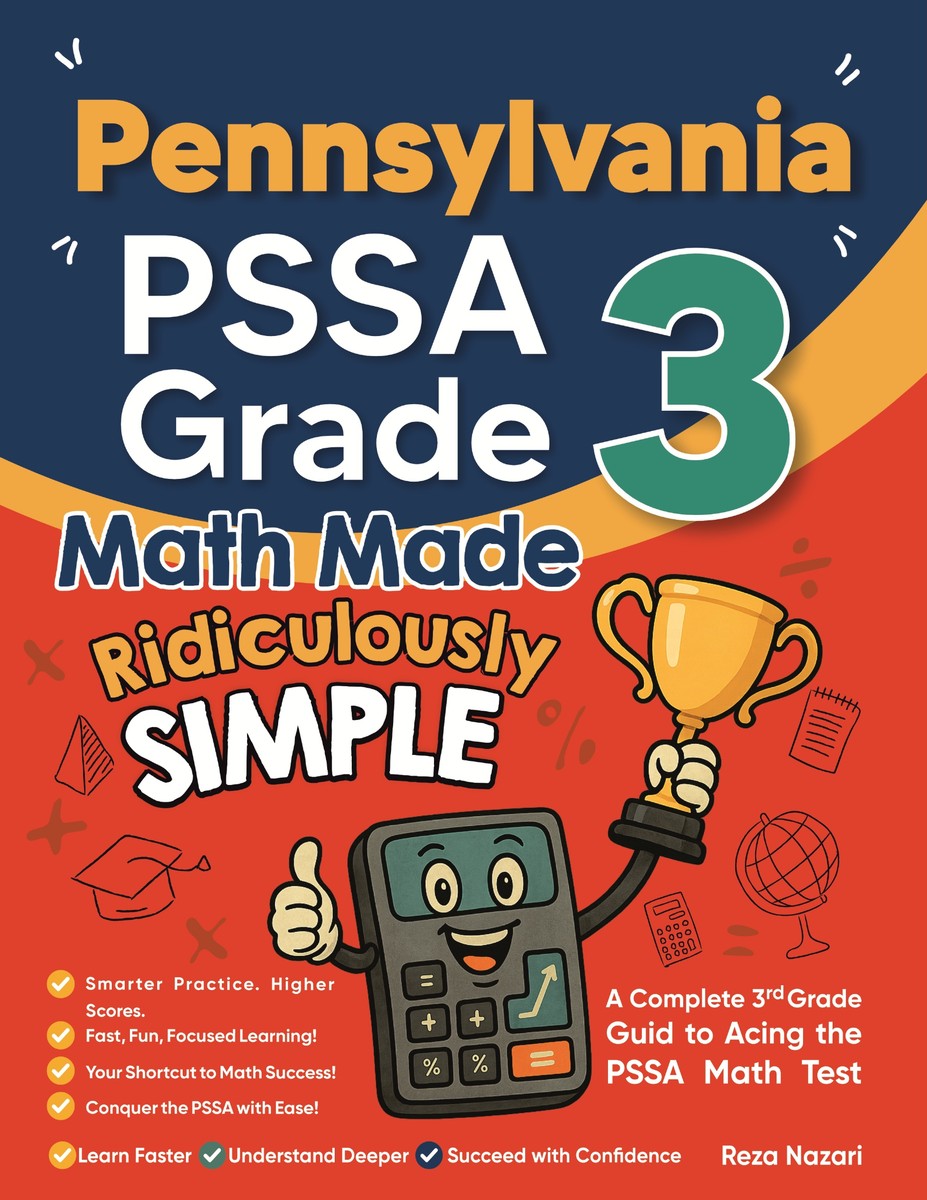
Pennsylvania PSSA Grade 3 Math Made Ridiculously Simple
An independently published Grade 3 mathematics book. Check its contents and edition alongside the school’s course and complete PA Core requirements before choosing preparation.
- Best starting point for the PSSA math test
- Pairs with Pennsylvania flashcards and worksheets
- Use it before full timed practice tests
- Organized for students who need examples before drills
Step-by-step lessons
Short explanations show the move before the student practices it.
✍Worked examples
Use the book’s worked explanations alongside the teacher’s assigned learning tasks.
Targeted practice
Rebuild one skill at a time instead of jumping around.
Test-day bridge
After each topic, connect to formulas, flashcards, and practice questions.
How to use it
- Read one lesson and copy the worked example.
- Do a short worksheet set on the same topic.
- Review the matching flashcards or formulas.
- Try a mixed quiz and mark every miss.
Pair it with free tools
Choose the right Pennsylvania Grade 3 math book
Pennsylvania PSSA Grade 3 Math Made Ridiculously Simple
Start here for Pennsylvania Grade 3 math, step by step.
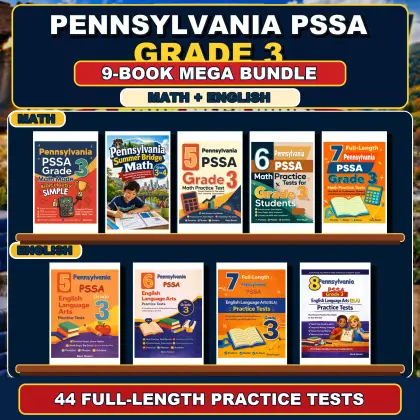
Pennsylvania PSSA Grade 3 Math & ELA Mega Bundle
9 books and 44 full-length practice tests in one TPT bundle.
Grade 3 math: useful planning questions
Why split elapsed time at the next hour?
It makes the 60-minute boundary explicit. Count to the next hour, then to the end, and combine the intervals. Check by adding the result to the starting time.
When does Pennsylvania Grade 3 take PSSA mathematics?
Pennsylvania’s PSSA overview includes mathematics and English in Grades 3–8, including Grade 3. Its 2026–2027 calendar lists English for April 26–30, 2027 and mathematics, science, and make-ups for May 3–7, with an optional May 10–14 extension. Science is assessed in Grades 5 and 8; the combined calendar is not a list of subjects taken by every grade. Confirm the school’s actual assigned dates, pathway, and current directions. Independent practice has its own timing, tools, question count, and scoring; its result does not predict a state performance level.
Grade 3 Math in Other States
Explore Grade 3 math standards, practice tests, and worksheets for every state.
- Alabama
- Alaska
- Arizona
- Arkansas
- California
- Colorado
- Connecticut
- Delaware
- Florida
- Georgia
- Hawaii
- Idaho
- Illinois
- Indiana
- Iowa
- Kansas
- Kentucky
- Louisiana
- Maine
- Maryland
- Massachusetts
- Michigan
- Minnesota
- Mississippi
- Missouri
- Montana
- Nebraska
- Nevada
- New Hampshire
- New Jersey
- New Mexico
- New York
- North Carolina
- North Dakota
- Ohio
- Oklahoma
- Oregon
- Rhode Island
- South Carolina
- South Dakota
- Tennessee
- Texas
- Utah
- Vermont
- Virginia
- Washington
- West Virginia
- Wisconsin
- Wyoming
- District of Columbia
Make This Your Pennsylvania PSSA Starting Point
Choose a related practice resource and compare its feedback with the student’s explanation. Use the lessons and printable resources to plan a focused next task.
Start a practice testPennsylvania Grade 3 Math: 10-Question Challenge
Ten fresh questions on the skills Pennsylvania 3rd graders work on most. Pick an answer, check it, and read the explanation either way.
The 8 is in the thousands place, so its value is 8 × 1,000 = 8,000.
Look at the tens digit, which is 7. Since 7 is 5 or more, round up. 874 rounds to 900.
The numerators are the same. When the same amount is split into fewer parts, each part is larger, so \(\frac{1}{4}\) is greater than \(\frac{1}{6}\).
Multiply the numerator and denominator by 2: \(\frac{2}{4}\) = \(\frac{4}{8}\).
Choose another state
Grade 3 Math in Every State
Select a state on the map to open its Grade 3 Math page. You are viewing Pennsylvania.
All states A–Z
A USEFUL NEXT STEP
Pennsylvania Grade 3 Math: study questions
Why split elapsed time at the next hour?
It makes the 60-minute boundary explicit. Count to the next hour, then to the end, and combine the intervals. Check by adding the result to the starting time.
When does Pennsylvania Grade 3 take PSSA mathematics?
Pennsylvania’s PSSA overview includes mathematics and English in Grades 3–8, including Grade 3. Its 2026–2027 calendar lists English for April 26–30, 2027 and mathematics, science, and make-ups for May 3–7, with an optional May 10–14 extension. Science is assessed in Grades 5 and 8; the combined calendar is not a list of subjects taken by every grade. Confirm the school’s actual assigned dates, pathway, and current directions. Independent practice has its own timing, tools, question count, and scoring; its result does not predict a state performance level.
Official source ↗Resources from Effortless Math · Editorial standards