LEARN · PRACTICE · EXPLORE
Delaware Grade 3 Math
Use an original reading-session timeline to calculate elapsed minutes across an hour, check the result, and follow Delaware Grade 3 time references.
Focused lessons · Useful practice · Clear next steps
Standards source: Delaware Mathematics Standards, Delaware Department of Education.
Start with Grade 3 Math Practice
Use this general Grade 3 math practice test to check your skills, then review the missed topics below. It is independent practice, not an official state assessment or a replica of its timing, scoring, or question types.
Open the Grade 3 practice test Explore Grade 3 lessons and worksheetsClassroom practice and state assessment information
Grade 3 is within Delaware’s Smarter Balanced mathematics testing range. The linked learning resources have their own directions and scoring; a practice score does not establish an official state performance level. Read the state summative assessment overview for official guidance.
Use the worked activity and lesson directory to choose a skill. Confirm the directions of an independent practice resource before assigning it.
Find the minutes from 2:35 to 3:20
Work through the example
An afternoon reading session begins at 2:35 and ends at 3:20. How many minutes does it last? Use the next whole hour as a helpful stopping point.
Connect the model and calculation
From 2:35 to 3:00 is 25 minutes, because 60 − 35 = 25. From 3:00 to 3:20 is another 20 minutes. Add the two intervals: 25 + 20 = 45 minutes. The session lasts 45 minutes. A check starts at 2:35, moves forward 25 minutes to 3:00, then another 20 to 3:20. Both parts must connect without a gap or overlap.
Understand an incorrect answer
Subtracting 35 from 20 without accounting for the hour change does not measure the interval. A clock hour has 60 minutes, so its written times cannot be handled like ordinary decimal numbers. Another error is to call 2:35 to 3:00 thirty-five minutes; that is the number of minutes already past two, not the minutes remaining before three. Draw or point to the remaining part of the hour.
Transfer the idea to another example
Keep the start at 2:35 and move the end to 3:10. The intervals become 25 and 10 minutes, totaling 35. Then ask what end time would follow a 30-minute session starting at 2:35: 25 minutes reaches 3:00 and five more reaches 3:05. Have the student label each jump with a duration and each endpoint with a clock time. That distinction helps when moving between an elapsed-time question and a missing-end-time question.
Selected Delaware Grade 3 references
The Delaware mathematics standards directory links the Common Core publisher. Delaware’s standards regulation, section 1.1.1.1, identifies adoption for the 2010–11 school year. Use the adopted document alongside the school’s instructional plan. These labels summarize the activity’s focus; read the complete expectations and mathematical practices in the publisher’s mathematics document.
| Reference | Activity focus | Official document |
|---|---|---|
| 3.MD.A.1 | Time to the minute and elapsed-time problems | Read PDF page 24 |
Sources checked October 5, 2026. This selected activity is an entry point for instruction, not a complete curriculum checklist.
Connect the explanation with practice
Use the lesson, worksheet, and quiz directory to choose a related skill. The existing resource links remain available; open each activity’s directions to understand its timer, tools, question count, and scoring.
Grade 3 is within Delaware’s Smarter Balanced mathematics testing range. The linked learning resources have their own directions and scoring; a practice score does not establish an official state performance level. Read Delaware’s official summative assessment overview.
Keep one example of the student’s reasoning with the practice result. Choose a smaller model, a related question, or a new context according to the difficulty revealed in the worked activity.
Delaware Grade 3 Math Topics
Student-friendly Grade 3 math skills, with a focused lesson, practice resources where available, and a topic quiz. Displayed codes are broad reference groups, not a certified state crosswalk.
Standards source: Delaware Mathematics Standards, Delaware Department of Education.
Place Value & Number Sense
Addition & Subtraction
Multiplication
Division
Problem Solving & Patterns
Fractions
Measurement, Time & Data
Best Delaware Smarter Balanced Grade 3 Math Books
Each book has a job: start from scratch, drill weak skills, or build pacing with full tests. All of them pair with the free tools on this page.
Choose the right Delaware Grade 3 math book
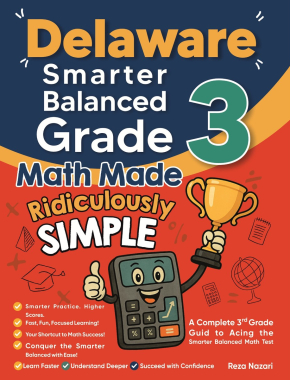
Delaware Smarter Balanced Grade 3 Math Made Ridiculously Simple
Start here for Delaware Grade 3 math, step by step.
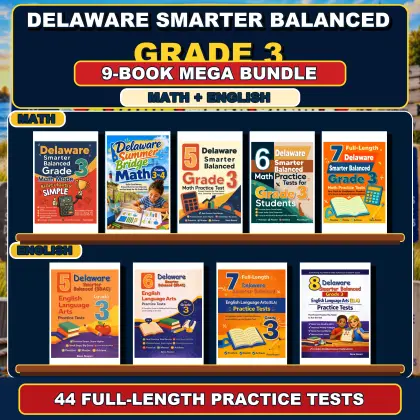
Delaware Smarter Balanced Grade 3 Math & ELA Mega Bundle
9 books and 44 full-length practice tests in one TPT bundle.
Delaware Grade 3 math: useful study questions
Why split the interval at 3:00?
The whole hour is a useful checkpoint. It separates 25 minutes before three from 20 minutes after three, making the total of 45 minutes easier to explain and check.
Is Grade 3 included in Delaware Smarter Balanced math testing?
Yes. Grade 3 is within Delaware’s Smarter Balanced range of Grades 3–8. The linked activities are independently published practice with separate directions and scoring.
Grade 3 Math in Other States
Explore Grade 3 math standards, practice tests, and worksheets for every state.
- Alabama
- Alaska
- Arizona
- Arkansas
- California
- Colorado
- Connecticut
- Florida
- Georgia
- Hawaii
- Idaho
- Illinois
- Indiana
- Iowa
- Kansas
- Kentucky
- Louisiana
- Maine
- Maryland
- Massachusetts
- Michigan
- Minnesota
- Mississippi
- Missouri
- Montana
- Nebraska
- Nevada
- New Hampshire
- New Jersey
- New Mexico
- New York
- North Carolina
- North Dakota
- Ohio
- Oklahoma
- Oregon
- Pennsylvania
- Rhode Island
- South Carolina
- South Dakota
- Tennessee
- Texas
- Utah
- Vermont
- Virginia
- Washington
- West Virginia
- Wisconsin
- Wyoming
- District of Columbia
Make This Your Delaware Smarter Balanced Starting Point
Take a timed practice test, find your weakest topic, and study it with the linked lessons, worksheets, and the Smarter Balanced study guide.
Start a practice testA USEFUL NEXT STEP
Delaware Grade 3 Math: study questions
Why split the interval at 3:00?
The whole hour is a useful checkpoint. It separates 25 minutes before three from 20 minutes after three, making the total of 45 minutes easier to explain and check.
Is Grade 3 included in Delaware Smarter Balanced math testing?
Yes. Grade 3 is within Delaware’s Smarter Balanced range of Grades 3–8. The linked activities are independently published practice with separate directions and scoring.
Official source ↗Resources from Effortless Math · Editorial standards