LEARN · PRACTICE · EXPLORE
Colorado Grade 3 Math
Compare one half with two fourths using equal-length strips, explain fraction equivalence, and find Colorado Grade 3 references, lessons, worksheets, and quizzes.
Focused lessons · Useful practice · Clear next steps
Standards source: Standards and Instructional Support, Colorado Department of Education.
Start with Grade 3 Math Practice
Use this general Grade 3 math practice test to check your skills, then review the missed topics below. It is independent practice, not an official state assessment or a replica of its timing, scoring, or question types.
Open the Grade 3 practice test Explore Grade 3 lessons and worksheetsClassroom practice and CMAS information
Grade 3 is within the CMAS mathematics testing range. Classroom learning and an independent practice score serve different purposes; a practice score does not establish an official state performance level. Read the official CMAS overview for state assessment guidance.
The linked tests, quizzes, and books have their own settings and directions. Use those directions when selecting a resource for instruction.
Explain why two fourths and one half describe the same amount
Different partitions, the same shaded length
Draw two strips of equal length. The first is divided into two equal parts with one shaded. The second is divided into four equal parts with two shaded. Do the shaded regions represent different amounts, or the same amount?
Align the strips at the same starting point. Both shaded regions end halfway along the whole strip. The first labels that amount 1/2; the second labels it 2/4. The two fourths cover the same length as one half, so 1/2 = 2/4.
Explain what changes when the partition changes
The second strip has more pieces, but each piece is smaller. A fourth is half the size of a half, so two fourths join to make one half. More shaded pieces do not necessarily mean a greater shaded amount. Ask the student to name the size of each piece as well as the number shaded.
On a number line, use the interval from 0 to 1 as the whole. Partition it into halves and mark 1/2. Then partition an equal 0-to-1 interval into fourths and mark 2/4. The points occupy the same position. This connects the strip model with fractions as numbers, rather than treating a fraction only as a picture label.
Investigate a tempting mistake
A child may say that 2/4 is larger because two shaded pieces are more than one. Compare the pieces directly. One shaded half can be split into two fourths without making the shaded amount longer. A different error is to divide a strip into unequal pieces and label each one a fourth. Fold or measure the partition to show why equal parts matter.
Also check that the strips represent equal wholes. If the second strip is twice as long, its two shaded fourths may be physically longer than one half of the first strip. The fraction names describe proportions of their own wholes; a physical-length comparison needs a shared whole.
Create and defend another equivalence
Shade two thirds of a new strip and divide each third into two equal pieces. Four sixths are now shaded, and the total shaded length has not changed. Explain 2/3 = 4/6 using the same reasoning. Students can point to the paired pieces before writing an equation.
Use the explanation to choose practice. A student who can name shaded fractions but cannot compare their amounts needs more equal-whole models. A student who can show equality can try placing the equivalent fractions on a number line and writing a sentence that explains their shared position.
Selected Colorado Grade 3 evidence outcomes
The Colorado mathematics directory links the 2020 Colorado Academic Standards, adopted in 2018. The linked grade-band document was corrected in December 2019. These activity labels summarize selected evidence outcomes; the codes below are the CCSS references displayed in Colorado’s document. Read the complete grade expectations, mathematical practices, and Colorado context alongside them.
| Reference in source | Activity focus | Official document |
|---|---|---|
| 3.NF.A.3.a | Equivalent fractions as equal amounts | Read PDF page 12 |
| 3.NF.A.3.b | Explain simple equivalence with a model | Read PDF page 12 |
Sources checked October 5, 2026. This selected activity is one entry point for instruction; it is not a complete curriculum checklist.
Connect the explanation with practice
Use the lesson, worksheet, and quiz directory to choose a related skill. The existing resource links remain available; use an activity’s directions to understand its timer, tools, question count, and scoring.
Grade 3 is within the CMAS mathematics testing range. Classroom learning and an independent practice score serve different purposes; a practice score does not establish an official state performance level. Read Colorado’s official CMAS overview.
Keep one example of the student’s reasoning with the practice result. Use the error analysis in the activity to choose a smaller model, a related question, or a new context for the next session.
Colorado Grade 3 Math Topics
Student-friendly Grade 3 math skills, with a focused lesson, practice resources where available, and a topic quiz. Displayed codes are broad reference groups, not a certified state crosswalk.
Standards source: Standards and Instructional Support, Colorado Department of Education.
Place Value & Number Sense
Addition & Subtraction
Multiplication
Division
Problem Solving & Patterns
Fractions
Measurement, Time & Data
Best Colorado CMAS Grade 3 Math Books
Each book has a job: start from scratch, drill weak skills, or build pacing with full tests. All of them pair with the free tools on this page.
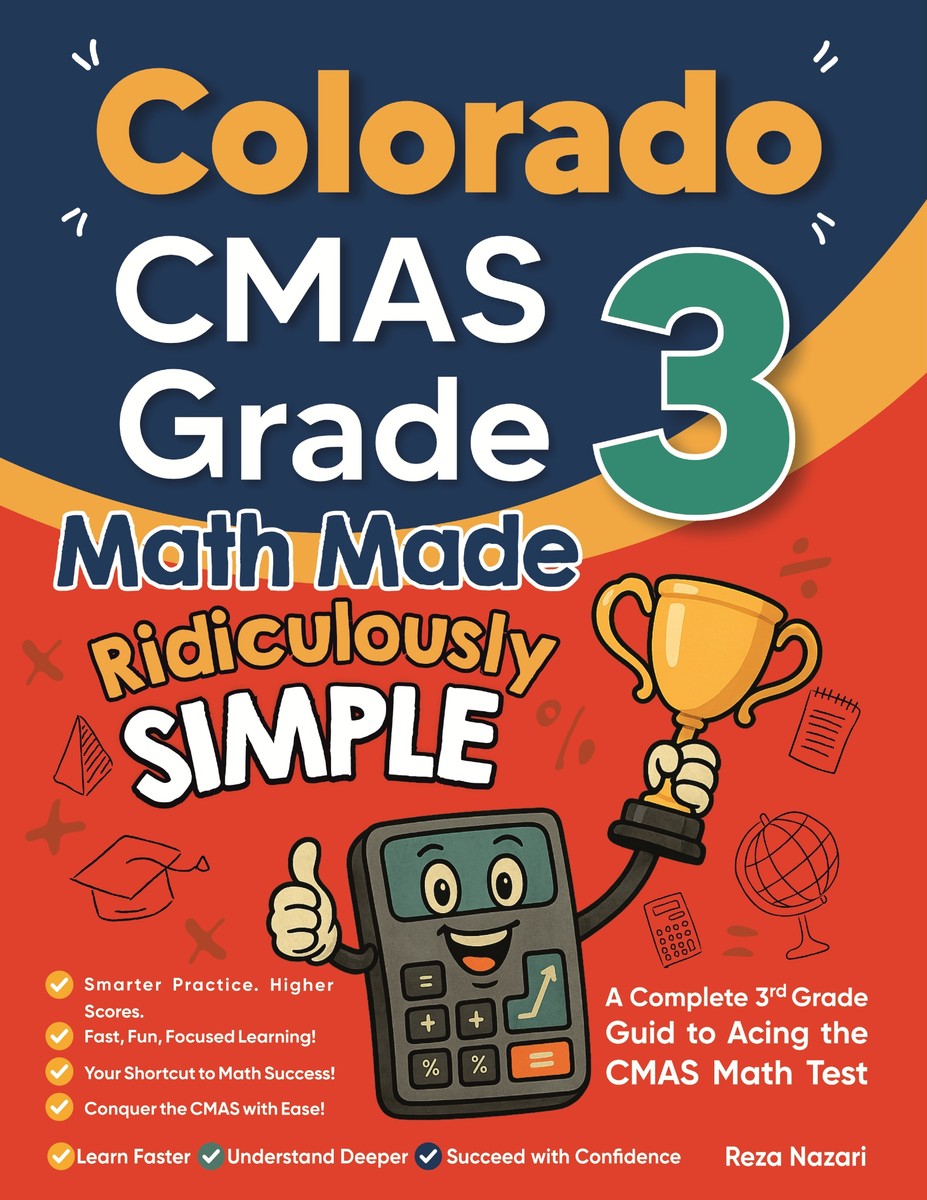
Colorado CMAS Grade 3 Math Made Ridiculously Simple
A step-by-step CMAS Grade 3 math book that rebuilds every tested skill clearly and in order, built to match the Colorado standards.
- Best starting point for the CMAS math test
- Pairs with Colorado flashcards and worksheets
- Use it before full timed practice tests
- Organized for students who need examples before drills
Step-by-step lessons
Short explanations show the move before the student practices it.
✍Worked examples
Examples translate CMAS-style wording into clear math steps.
Targeted practice
Rebuild one skill at a time instead of jumping around.
Test-day bridge
After each topic, connect to formulas, flashcards, and practice questions.
How to use it
- Read one lesson and copy the worked example.
- Do a short worksheet set on the same topic.
- Review the matching flashcards or formulas.
- Try a mixed quiz and mark every miss.
Pair it with free tools
Choose the right Colorado Grade 3 math book
Colorado CMAS Grade 3 Math Made Ridiculously Simple
Start here for Colorado Grade 3 math, step by step.
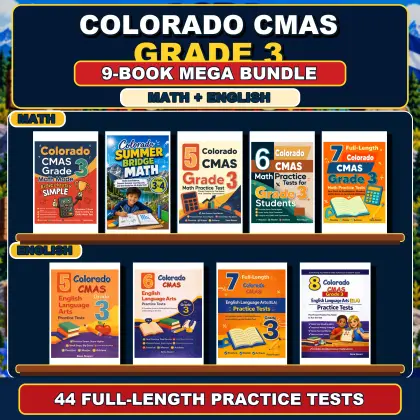
Colorado CMAS Grade 3 Math & ELA Mega Bundle
9 books and 44 full-length practice tests in one TPT bundle.
Colorado Grade 3 math: useful study questions
Why must the strips represent the same whole?
One half of a longer strip need not have the same physical length as two fourths of a shorter strip. Equal wholes let the fraction models show whether the represented amounts are equal.
Is Grade 3 included in CMAS math testing?
Yes. Grade 3 is within CMAS mathematics testing in Grades 3–8. Linked practice activities are independently published and have their own directions and scoring.
Grade 3 Math in Other States
Explore Grade 3 math standards, practice tests, and worksheets for every state.
- Alabama
- Alaska
- Arizona
- Arkansas
- California
- Connecticut
- Delaware
- Florida
- Georgia
- Hawaii
- Idaho
- Illinois
- Indiana
- Iowa
- Kansas
- Kentucky
- Louisiana
- Maine
- Maryland
- Massachusetts
- Michigan
- Minnesota
- Mississippi
- Missouri
- Montana
- Nebraska
- Nevada
- New Hampshire
- New Jersey
- New Mexico
- New York
- North Carolina
- North Dakota
- Ohio
- Oklahoma
- Oregon
- Pennsylvania
- Rhode Island
- South Carolina
- South Dakota
- Tennessee
- Texas
- Utah
- Vermont
- Virginia
- Washington
- West Virginia
- Wisconsin
- Wyoming
- District of Columbia
Make This Your Colorado CMAS Starting Point
Take a timed practice test, find your weakest topic, and study it with the linked lessons, worksheets, and the CMAS study guide.
Start a practice testA USEFUL NEXT STEP
Colorado Grade 3 Math: study questions
Why must the strips represent the same whole?
One half of a longer strip need not have the same physical length as two fourths of a shorter strip. Equal wholes let the fraction models show whether the represented amounts are equal.
Is Grade 3 included in CMAS math testing?
Yes. Grade 3 is within CMAS mathematics testing in Grades 3–8. Linked practice activities are independently published and have their own directions and scoring.
Official source ↗Resources from Effortless Math · Editorial standards