LEARN · PRACTICE · EXPLORE
Michigan Grade 3 Math
Build and interpret a line plot from quarter-inch measurements, check its scale, and access Michigan Grade 3 math lessons, worksheets, and quizzes.
Focused lessons · Useful practice · Clear next steps
Standards source: Michigan Mathematics Standards, Michigan Department of Education.
Start with Grade 3 Math Practice
Use this general Grade 3 math practice test to check your skills, then review the missed topics below. It is independent practice, not an official state assessment or a replica of its timing, scoring, or question types.
Open the Grade 3 practice test Explore Grade 3 lessons and worksheetsClassroom practice and state assessment information
The currently linked 2025–26 state guide identifies M-STEP English language arts and mathematics in Grades 3–7, including Grade 3. Follow the school’s current assigned assessment pathway and directions. Independently published practice may use its own timer, tools, question count, and scoring; these are not official administration specifications or a prediction of a state performance level. Read the currently linked state assessment guide for official guidance.
Use the worked activity and lesson directory to choose a skill. Confirm the directions of an independent practice resource before assigning it.
Represent quarter-inch measurements with a line plot
What does each mark on the plot count?
A classroom measures six paper strips to the nearest quarter inch. The example lengths are 2, 2 1/4, 2 1/4, 2 1/2, 2 3/4, and 2 3/4 inches. Display all six measurements on a line plot. Label a quarter-inch scale, and explain the difference between a position on the scale and a mark above that position. The data are illustrative, not measurements taken from your classroom.
Explain the solution
Make equally spaced positions for 2, 2 1/4, 2 1/2, and 2 3/4 inches. The distance between adjacent labeled positions represents one quarter inch. Place one mark above 2, two stacked marks above 2 1/4, one above 2 1/2, and two above 2 3/4. Each mark represents one measured strip; its horizontal position identifies that strip’s length. Count the marks to check that all six strips appear. The longest measurement is 2 3/4 inches and the shortest is 2 inches, a difference of 3/4 inch. Two different lengths are tied for the most frequent measurement, with two strips at each.
| Length in inches | Number of strips |
|---|---|
| 2 | 1 |
| 2 1/4 | 2 |
| 2 1/2 | 1 |
| 2 3/4 | 2 |
Notice the reasoning
The upper mark in a stack does not describe a longer strip than the lower mark. Both marks share the same horizontal measurement. Ask a learner to point to the length on the axis and then count how many strips have that length. A line plot needs a consistent numerical scale, not merely equally spaced categories with unrelated values. Start the ruler measurement at zero and keep the ruler aligned with the strip before recording data. The illustrative lengths are quarter-inch multiples; a real measurement requires the teacher’s directions about precision. A frequency of two means two strips, not two inches.
Try a related task
Measure a new set of strips using a ruler marked in halves and quarters of an inch. Record each measurement before plotting it, and choose an appropriate horizontal range. If a strip measures 2 1/2 inches, add a second mark at that position in the example plot and explain which frequency changed. The example would then contain seven strips, while its longest and shortest lengths would remain unchanged. Ask a partner to reconstruct the list of lengths from the plot. This checks whether the display preserves the individual measurements rather than only a total count.
Selected references from Michigan mathematics standards
The Michigan mathematics standards directory links the current mathematics document, adopted by the State Board of Education in 2010 and currently linked in the state’s academic standards directory. These selected references identify the worked activity’s focus. The expectations include numbered requirements, examples, and mathematical practices. Read the full document and confirm the school’s current instructional sequence.
| Adopted-document reference | Activity focus | Official document |
|---|---|---|
| 3.MD.4 | Measure lengths in halves and fourths of an inch and make a line plot | Read the state PDF, page 27 |
Sources checked October 6, 2026. Read complete requirements, clarifications, limitations, and mathematical practices alongside the school’s sequence. This selected activity is an entry point for instruction.
Connect the explanation with practice
Use the lesson, worksheet, and quiz directory to choose a related skill. The existing resource links remain available; open each activity’s directions to understand its timer, tools, question count, and scoring.
The currently linked 2025–26 state guide identifies M-STEP English language arts and mathematics in Grades 3–7, including Grade 3. Follow the school’s current assigned assessment pathway and directions. Independently published practice may use its own timer, tools, question count, and scoring; these are not official administration specifications or a prediction of a state performance level. Read the currently linked state assessment guide.
Read MDE assessment updates for later guidance. Keep one example of the student’s reasoning with the practice result. Choose a smaller model, a related question, or a new context according to the difficulty revealed in the worked activity.
Michigan Grade 3 Math Topics
Choose a lesson, printable worksheet collection, or topic quiz. This broader library includes review and enrichment. Use the school’s current sequence and the adopted Michigan document when choosing skills; these rows are not a certified full-course crosswalk.
Standards source: Michigan Academic Standards, Michigan Department of Education.
Place Value & Number Sense
Addition & Subtraction
Multiplication
Division
Problem Solving & Patterns
Fractions
Measurement, Time & Data
Best Michigan M-STEP Grade 3 Math Books
Each book has a job: start from scratch, drill weak skills, or build pacing with full tests. All of them pair with the free tools on this page.
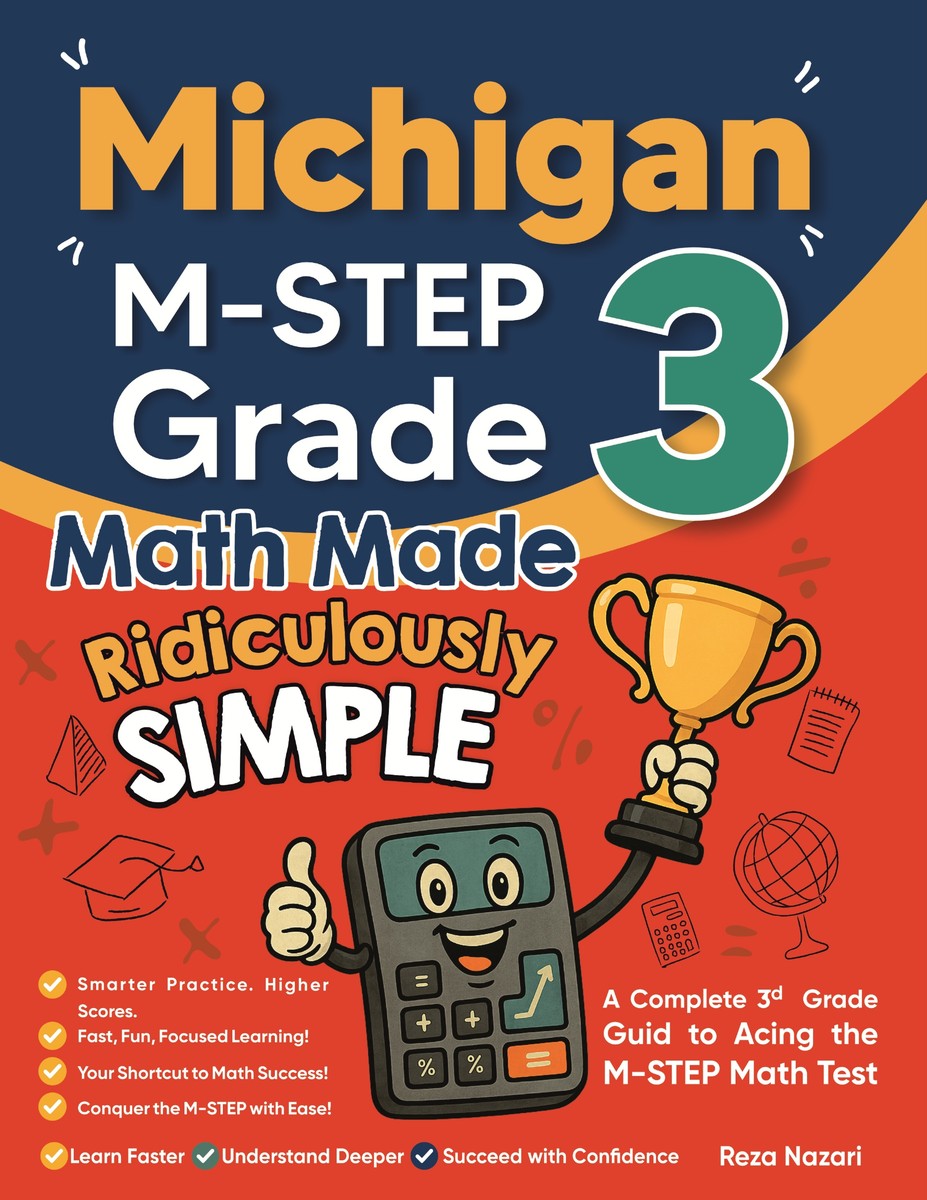
Michigan M-STEP Grade 3 Math Made Ridiculously Simple
An independently published Grade 3 mathematics resource. Check its edition and contents against Michigan’s adopted document and the school’s course before choosing preparation.
- Best starting point for the M-STEP math test
- Pairs with Michigan flashcards and worksheets
- Use it before full timed practice tests
- Organized for students who need examples before drills
Step-by-step lessons
Short explanations show the move before the student practices it.
✍Worked examples
Check the listed book’s contents and edition against the learner’s course before choosing it.
Targeted practice
Rebuild one skill at a time instead of jumping around.
Test-day bridge
After each topic, connect to formulas, flashcards, and practice questions.
How to use it
- Read one lesson and copy the worked example.
- Do a short worksheet set on the same topic.
- Review the matching flashcards or formulas.
- Try a mixed quiz and mark every miss.
Pair it with free tools
Choose the right Michigan Grade 3 math book
Michigan M-STEP Grade 3 Math Made Ridiculously Simple
Start here for Michigan Grade 3 math, step by step.
Michigan Grade 3 math: useful study questions
What does a stack of two marks mean on this measurement line plot?
Two strips have the length shown below that stack. The stack’s height counts strips; the horizontal position gives their length in inches.
Which statewide mathematics assessment pathway applies to Michigan Grade 3?
The currently linked 2025–26 state guide identifies M-STEP English language arts and mathematics in Grades 3–7, including Grade 3. Follow the school’s current assigned assessment pathway and directions. Independently published practice may use its own timer, tools, question count, and scoring; these are not official administration specifications or a prediction of a state performance level.
Grade 3 Math in Other States
Explore Grade 3 math standards, practice tests, and worksheets for every state.
- Alabama
- Alaska
- Arizona
- Arkansas
- California
- Colorado
- Connecticut
- Delaware
- Florida
- Georgia
- Hawaii
- Idaho
- Illinois
- Indiana
- Iowa
- Kansas
- Kentucky
- Louisiana
- Maine
- Maryland
- Massachusetts
- Minnesota
- Mississippi
- Missouri
- Montana
- Nebraska
- Nevada
- New Hampshire
- New Jersey
- New Mexico
- New York
- North Carolina
- North Dakota
- Ohio
- Oklahoma
- Oregon
- Pennsylvania
- Rhode Island
- South Carolina
- South Dakota
- Tennessee
- Texas
- Utah
- Vermont
- Virginia
- Washington
- West Virginia
- Wisconsin
- Wyoming
- District of Columbia
Make This Your Michigan M-STEP Starting Point
Choose a related practice resource, compare its feedback with classroom explanations, and follow the school’s current learning and assessment guidance.
Start a practice testA USEFUL NEXT STEP
Michigan Grade 3 Math: study questions
What does a stack of two marks mean on this measurement line plot?
Two strips have the length shown below that stack. The stack’s height counts strips; the horizontal position gives their length in inches.
Which statewide mathematics assessment pathway applies to Michigan Grade 3?
The currently linked 2025–26 state guide identifies M-STEP English language arts and mathematics in Grades 3–7, including Grade 3. Follow the school’s current assigned assessment pathway and directions. Independently published practice may use its own timer, tools, question count, and scoring; these are not official administration specifications or a prediction of a state performance level.
Official source ↗Resources from Effortless Math · Editorial standards