LEARN · PRACTICE · EXPLORE
District of Columbia Grade 3 Math
Explore a 6-by-4 rectangle, distinguish 24 square units of area from 20 units of perimeter, and use selected DC Grade 3 math references.
Focused lessons · Useful practice · Clear next steps
What do DC 3rd graders learn in math?
In 3rd grade, DC math centers on multiplication and division within 100, fractions on a number line, area and perimeter, and rounding. Students take the DC CAPE grade 3 math test in the spring. This page explains each DC grade 3 math standard and pairs it with short lessons, skill quizzes and printable worksheets.
Standards source: DC Standards of Learning, Office of the State Superintendent of Education.
Count the inside squares and measure the outside edge
Work through the example
An imaginary display mat is a rectangle 6 units long and 4 units wide. Each small square in the model has sides of 1 unit. Find how many unit squares cover the mat without gaps or overlaps. Then find how much ribbon would follow its outside edge once, with no extra for joining the ends.
Connect the model and calculation
Each of the four rows contains six unit squares. Four groups of six make 24, so the area is 24 square units. The multiplication 6 × 4 = 24 counts the covering squares; it does not count pieces of ribbon. For the outside edge, add the four side lengths: 6 + 4 + 6 + 4 = 20 units. There are two long sides and two short sides. Area measures the covered surface, while perimeter measures the distance around its boundary.
Understand an incorrect answer
If a student calls 20 the area, ask them to count one row of squares and then the rows. If 24 is given as the ribbon length, trace each edge and record its length separately. Adding 6 + 4 reaches only halfway around the rectangle. A correct number with the wrong unit still describes the wrong measurement: square units fit the covering task, and units of length fit the edge task.
Transfer the idea to another example
Change the rectangle to 5 units by 5 units. Its perimeter is still 20 units, but its area is 25 square units. Draw its five rows and compare them with the original four rows of six. These two rectangles show that an equal perimeter need not give an equal area. Then try a 3-by-8 rectangle: its area is 24 square units, matching the original, while its perimeter is 22 units. Ask the student to choose a measurement for a new task before calculating: covering a board and framing its edge require different information.
Selected DC Grade 3 references
The OSSE standards directory links the Common Core mathematics standards. DC adopted Common Core in July 2010. Use the adopted document and the school’s instructional sequence for planning. These labels describe the activity’s focus; the publisher’s mathematics document supplies the full expectations and mathematical practices.
| Reference | Activity focus | Official document |
|---|---|---|
| 3.MD.C.7a | Rectangle area through tiling and multiplication | Read PDF page 25 |
| 3.MD.D.8 | Perimeter and the distinction between area and length | Read PDF page 25 |
Sources checked October 5, 2026. This selected activity supports instruction; it does not cover the whole grade’s curriculum.
Connect the explanation with practice
Choose a related skill from the lesson, worksheet, and quiz directory. Use the worked example to decide what needs support, then read the selected resource’s directions before assigning it.
DC CAPE Next begins with the spring 2027 administration. OSSE lists mathematics assessments in Grades 3–8 and says the educational standards have not changed. Confirm current participation and preparation guidance with the school. Read the DC CAPE Next changes and 2026–27 assessment policy.
The linked practice and books are independently published. Some editions may predate DC CAPE Next; check their contents and directions alongside current OSSE guidance rather than assuming their timer, question count, tools, or scoring matches the new assessment.
Keep one example of the student’s explanation with the practice result. Choose a smaller model, another related task, or a new context according to the difficulty shown in the activity.
Start with Grade 3 Math Practice
Use this general Grade 3 math practice test to check your skills, then review the missed topics below. It is independent practice, not an official state assessment or a replica of its timing, scoring, or question types.
Open the Grade 3 practice test Explore Grade 3 lessons and worksheetsClassroom practice and current DC assessment information
DC CAPE Next begins with the spring 2027 administration. OSSE lists mathematics assessments in Grades 3–8 and says the educational standards have not changed. Confirm current participation and preparation guidance with the school. Read the current OSSE overview.
The original example above is a teaching activity. The resource directory below provides broader practice; independently published activities have their own instructions and scoring.
District Of Columbia Grade 3 Math Topics
Choose a math lesson, worksheet, or topic quiz. This broader practice library includes review and enrichment; use the adopted standards and the school’s sequence to choose suitable skills.
Standards source: DC Standards of Learning, Office of the State Superintendent of Education.
Place Value & Number Sense
Addition & Subtraction
Multiplication
Division
Problem Solving & Patterns
Fractions
Measurement, Time & Data
Best District of Columbia DC CAPE Grade 3 Math Books
Each book has a job: start from scratch, drill weak skills, or build pacing with full tests. All of them pair with the free tools on this page.
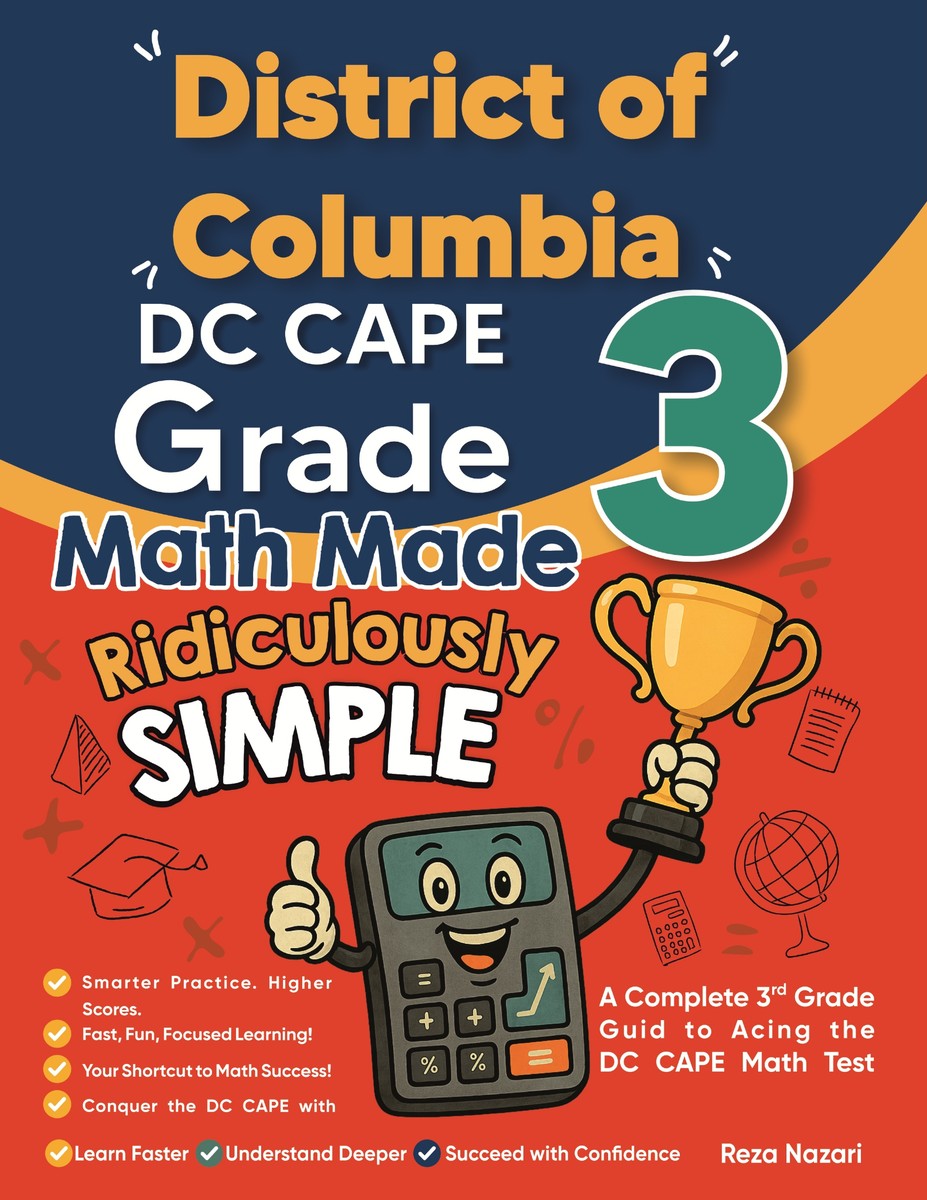
District of Columbia DC CAPE Grade 3 Math Made Ridiculously Simple
A step-by-step DC CAPE Grade 3 math book that rebuilds every tested skill clearly and in order, built to match the District of Columbia standards.
- Best starting point for the DC CAPE math test
- Pairs with District of Columbia flashcards and worksheets
- Use it before full timed practice tests
- Organized for students who need examples before drills
Step-by-step lessons
Short explanations show the move before the student practices it.
✍Worked examples
Examples translate DC CAPE-style wording into clear math steps.
Targeted practice
Rebuild one skill at a time instead of jumping around.
Test-day bridge
After each topic, connect to formulas, flashcards, and practice questions.
How to use it
- Read one lesson and copy the worked example.
- Do a short worksheet set on the same topic.
- Review the matching flashcards or formulas.
- Try a mixed quiz and mark every miss.
Choose the right District of Columbia Grade 3 math book
District of Columbia DC CAPE Grade 3 Math Made Ridiculously Simple
Start here to rebuild DC CAPE math from the ground up.
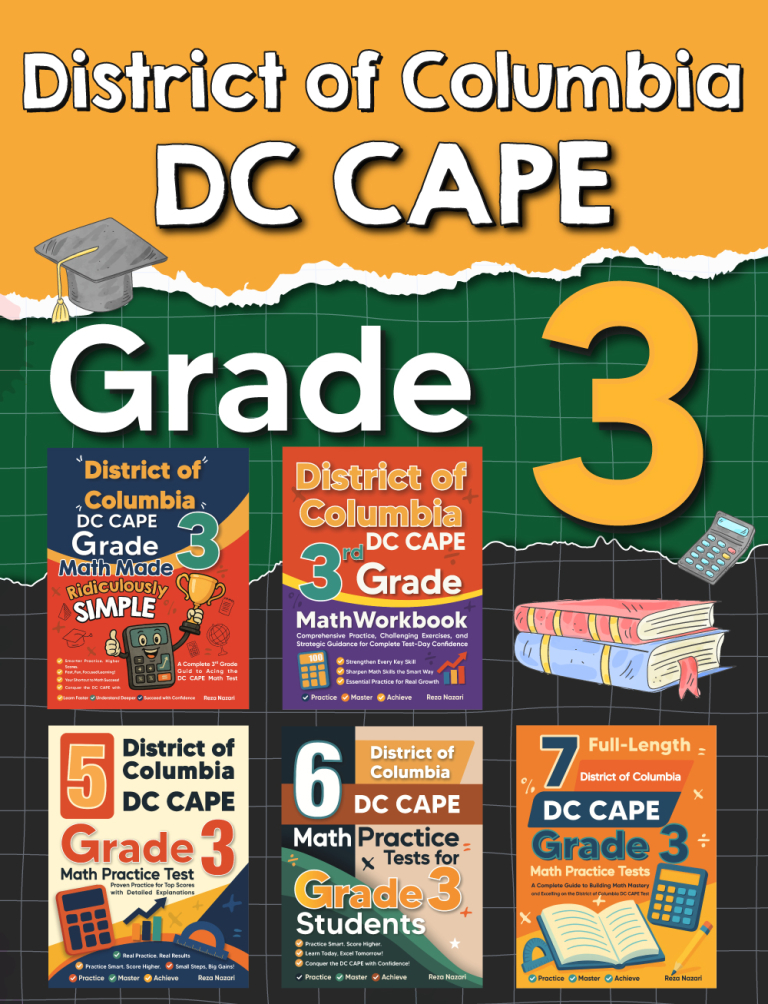 (resource currently unavailable)
District of Columbia DC CAPE Grade 3 Math Preparation Bundle (resource currently unavailable)
The full prep library, study guide, workbook, and practice tests together.
7 District of Columbia DC CAPE Grade 3 Math Practice Tests
Use after topic review to build pacing and test stamina.
DC Grade 3 math: useful study questions
Can two rectangles have the same perimeter but different areas?
Yes. A 6-by-4 rectangle and a 5-by-5 square both have a perimeter of 20 units. Their areas are 24 and 25 square units, respectively.
What changes for DC Grade 3 math assessment preparation in 2026–27?
DC CAPE Next first administers in spring 2027. OSSE says the educational standards have not changed. Use current OSSE guidance and the school’s plan, and check the edition and directions of independently published preparation resources.
Grade 3 Math in Other States
Explore Grade 3 math standards, practice tests, and worksheets for every state.
- Alabama
- Alaska
- Arizona
- Arkansas
- California
- Colorado
- Connecticut
- Delaware
- Florida
- Georgia
- Hawaii
- Idaho
- Illinois
- Indiana
- Iowa
- Kansas
- Kentucky
- Louisiana
- Maine
- Maryland
- Massachusetts
- Michigan
- Minnesota
- Mississippi
- Missouri
- Montana
- Nebraska
- Nevada
- New Hampshire
- New Jersey
- New Mexico
- New York
- North Carolina
- North Dakota
- Ohio
- Oklahoma
- Oregon
- Pennsylvania
- Rhode Island
- South Carolina
- South Dakota
- Tennessee
- Texas
- Utah
- Vermont
- Virginia
- Washington
- West Virginia
- Wisconsin
- Wyoming
Make This Your District of Columbia DC CAPE Starting Point
Explain a related worked example, choose focused practice, and review the reasoning behind the result. Check the edition and contents of an optional book before selecting assessment preparation.
Start a practice testA USEFUL NEXT STEP
District of Columbia Grade 3 Math: study questions
Can two rectangles have the same perimeter but different areas?
Yes. A 6-by-4 rectangle and a 5-by-5 square both have a perimeter of 20 units. Their areas are 24 and 25 square units, respectively.
What changes for DC Grade 3 math assessment preparation in 2026–27?
DC CAPE Next first administers in spring 2027. OSSE says the educational standards have not changed. Use current OSSE guidance and the school’s plan, and check the edition and directions of independently published preparation resources.
Official source ↗Resources from Effortless Math · Editorial standards