LEARN · PRACTICE · EXPLORE
California Grade 3 Math
Find a rectangle’s area by splitting it into two parts, explain square units, and choose California Grade 3 references, lessons, worksheets, and quizzes.
Focused lessons · Useful practice · Clear next steps
What do California 3rd graders learn in math?
In 3rd grade, California math centers on multiplication and division within 100, fractions on a number line, area and perimeter, and rounding. Students take the CAASPP grade 3 math test in the spring. This page explains each California grade 3 math standard and pairs it with short lessons, skill quizzes, printable worksheets and a full-length practice test.
Printable California grade 3 math books:
- 6 California CAASPP Grade 3 Math Practice Tests
- 6 California CAASPP Grade 3 Math Practice Tests
- 7 California CAASPP Grade 3 Math Practice Tests
- California CAASPP 3rd Grade Math Workbook
- California CAASPP Grade 3 Math Made Ridiculously Simple
- The Most Comprehensive California CAASPP Grade 3 Math Preparation Bundle
Standards source: Content Standards, California Department of Education.
Start with Grade 3 Math Practice
Use this general Grade 3 math practice test to check your skills, then review the missed topics below. It is independent practice, not an official state assessment or a replica of its timing, scoring, or question types.
Open the Grade 3 practice test Explore Grade 3 lessons and worksheetsPlan classroom practice and assessment preparation
Grade 3 falls within California’s Smarter Balanced summative mathematics testing range. Read the official assessment overview for the program’s format and guidance.
The practice tests, topic quizzes, and books linked here are independently published. Their timers, question counts, tools, and scores describe those resources. Open an activity’s directions before using it; a practice score does not establish an official state performance level.
Split a rectangle without changing its area
Work through a problem, explain what each quantity means, and use the explanation to choose the next lesson or practice task.
A tiled panel with two sections
A rectangular classroom panel is 8 units long and 7 units high. Each tile is a one-unit square. Split the length into 5 units and 3 units. How many square tiles cover the whole panel, with no gaps or overlaps?
The left section has 7 rows of 5 tiles, so its area is 7 × 5 = 35 square units. The right section has 7 rows of 3 tiles, so its area is 7 × 3 = 21 square units. Together they cover 35 + 21 = 56 square units. The whole rectangle gives the same result: 7 × 8 = 56.
Connect the drawing with the equation
Write 7 × (5 + 3) = (7 × 5) + (7 × 3). The split does not change the panel’s height, and the two lengths still total 8. The equation describes the two non-overlapping areas joining to make the whole. Students can count tiles first and then use the equal rows to explain multiplication.
What an incorrect answer can tell you
An answer of 15 adds the side lengths rather than counting square units. An answer of 35 finds only the left section. An answer of 7 × 5 + 3 leaves the right section as three tiles, even though it has seven rows. Point to the part of the model each calculation describes before asking the student to repeat the arithmetic.
- Name one square unit and identify a row in the panel.
- Find each section’s area and label it with square units.
- Join the areas and check against the whole-rectangle product.
- Split the same length into 4 and 4 and explain why the total stays 56.
Next, ask the student to draw a different rectangle and choose a helpful split. Keep whole-number side lengths for this activity. A student who calculates quickly but cannot connect the numbers to the drawing needs a modeling conversation; a student with a clear model but an unreliable fact may need focused multiplication practice.
Selected California Grade 3 references
These activity labels summarize two references in California’s mathematics standards, modified January 2013. Consult the complete document for the grade’s broader content and mathematical practices. California additions are marked CA in the source.
| Reference | Activity focus | Official document |
|---|---|---|
| 3.MD.7b | Rectangle area | Read page 34 |
| 3.MD.7c | Area and distribution | Read page 34 |
The state mathematics resource directory also links teaching guidance. State sources checked October 5, 2026.
California Grade 3 Math Topics
Student-friendly Grade 3 math skills, with a focused lesson, practice resources where available, and a topic quiz. Displayed codes are broad reference groups, not a certified state crosswalk.
Standards source: Content Standards, California Department of Education.
Place Value & Number Sense
Addition & Subtraction
Multiplication
Division
Problem Solving & Patterns
Fractions
Measurement, Time & Data
Best California CAASPP Grade 3 Math Books
Each book has a job: start from scratch, drill weak skills, or build pacing with full tests. All of them pair with the free tools on this page.
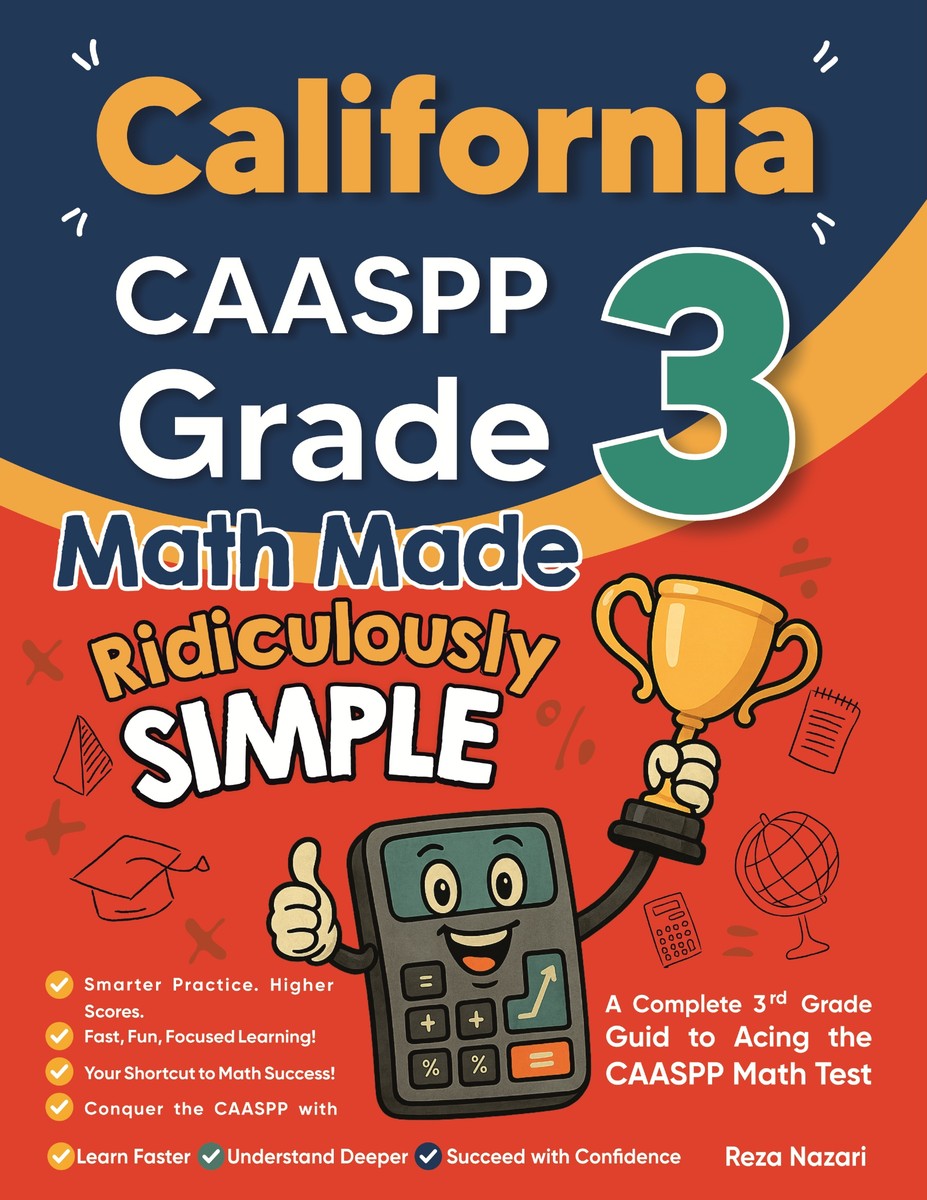
California CAASPP Grade 3 Math Made Ridiculously Simple
A step-by-step CAASPP Grade 3 math book that rebuilds every tested skill clearly and in order, built to match the California standards.
- Best starting point for the CAASPP math test
- Pairs with California flashcards and worksheets
- Use it before full timed practice tests
- Organized for students who need examples before drills
Step-by-step lessons
Short explanations show the move before the student practices it.
✍Worked examples
Examples translate CAASPP-style wording into clear math steps.
Targeted practice
Rebuild one skill at a time instead of jumping around.
Test-day bridge
After each topic, connect to formulas, flashcards, and practice questions.
How to use it
- Read one lesson and copy the worked example.
- Do a short worksheet set on the same topic.
- Review the matching flashcards or formulas.
- Try a mixed quiz and mark every miss.
Pair it with free tools
Choose the right California Grade 3 math book
California CAASPP Grade 3 Math Made Ridiculously Simple
Start here for California Grade 3 math, step by step.
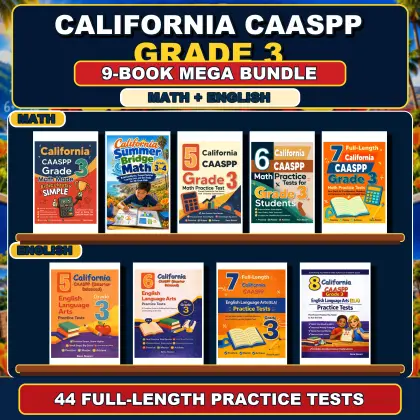
California CAASPP Grade 3 Math & ELA Mega Bundle
9 books and 44 full-length practice tests in one TPT bundle.
California Grade 3 math: useful study questions
Why does the 7 multiply both 5 and 3?
Both sections have the same height of 7 units. The 5-unit section contains seven rows of five squares, and the 3-unit section contains seven rows of three squares. Both areas must be included.
How does this Grade 3 guide relate to the state assessment?
It offers an independently written worked activity and selected curriculum references. Smarter Balanced is the state summative program; the linked practice settings and scores are separate. Read official guidance.
Grade 3 Math in Other States
Explore Grade 3 math standards, practice tests, and worksheets for every state.
- Alabama
- Alaska
- Arizona
- Arkansas
- Colorado
- Connecticut
- Delaware
- Florida
- Georgia
- Hawaii
- Idaho
- Illinois
- Indiana
- Iowa
- Kansas
- Kentucky
- Louisiana
- Maine
- Maryland
- Massachusetts
- Michigan
- Minnesota
- Mississippi
- Missouri
- Montana
- Nebraska
- Nevada
- New Hampshire
- New Jersey
- New Mexico
- New York
- North Carolina
- North Dakota
- Ohio
- Oklahoma
- Oregon
- Pennsylvania
- Rhode Island
- South Carolina
- South Dakota
- Tennessee
- Texas
- Utah
- Vermont
- Virginia
- Washington
- West Virginia
- Wisconsin
- Wyoming
- District of Columbia
Make This Your California CAASPP Starting Point
Take a timed practice test, find your weakest topic, and study it with the linked lessons, worksheets, and the CAASPP study guide.
Start a practice testA USEFUL NEXT STEP
California Grade 3 Math: study questions
Why does the 7 multiply both 5 and 3?
Both sections have the same height of 7 units. The 5-unit section contains seven rows of five squares, and the 3-unit section contains seven rows of three squares. Both areas must be included.
How does this Grade 3 guide relate to the state assessment?
It offers an independently written worked activity and selected curriculum references. Smarter Balanced is the state summative program; the linked practice settings and scores are separate.
Official source ↗Resources from Effortless Math · Editorial standards