LEARN · PRACTICE · EXPLORE
New Hampshire Grade 3 Math
Practice New Hampshire Grade 3 math with visual fraction comparisons, worked reasoning, selected Common Core references, worksheets and topic quizzes.
Focused lessons · Useful practice · Clear next steps
Standards source: New Hampshire school-approval rules, Ed 306.34.
Start with Grade 3 Math Practice
Use this general Grade 3 math practice test to check your skills, then review the missed topics below. It is independent practice, not an official state assessment or a replica of its timing, scoring, or question types.
Open the Grade 3 practice test Explore Grade 3 lessons and worksheetsClassroom practice and state assessment information
The 2025–2026 public NH SAS manual describes general mathematics testing in Grades 3–8, including Grade 3, using a computer-adaptive assessment. Confirm the learner’s assigned pathway, tools, and the school’s current administration directions. The reviewed manual is the 2025–2026 edition; confirm later-year directions with the school. Independently published practice may use its own timer, tools, question count, and scoring; these are not official administration specifications or a prediction of a state performance level. Read the public NH SAS manual resource page for official guidance.
Use the worked activity and lesson directory to choose a skill. Confirm the directions of an independent practice resource before assigning it.
Compare equal counts of differently sized fraction parts
A fraction’s denominator tells how many equal parts make the whole. When two fractions use the same whole and the same numerator, the size of each part can settle the comparison. The equal bars show why the count of shaded pieces alone is not enough.
Try this original activity
Compare 4/8 and 4/6 using the pictured equal-sized bars. Which is greater? Record the comparison with a symbol and explain what the denominators mean. Do not compare pieces from differently sized wholes.
Work through the reasoning
Each whole has the same length. Splitting it into eight equal parts makes each part smaller than splitting it into six equal parts. Four sixths therefore cover more of the whole than four eighths. The comparison is 4/8 < 4/6. The first shaded amount reaches halfway across its bar; the second reaches farther than halfway. Both numerators are four, but each fourth counted piece in the second bar belongs to a larger unit fraction. The bars provide a visual justification without requiring a new fraction algorithm. The different partitions matter; counting four shaded pieces in each bar does not make the shaded lengths equal.
Check the common mistake
Choosing 4/8 because eight is bigger confuses the number of parts with their size. The same-whole condition also matters. Four eighths of a very long ribbon could be longer than four sixths of a short ribbon, so do not make a physical-length comparison without equal wholes. The visual here deliberately gives both bars the same full width. Resizing the screen keeps their relative lengths but does not supply an inch measurement.
Try a related case
Compare 2/3 with 2/4 using two new equal bars. Thirds are larger than fourths, so two thirds are greater than two fourths: 2/3 > 2/4. Ask the student to shade and explain both fractions. This same-numerator reasoning does not settle every fraction pair when both numerator and denominator change.
Selected Common Core references for this activity
New Hampshire’s current school-approval rules, Ed 306.34, allow local boards to use the adopted 2010 Common Core mathematics standards or approved alternative academic standards. Confirm the school’s standards choice and local competencies first. The selected Common Core references below were checked in the original publisher’s 2010 document. They identify this activity’s focus, rather than a complete local course. Read the full requirements, mathematical practices, examples, and progression with the school’s curriculum.
| Selected Common Core reference | Activity focus | Publisher’s document |
|---|---|---|
| 3.NF.3d | Same-numerator fraction comparisons | Read the publisher’s PDF, page 24 |
Sources checked October 6, 2026. Read complete requirements, clarifications, limitations, and mathematical practices alongside the school’s sequence. This selected activity is an entry point for instruction.
Connect the explanation with practice
Use the lesson, worksheet, and quiz directory to choose a related skill. The existing resource links remain available; open each activity’s directions to understand its timer, tools, question count, and scoring.
The 2025–2026 public NH SAS manual describes general mathematics testing in Grades 3–8, including Grade 3, using a computer-adaptive assessment. Confirm the learner’s assigned pathway, tools, and the school’s current administration directions. The reviewed manual is the 2025–2026 edition; confirm later-year directions with the school. Independently published practice may use its own timer, tools, question count, and scoring; these are not official administration specifications or a prediction of a state performance level. Read the public NH SAS manual resource page.
Read New Hampshire local curriculum rules for later guidance. Keep one example of the student’s reasoning with the practice result. Choose a smaller model, a related question, or a new context according to the difficulty revealed in the worked activity.
New Hampshire Grade 3 Math Topics
Choose a lesson, printable worksheet collection, or topic quiz. This broader library includes review and enrichment. Use the school’s current sequence and the standards selected by the school when choosing skills; these rows are not a certified full-course crosswalk.
Curriculum guidance: New Hampshire school-approval rules, Ed 306.34.
Place Value & Number Sense
Addition & Subtraction
Multiplication
Division
Problem Solving & Patterns
Fractions
Measurement, Time & Data
New Hampshire Grade 3 Math Books and Resources
Each book has a job: start from scratch, drill weak skills, or build pacing with full tests. All of them pair with the free tools on this page.
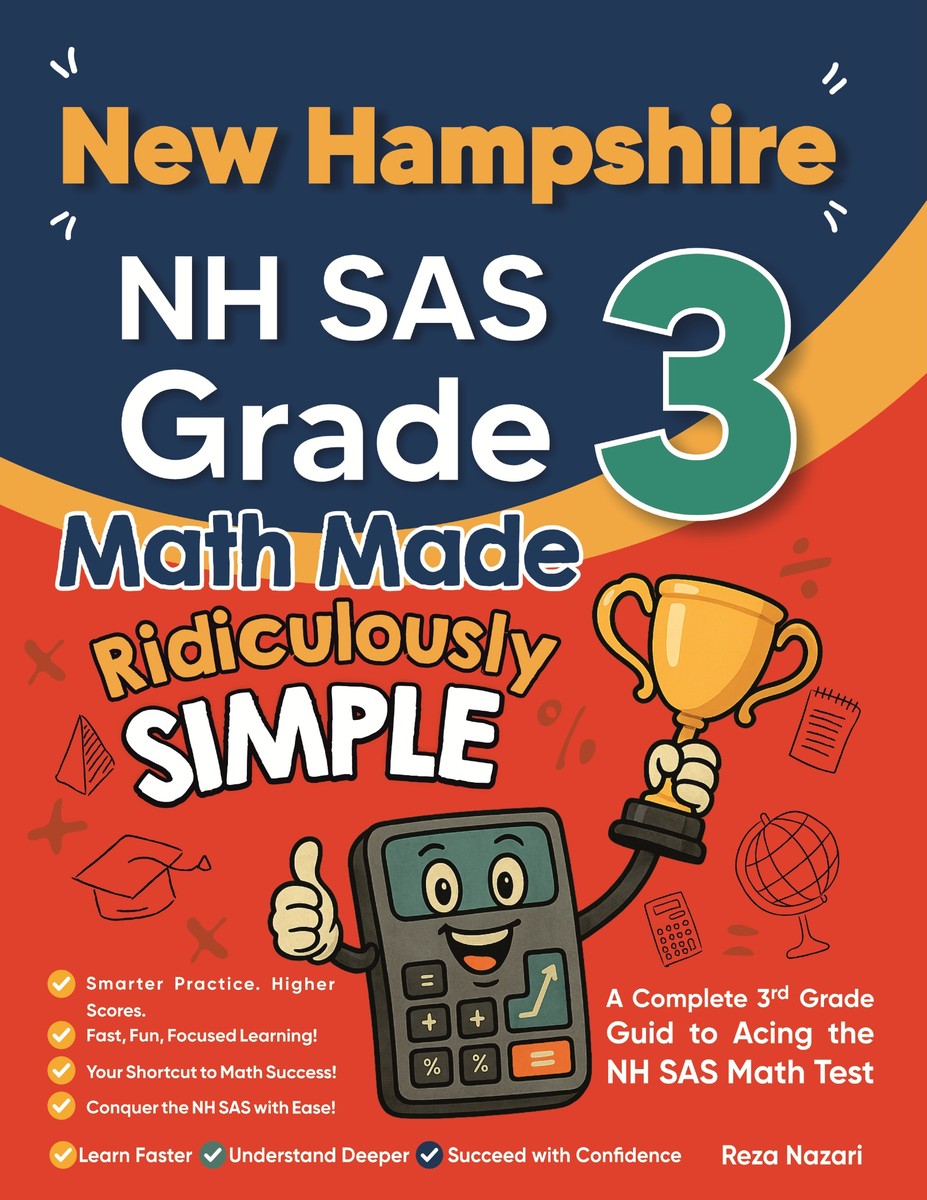
New Hampshire NH SAS Grade 3 Math Made Ridiculously Simple
An independently published Grade 3 mathematics resource. Check its edition and contents against New Hampshire’s adopted document and the school’s course before choosing preparation.
- Best starting point for the NH SAS math test
- Pairs with New Hampshire flashcards and worksheets
- Use it before full timed practice tests
- Organized for students who need examples before drills
Step-by-step lessons
Short explanations show the move before the student practices it.
✍Worked examples
Check the listed book’s contents and edition against the learner’s course before choosing it.
Targeted practice
Rebuild one skill at a time instead of jumping around.
Test-day bridge
After each topic, connect to formulas, flashcards, and practice questions.
How to use it
- Read one lesson and copy the worked example.
- Do a short worksheet set on the same topic.
- Review the matching flashcards or formulas.
- Try a mixed quiz and mark every miss.
Pair it with free tools
Choose the right New Hampshire Grade 3 math book
New Hampshire NH SAS Grade 3 Math Made Ridiculously Simple
Start here for New Hampshire Grade 3 math, step by step.
New Hampshire Grade 3 math: useful study questions
Why is four sixths greater than four eighths?
For the same whole, a sixth is larger than an eighth. Taking four of the larger parts gives a greater amount: 4/6 > 4/8.
Which statewide mathematics assessment pathway applies to New Hampshire Grade 3?
The 2025–2026 public NH SAS manual describes general mathematics testing in Grades 3–8, including Grade 3, using a computer-adaptive assessment. Confirm the learner’s assigned pathway, tools, and the school’s current administration directions. The reviewed manual is the 2025–2026 edition; confirm later-year directions with the school. Independently published practice may use its own timer, tools, question count, and scoring; these are not official administration specifications or a prediction of a state performance level.
Grade 3 Math in Other States
Explore Grade 3 math standards, practice tests, and worksheets for every state.
- Alabama
- Alaska
- Arizona
- Arkansas
- California
- Colorado
- Connecticut
- Delaware
- Florida
- Georgia
- Hawaii
- Idaho
- Illinois
- Indiana
- Iowa
- Kansas
- Kentucky
- Louisiana
- Maine
- Maryland
- Massachusetts
- Michigan
- Minnesota
- Mississippi
- Missouri
- Montana
- Nebraska
- Nevada
- New Jersey
- New Mexico
- New York
- North Carolina
- North Dakota
- Ohio
- Oklahoma
- Oregon
- Pennsylvania
- Rhode Island
- South Carolina
- South Dakota
- Tennessee
- Texas
- Utah
- Vermont
- Virginia
- Washington
- West Virginia
- Wisconsin
- Wyoming
- District of Columbia
Plan Your Next Grade 3 Math Task
Choose a related practice resource, compare its feedback with classroom explanations, and follow the school’s current learning and assessment guidance.
Start a practice testA USEFUL NEXT STEP
New Hampshire Grade 3 Math: study questions
Why is four sixths greater than four eighths?
For the same whole, a sixth is larger than an eighth. Taking four of the larger parts gives a greater amount: 4/6 > 4/8.
Which statewide mathematics assessment pathway applies to New Hampshire Grade 3?
The 2025–2026 public NH SAS manual describes general mathematics testing in Grades 3–8, including Grade 3, using a computer-adaptive assessment. Confirm the learner’s assigned pathway, tools, and the school’s current administration directions. The reviewed manual is the 2025–2026 edition; confirm later-year directions with the school. Independently published practice may use its own timer, tools, question count, and scoring; these are not official administration specifications or a prediction of a state performance level.
Official source ↗Resources from Effortless Math · Editorial standards