LEARN · PRACTICE · EXPLORE
Rhode Island Grade 3 Math
Explain why a multiplication pattern continues using equal groups, with a worked Grade 3 example, Rhode Island references, lessons, and printable practice.
Focused lessons · Useful practice · Clear next steps
What do Rhode Island 3rd graders learn in math?
In 3rd grade, Rhode Island math centers on multiplication and division within 100, fractions on a number line, area and perimeter, and rounding. Students take the RICAS grade 3 math test in the spring. This page explains each Rhode Island grade 3 math standard and pairs it with short lessons, skill quizzes and printable worksheets.
Printable Rhode Island grade 3 math books:
- 5 Rhode Island RICAS Grade 3 Math Practice Tests
- 6 Rhode Island RICAS Grade 3 Math Practice Tests
- 7 Rhode Island RICAS Grade 3 Math Practice Tests
- Rhode Island RICAS 3rd Grade Math Workbook
- Rhode Island RICAS Grade 3 Math Made Ridiculously Simple
- The Most Comprehensive Rhode Island RICAS Grade 3 Math Preparation Bundle
Standards source: Rhode Island mathematics standards.
Start with Grade 3 Math Practice
Use this general Grade 3 math practice test to check your skills, then review the missed topics below. It is independent practice, not an official state assessment or a replica of its timing, scoring, or question types.
Open the Grade 3 practice test Explore Grade 3 lessons and worksheetsClassroom practice and state assessment
Rhode Island’s RICAS overview lists English language arts and mathematics in Grades 3–8, including Grade 3. Follow the school’s assigned dates and current assessment directions. An independent practice resource has its own tools, timing, question count, and scoring; its result does not establish a state performance level. Read official RICAS guidance.
Explain a Multiplication Pattern
Explain why a multiplication pattern continues using equal groups, with a worked Grade 3 example, Rhode Island references, lessons, and printable practice.
Why multiples of six are even
Consider 6 × 3 = 18, 6 × 4 = 24, 6 × 5 = 30, and 6 × 6 = 36. Each product is even. Explain the pattern using equal groups rather than relying only on these four examples.
Follow the reasoning
Split a group of six into two equal groups of three. Three groups of six can be rearranged as 9 + 9 = 18; four groups give 12 + 12 = 24. In general, a whole number of groups of six can be split into two equal collections: 6 × n = (3 × n) + (3 × n). A total arranged as two equal whole-number groups is even. This explains the pattern for every whole-number multiplier, including zero, instead of only checking the listed products.
What the examples do not prove
Four correct products suggest a pattern, but more examples alone do not explain why it continues. The equal-group rearrangement supplies the reason. The products are not all multiples of twelve: 18 and 30 are counterexamples. Being even and being a multiple of twelve are different conditions.
Try the next step
Predict whether 6 × 17 is even without first calculating its total. Describe two equal groups of 3 × 17. Then calculate to check: 51 + 51 = 102. Draw a smaller example if the rearrangement is hard to picture.
Selected Rhode Island mathematics reference
The Rhode Island mathematics page identifies the Rhode Island Core Standards endorsed March 9, 2021. The linked 2021 mathematics document adapts the 2017 Massachusetts framework. Use the actual Rhode Island clause and its surrounding grade expectations when planning instruction; a generic Common Core code list alone does not establish the same state requirements.
| State reference | Selected focus | Complete requirement |
|---|---|---|
| 3.OA.9 | Identify arithmetic patterns and explain them using properties of operations | Read PDF page 19 |
This original worked activity develops one selected focus. It is not the complete grade curriculum or a certified alignment of every independently published learning resource. Read the other grade expectations and the school’s actual course sequence.
Choose a next task from the student’s explanation
Use a different set of numbers to check whether the student can explain the same relationship. If the explanation is unclear, return to the model; if the reasoning is sound but a calculation is wrong, work through a shorter calculation and check it against the model. Use the related learning resources alongside the teacher’s assigned goals.
Rhode Island’s RICAS overview lists English language arts and mathematics in Grades 3–8, including Grade 3. Follow the school’s assigned dates and current assessment directions. An independent practice resource has its own tools, timing, question count, and scoring; its result does not establish a state performance level. Read the current RICAS overview.
State sources and the selected complete PDF page checked October 6, 2026. Confirm later guidance and local assignments before planning assessment preparation.
Rhode Island Grade 3 Math Topics
Choose a related lesson, printable resource, or quiz. This broader directory may include review and enrichment. Compare the task with the school’s learning goals; use the separately linked state reference for the worked activity above.
Official source: Rhode Island mathematics standards and guidance.
Place Value & Number Sense
Addition & Subtraction
Multiplication
Division
Problem Solving & Patterns
Fractions
Measurement, Time & Data
Rhode Island Grade 3 Math Books and Resources
Each book has a job: start from scratch, drill weak skills, or build pacing with full tests. All of them pair with the free tools on this page.
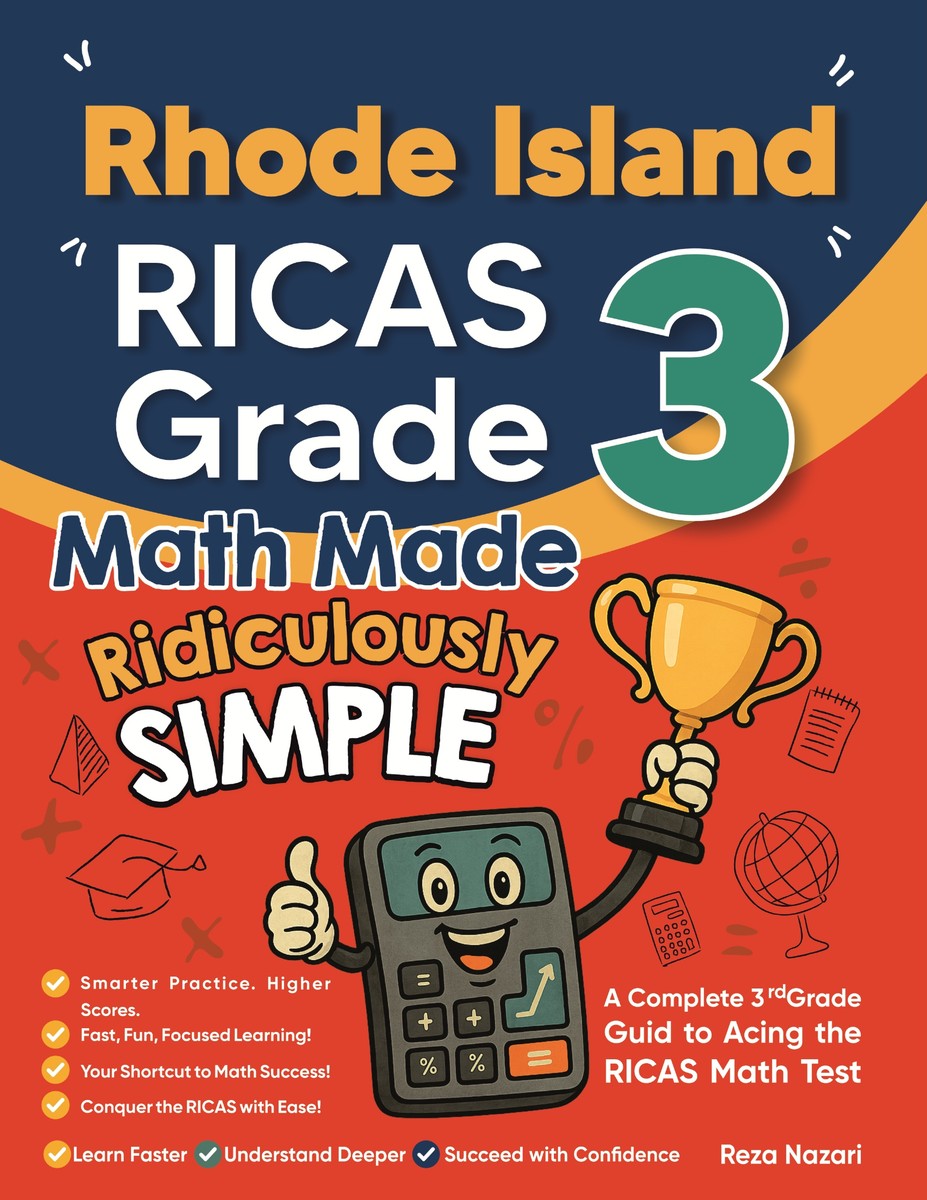
Rhode Island RICAS Grade 3 Math Made Ridiculously Simple
An independently published Grade 3 mathematics resource. Compare its contents and worked explanations with the current classroom unit and complete state requirements.
- Best starting point for the RICAS math test
- Pairs with Rhode Island flashcards and worksheets
- Use it before full timed practice tests
- Organized for students who need examples before drills
Step-by-step lessons
Short explanations show the move before the student practices it.
✍Worked examples
An independently published Grade 3 mathematics resource. Compare its contents and worked explanations with the current classroom unit and complete state requirements.
Targeted practice
Rebuild one skill at a time instead of jumping around.
Test-day bridge
After each topic, connect to formulas, flashcards, and practice questions.
How to use it
- Read one lesson and copy the worked example.
- Do a short worksheet set on the same topic.
- Review the matching flashcards or formulas.
- Try a mixed quiz and mark every miss.
Pair it with free tools
Choose the right Rhode Island Grade 3 math book

Rhode Island RICAS Grade 3 Math Made Ridiculously Simple
Start here for Rhode Island Grade 3 math, step by step.
Grade 3 math: useful planning questions
How is explaining a pattern different from listing it?
A list shows examples. An explanation gives a reason the pattern holds, such as splitting each group of six into two equal groups of three.
How does Grade 3 mathematics connect with RICAS?
Rhode Island’s RICAS overview lists English language arts and mathematics in Grades 3–8, including Grade 3. Follow the school’s assigned dates and current assessment directions. An independent practice resource has its own tools, timing, question count, and scoring; its result does not establish a state performance level.
Grade 3 Math in Other States
Explore Grade 3 math standards, practice tests, and worksheets for every state.
- Alabama
- Alaska
- Arizona
- Arkansas
- California
- Colorado
- Connecticut
- Delaware
- Florida
- Georgia
- Hawaii
- Idaho
- Illinois
- Indiana
- Iowa
- Kansas
- Kentucky
- Louisiana
- Maine
- Maryland
- Massachusetts
- Michigan
- Minnesota
- Mississippi
- Missouri
- Montana
- Nebraska
- Nevada
- New Hampshire
- New Jersey
- New Mexico
- New York
- North Carolina
- North Dakota
- Ohio
- Oklahoma
- Oregon
- Pennsylvania
- South Carolina
- South Dakota
- Tennessee
- Texas
- Utah
- Vermont
- Virginia
- Washington
- West Virginia
- Wisconsin
- Wyoming
- District of Columbia
Make This Your Rhode Island RICAS Starting Point
Take a timed practice test, find your weakest topic, and study it with the linked lessons, worksheets, and the RICAS study guide.
Start a practice testA USEFUL NEXT STEP
Rhode Island Grade 3 Math: study questions
How is explaining a pattern different from listing it?
A list shows examples. An explanation gives a reason the pattern holds, such as splitting each group of six into two equal groups of three.
How does Grade 3 mathematics connect with RICAS?
Rhode Island’s RICAS overview lists English language arts and mathematics in Grades 3–8, including Grade 3. Follow the school’s assigned dates and current assessment directions. An independent practice resource has its own tools, timing, question count, and scoring; its result does not establish a state performance level.
Official source ↗Resources from Effortless Math · Editorial standards