LEARN · PRACTICE · EXPLORE
Connecticut Grade 3 Math
Share 36 objects among four trays, connect division with a missing factor, and find Connecticut Grade 3 lessons, worksheets, quizzes, and references.
Focused lessons · Useful practice · Clear next steps
What do Connecticut 3rd graders learn in math?
In 3rd grade, Connecticut math centers on multiplication and division within 100, fractions on a number line, area and perimeter, and rounding. Students take the Smarter Balanced grade 3 math test in the spring. This page explains each Connecticut grade 3 math standard and pairs it with short lessons, skill quizzes, printable worksheets and a full-length practice test.
Printable Connecticut grade 3 math books:
- 6 Connecticut Smarter Balanced Grade 3 Math Practice Tests
- 6 Connecticut Smarter Balanced Grade 3 Math Practice Tests
- 7 Connecticut Smarter Balanced Grade 3 Math Practice Tests
- Connecticut Smarter Balanced 3rd Grade Math Workbook
- Connecticut Smarter Balanced Grade 3 Math Made Ridiculously Simple
- The Most Comprehensive Connecticut Smarter Balanced Grade 3 Math Preparation Bundle
Standards source: Mathematics Standards and Resources, Connecticut State Department of Education.
Start with Grade 3 Math Practice
Use this general Grade 3 math practice test to check your skills, then review the missed topics below. It is independent practice, not an official state assessment or a replica of its timing, scoring, or question types.
Open the Grade 3 practice test Explore Grade 3 lessons and worksheetsClassroom practice and state assessment information
Grade 3 is within Connecticut’s Smarter Balanced mathematics testing range. The linked learning resources have their own directions and scoring; a practice score does not establish an official state performance level. Read the state summative assessment overview for official guidance.
Use the worked activity and lesson directory to choose a skill. Confirm the directions of an independent practice resource before assigning it.
Interpret division through equal shares and an unknown factor
Thirty-six objects, four trays
A teacher shares 36 counters equally among four trays. How many counters go in each tray? The total is known, and the number of groups is known. The unknown is the amount in each group. Draw four tray outlines and distribute counters so all trays end with the same count.
Nine counters fit in each tray because 4 × 9 = 36. The division equation is 36 ÷ 4 = 9, and the answer is nine counters per tray. Naming that unit matters: four trays and nine counters per tray describe different quantities.
Use a known product to find the missing factor
Write 4 × □ = 36. If 4 × 5 = 20 is familiar, place five counters in each tray first. Sixteen counters remain. Sharing those among four trays adds four counters to each. Every tray now has 5 + 4 = 9 counters. The calculation uses the same equal-sharing structure as the original problem.
Draw an array with four rows of nine. Circle the first five in every row, then the remaining four. The two sections contain twenty and sixteen counters, and together contain thirty-six. A six-by-six array also contains thirty-six, but it represents six equal groups of six rather than this four-tray situation.
Distinguish two meanings of the same quotient
Now change the story: there are 36 counters, and each tray must hold four. How many trays are needed? The same calculation gives nine, but the answer is nine trays. In the first story, four was the number of groups; in the new story, four is the size of each group. Have the student label a drawing for each story instead of treating division as an unexplained instruction to produce a number.
An answer of 32 comes from subtracting four only once. That removes one group of four without finding how many groups fit or how large each equal share is. Ask what the remaining thirty-two represents and whether it answers the stated question.
Choose practice from the student’s explanation
Try sharing 28 counters among four trays. Use 4 × □ = 28 and verify that each tray contains seven. A student who can explain the grouping can practice related multiplication–division facts. A student who produces the quotient but confuses its unit needs another pair of stories, one with group size unknown and one with number of groups unknown. Keep the drawings labeled until that distinction is clear.
Selected Connecticut Grade 3 references
The Connecticut mathematics standards directory links the Core Standards publisher. The state’s Core Standards overview identifies adoption in 2010 and explains that districts develop local curricula. These labels summarize the activity’s focus; read the complete expectations and mathematical practices in the publisher’s mathematics document.
| Reference | Activity focus | Official document |
|---|---|---|
| 3.OA.A.2 | Interpret a quotient as objects in each equal share | Read PDF page 23 |
| 3.OA.B.6 | Connect division with an unknown factor | Read PDF page 23 |
Sources checked October 5, 2026. This selected activity is an entry point for instruction, not a complete curriculum checklist.
Connect the explanation with practice
Use the lesson, worksheet, and quiz directory to choose a related skill. The existing resource links remain available; open each activity’s directions to understand its timer, tools, question count, and scoring.
Grade 3 is within Connecticut’s Smarter Balanced mathematics testing range. The linked learning resources have their own directions and scoring; a practice score does not establish an official state performance level. Read Connecticut’s official summative assessment overview.
Keep one example of the student’s reasoning with the practice result. Choose a smaller model, a related question, or a new context according to the difficulty revealed in the worked activity.
Connecticut Grade 3 Math Topics
Student-friendly Grade 3 math skills, with a focused lesson, practice resources where available, and a topic quiz. Displayed codes are broad reference groups, not a certified state crosswalk.
Standards source: Mathematics Standards and Resources, Connecticut State Department of Education.
Place Value & Number Sense
Addition & Subtraction
Multiplication
Division
Problem Solving & Patterns
Fractions
Measurement, Time & Data
Best Connecticut Smarter Balanced Grade 3 Math Books
Each book has a job: start from scratch, drill weak skills, or build pacing with full tests. All of them pair with the free tools on this page.
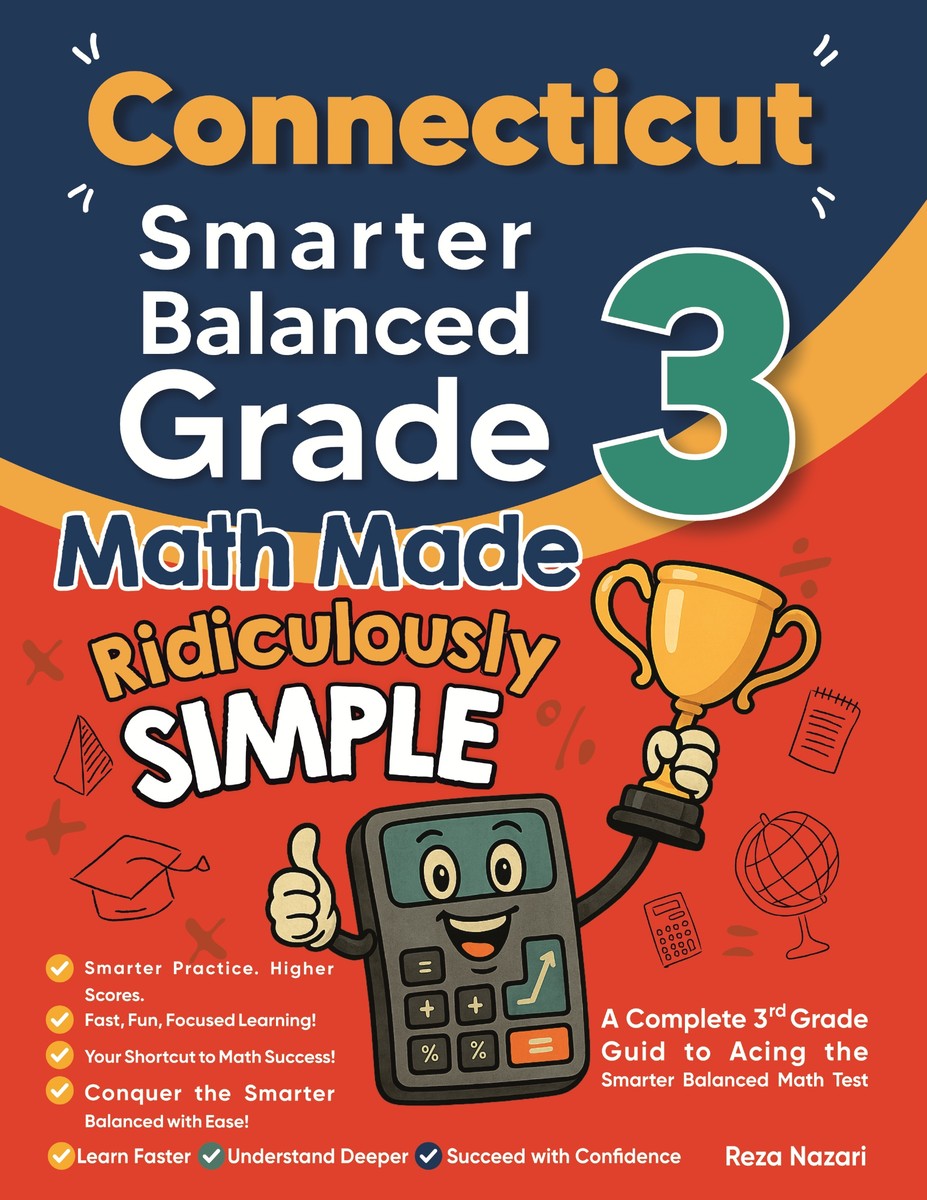
Connecticut Smarter Balanced Grade 3 Math Made Ridiculously Simple
A step-by-step Smarter Balanced Grade 3 math book that rebuilds every tested skill clearly and in order, built to match the Connecticut standards.
- Best starting point for the Smarter Balanced math test
- Pairs with Connecticut flashcards and worksheets
- Use it before full timed practice tests
- Organized for students who need examples before drills
Step-by-step lessons
Short explanations show the move before the student practices it.
✍Worked examples
Examples translate Smarter Balanced-style wording into clear math steps.
Targeted practice
Rebuild one skill at a time instead of jumping around.
Test-day bridge
After each topic, connect to formulas, flashcards, and practice questions.
How to use it
- Read one lesson and copy the worked example.
- Do a short worksheet set on the same topic.
- Review the matching flashcards or formulas.
- Try a mixed quiz and mark every miss.
Choose the right Connecticut Grade 3 math book

Connecticut Smarter Balanced Grade 3 Math Made Ridiculously Simple
Start here for Connecticut Grade 3 math, step by step.
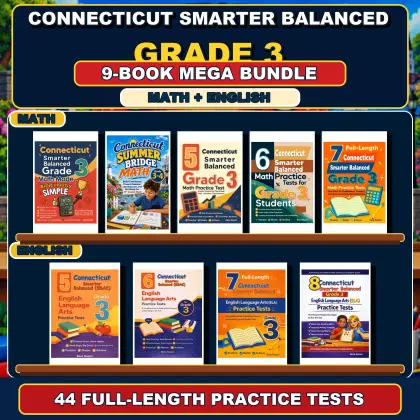
Connecticut Smarter Balanced Grade 3 Math & ELA Mega Bundle
9 books and 44 full-length practice tests in one TPT bundle.
Connecticut Grade 3 math: useful study questions
Does 36 divided by 4 always describe four groups?
Not necessarily. In the tray problem, four is the number of groups and nine is the amount in each. In a problem making groups of four, four is the group size and nine is the number of groups. The story identifies the units.
Is Grade 3 included in Connecticut Smarter Balanced math testing?
Yes. Grade 3 is within Connecticut’s Smarter Balanced range of Grades 3–8. The linked activities are independently published practice with separate directions and scoring.
Grade 3 Math in Other States
Explore Grade 3 math standards, practice tests, and worksheets for every state.
- Alabama
- Alaska
- Arizona
- Arkansas
- California
- Colorado
- Delaware
- Florida
- Georgia
- Hawaii
- Idaho
- Illinois
- Indiana
- Iowa
- Kansas
- Kentucky
- Louisiana
- Maine
- Maryland
- Massachusetts
- Michigan
- Minnesota
- Mississippi
- Missouri
- Montana
- Nebraska
- Nevada
- New Hampshire
- New Jersey
- New Mexico
- New York
- North Carolina
- North Dakota
- Ohio
- Oklahoma
- Oregon
- Pennsylvania
- Rhode Island
- South Carolina
- South Dakota
- Tennessee
- Texas
- Utah
- Vermont
- Virginia
- Washington
- West Virginia
- Wisconsin
- Wyoming
- District of Columbia
Make This Your Connecticut Smarter Balanced Starting Point
Take a timed practice test, find your weakest topic, and study it with the linked lessons, worksheets, and the Smarter Balanced study guide.
Start a practice testA USEFUL NEXT STEP
Connecticut Grade 3 Math: study questions
Does 36 divided by 4 always describe four groups?
Not necessarily. In the tray problem, four is the number of groups and nine is the amount in each. In a problem making groups of four, four is the group size and nine is the number of groups. The story identifies the units.
Is Grade 3 included in Connecticut Smarter Balanced math testing?
Yes. Grade 3 is within Connecticut’s Smarter Balanced range of Grades 3–8. The linked activities are independently published practice with separate directions and scoring.
Official source ↗Resources from Effortless Math · Editorial standards