LEARN · PRACTICE · EXPLORE
New York Grade 3 Math
Free New York Grade 3 math practice: short lessons, skill quizzes and printable worksheets for every standard, plus full-length practice tests with step-by-step solutions.
Focused lessons · Useful practice · Clear next steps
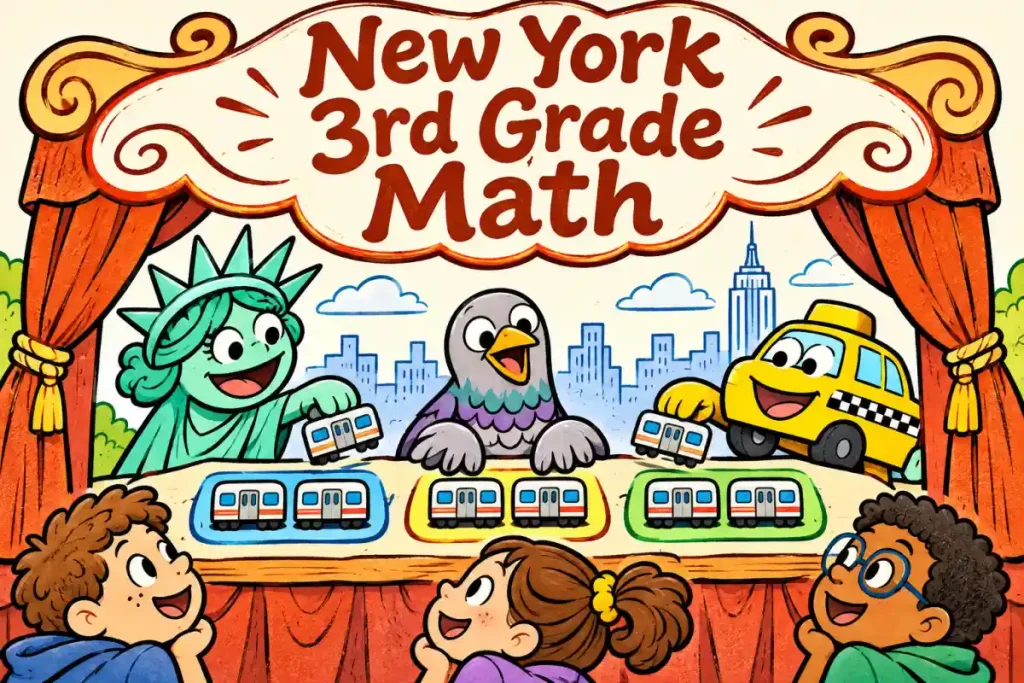
What do New York 3rd graders learn in math?
In 3rd grade, New York math centers on multiplication and division within 100, fractions on a number line, area and perimeter, and rounding. Students take the New York State grade 3 math test in the spring. This page explains each New York grade 3 math standard and pairs it with short lessons, skill quizzes, printable worksheets and a full-length practice test.
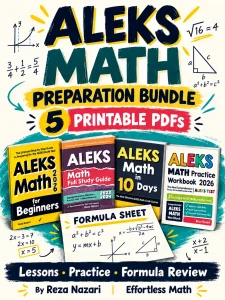
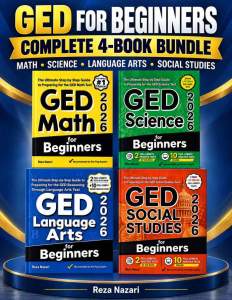
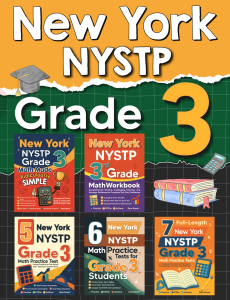
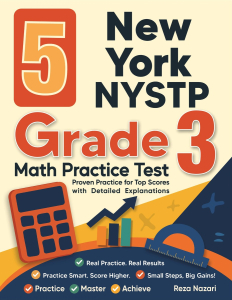
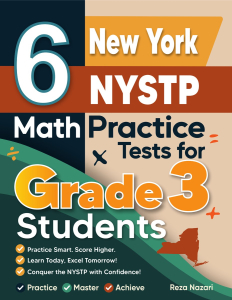
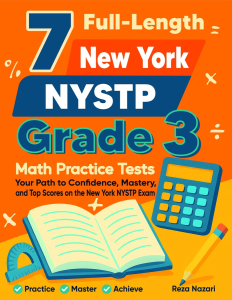
Printable New York grade 3 math books:
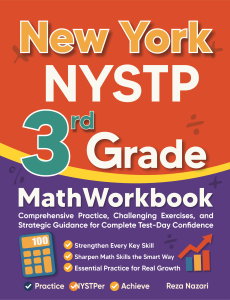
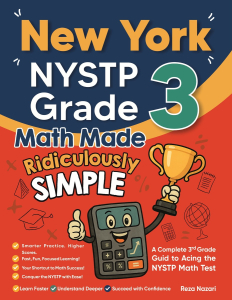
New York State Grade 3 Math Test: Facts and Scores
In spring 2027, schools give the Grade 3 Mathematics Test on two consecutive school days between April 5 and May 14. Ask your school for your child’s dates. It has two sessions on two days and no time limit within the school day. On the 2026 test, scale scores ran from 381 to 503, and 450 was the lowest score at NYS Level 3 (proficient) and 487 was the lowest at NYS Level 4 (excels).
| Test | New York State Grade 3 Mathematics Test |
|---|---|
| Who takes it | Public school students in grades 3 through 8 |
| Sessions | Two sessions over two days; students may work as long as they need within the regular school day |
| Questions | Multiple choice plus 1-, 2- and 3-credit constructed-response questions |
| Calculators | No calculators on the Grade 3 math test |
| Free practice | Try the Effortless Math Grade 3 practice test |
Grade 3 math performance levels
| Performance level | 2026 scale scores |
|---|---|
| NYS Level 1 (below proficient) | 381 to 423 |
| NYS Level 2 (partially proficient) | 424 to 449 |
| NYS Level 3 (proficient) | 450 to 486 |
| NYS Level 4 (excels) | 487 to 503 |
Practice on this page: Practice testsSkill quizzesNew York standardsTopics and lessons
Facts from the New York State Education Department, checked November 23, 2026: NYSED: 2026 performance levels and scale score ranges, grades 3–8; NYSED: Educator Guide to the 2026 Grades 3–8 Mathematics Tests; NYSED: 2026–27 testing calendar.
All 30 New York Grade 3 Math Standards
Every Grade 3 standard in the New York State Next Generation Mathematics Learning Standards, grouped by domain. These are full-year standards. NYSED designates some for instruction after the spring test. For Grade 3, that group includes scaled picture and bar graphs, measurement line plots, perimeter, and classifying polygons. See NYSED’s standards guidance for details. Open a group to see its standards.
Operations and Algebraic Thinking (10)
| NY-3.OA.1 | Interpret products of whole numbers. |
|---|---|
| NY-3.OA.2 | Interpret whole-number quotients of whole numbers. |
| NY-3.OA.3 | Use multiplication and division within 100 to solve word problems in situations involving equal groups, arrays, and measurement quantities. |
| NY-3.OA.4 | Determine the unknown whole number in a multiplication or division equation relating three whole numbers. |
| NY-3.OA.5 | Apply properties of operations as strategies to multiply and divide. |
| NY-3.OA.6 | Understand division as an unknown-factor problem. |
| NY-3.OA.7a | Fluently solve single-digit multiplication and related divisions, using strategies such as the relationship between multiplication and division or properties of operations. |
| NY-3.OA.7b | Know from memory all products of two one-digit numbers. |
| NY-3.OA.8 | Solve two-step word problems posed with whole numbers and having whole-number answers using the four operations. |
| NY-3.OA.9 | Identify and extend arithmetic patterns (including patterns in the addition table or multiplication table). |
Number and Operations in Base Ten (5)
| NY-3.NBT.1 | Use place value understanding to round whole numbers to the nearest 10 or 100. |
|---|---|
| NY-3.NBT.2 | Fluently add and subtract within 1,000 using strategies and algorithms based on place value, properties of operations, and/or the relationship between addition and subtraction. |
| NY-3.NBT.3 | Multiply one-digit whole numbers by multiples of 10 in the range 10-90 using strategies based on place value and properties of operations. |
| NY-3.NBT.4a | Understand that the digits of a four-digit number represent amounts of thousands, hundreds, tens, and ones. |
| NY-3.NBT.4b | Read and write four-digit numbers using base-ten numerals, number names, and expanded form. |
Number and Operations: Fractions (3)
| NY-3.NF.1 | Understand a unit fraction 1/b as the quantity formed by 1 part when a whole is partitioned into b equal parts; understand a fraction a/b as the quantity formed by a parts of size 1/b. |
|---|---|
| NY-3.NF.2 | Understand a fraction as a number on the number line. |
| NY-3.NF.3 | Explain equivalence of fractions and compare fractions by reasoning about their size. |
Measurement and Data (10)
| NY-3.MD.1 | Tell and write time to the nearest minute and measure time intervals in minutes. Solve one-step word problems involving addition and subtraction of time intervals in minutes. |
|---|---|
| NY-3.MD.2a | Measure and estimate liquid volumes and masses of objects using grams (g), kilograms (kg), and liters (l). |
| NY-3.MD.2b | Add, subtract, multiply, or divide to solve one-step word problems involving masses or liquid volumes that are given in the same units. |
| NY-3.MD.3 | Draw a scaled picture graph and a scaled bar graph to represent a data set with several categories. Solve one- and two-step “how many more” and “how many less” problems using information presented in a scaled picture graph or a scaled bar graph. |
| NY-3.MD.4 | Generate measurement data by measuring lengths using rulers marked with halves and fourths of an inch. Show the data by making a line plot where the horizontal scale is marked off in appropriate units—whole numbers, halves, or quarters. |
| NY-3.MD.5 | Recognize area as an attribute of plane figures and understand concepts of area measurement. |
| NY-3.MD.6 | Measure areas by counting unit squares. |
| NY-3.MD.7 | Relate area to the operations of multiplication and addition. |
| NY-3.MD.8a | Solve real world and mathematical problems involving perimeters of polygons, including finding the perimeter given the side lengths or finding one unknown side length given the perimeter and other side lengths. |
| NY-3.MD.8b | Identify rectangles with the same perimeter and different areas or with the same area and different perimeters. |
Geometry (2)
| NY-3.G.1 | Recognize and classify polygons based on the number of sides and vertices (triangles, quadrilaterals, pentagons, and hexagons). Identify shapes that do not belong to one of the given subcategories. |
|---|---|
| NY-3.G.2 | Partition shapes into parts with equal areas. Express the area of each part as a unit fraction of the whole. |
Codes and wording from the NYSED standards document (main statement of each standard; sub-parts and examples are in the official document). Checked November 23, 2026: NYSED: New York State Next Generation Mathematics Learning Standards (2017).
Standards source: Next Generation Learning Standards, New York State Education Department.
Start with Grade 3 Math Practice
Use this general Grade 3 math practice test to check your skills, then review the missed topics below. This general practice covers the full year and has its own timer and scoring. For spring test preparation, work without a calculator and use the skills NYSED designates for the spring test.
Open the Grade 3 practice test Explore Grade 3 lessons and worksheetsNew York Grade 3 Math Resource Snapshot
Use the topic directory below for grade-level skills and linked standards. The general practice test is an independent learning tool, not an official state test. Timing and calculator rules depend on your school or testing program.
New York Grade 3: match practice to what your class is learning
Use New York curriculum source to see what your class is working on right now, then pick the matching standard below. Read it together, ask your child to explain it in their own words, and open the lesson or worksheet for that skill in the topic list. The codes are planning references; the teacher's pacing guide decides the order.
- 3.OA.2
- Interpret whole-number quotients of whole numbers
- 3.NBT.1
- Use place value understanding to round whole numbers to the nearest 10 or 100
- 3.NF.1
- Understand a unit fraction, 1/b, is the quantity formed by 1 part when a whole is partitioned into b equal parts. Understand a fraction a/b as the quantity formed by a parts of size 1/b
- 3.MD.1
- Tell and write time to the nearest minute and measure time intervals in minutes. Solve one-step word problems involving addition and subtraction of time intervals in minutes
- 3.G.1
- Recognize and classify polygons based on the number of sides and vertices (triangles, quadrilaterals, pentagons, and hexagons). Identify shapes that do not belong to one of the given subcategories
Choose practice from the explanation
Ask the student to explain one of the ideas above with a drawing, model, table, or short calculation. If the explanation is unclear, open the related lesson before assigning a mixed test. If the idea is understood but the calculation is unreliable, choose a focused worksheet and review the strategy afterward.
Keep the classroom target, the resource used, and the next step together in a study note. A topic quiz can guide review; its score is not an official state performance level. Revisit the skill in a new context after a few days.
New York Grade 3 Math Topics
Student-friendly Grade 3 math skills, with a focused lesson, practice resources where available, and a topic quiz. Displayed codes are broad reference groups, not a certified state crosswalk.
Standards source: Next Generation Learning Standards, New York State Education Department.
Place Value & Number Sense
Addition & Subtraction
Multiplication
Division
Problem Solving & Patterns
Fractions
Measurement, Time & Data
Best New York NYSTP Grade 3 Math Books
Each book has a job: start from scratch, drill weak skills, or build pacing with full tests. All of them pair with the free tools on this page.
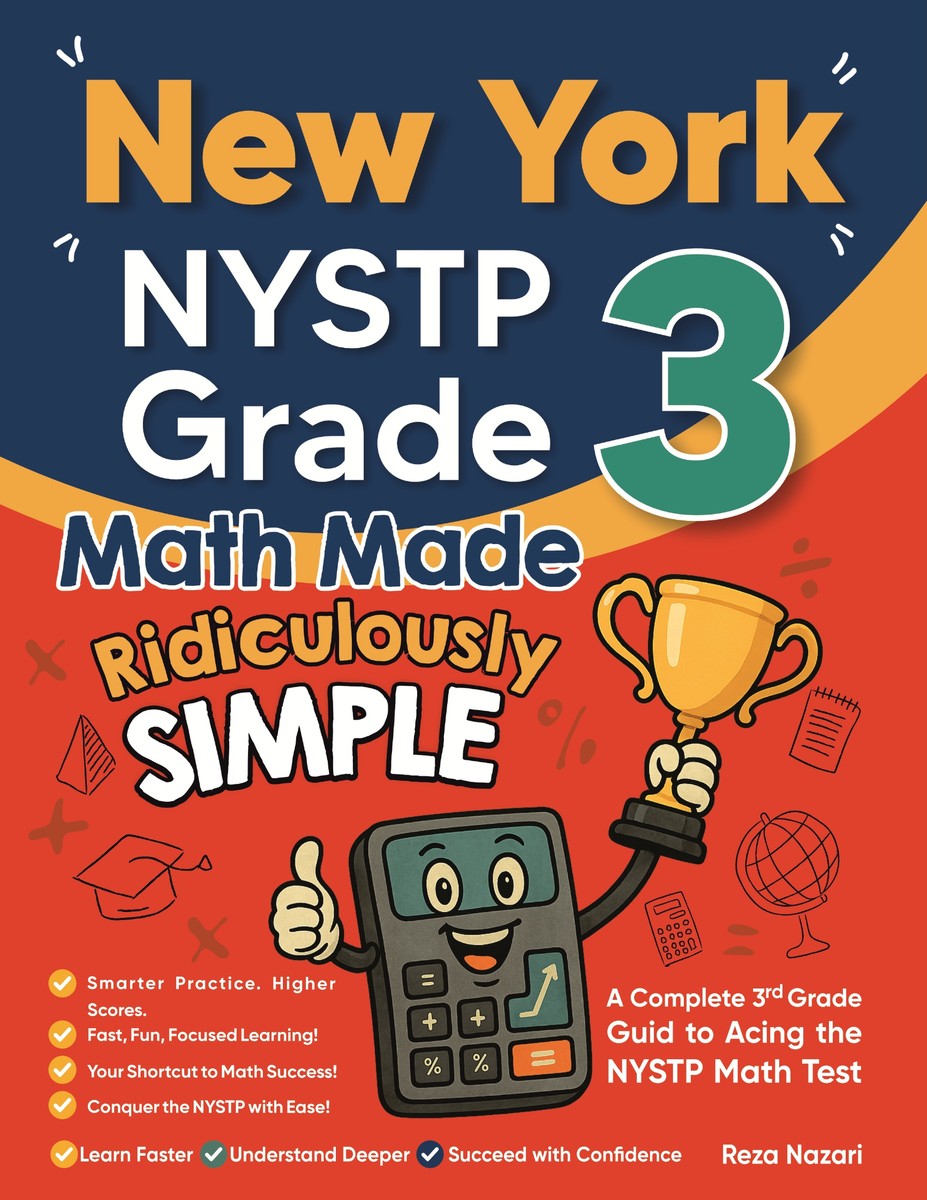
New York NYSTP Grade 3 Math Made Ridiculously Simple
A step-by-step NYSTP Grade 3 math book that rebuilds every tested skill clearly and in order, built to match the New York standards.
- Best starting point for the NYSTP math test
- Pairs with New York flashcards and worksheets
- Use it before full timed practice tests
- Organized for students who need examples before drills
Step-by-step lessons
Short explanations show the move before the student practices it.
✍Worked examples
Examples translate NYSTP-style wording into clear math steps.
Targeted practice
Rebuild one skill at a time instead of jumping around.
Test-day bridge
After each topic, connect to formulas, flashcards, and practice questions.
How to use it
- Read one lesson and copy the worked example.
- Do a short worksheet set on the same topic.
- Review the matching flashcards or formulas.
- Try a mixed quiz and mark every miss.
Pair it with free tools
Choose the right New York Grade 3 math book
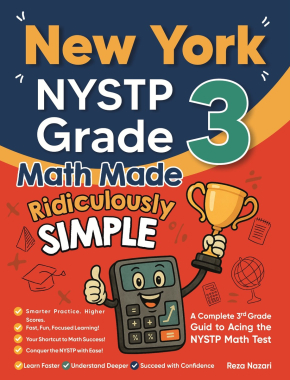
New York NYSTP Grade 3 Math Made Ridiculously Simple
Start here for New York Grade 3 math, step by step.
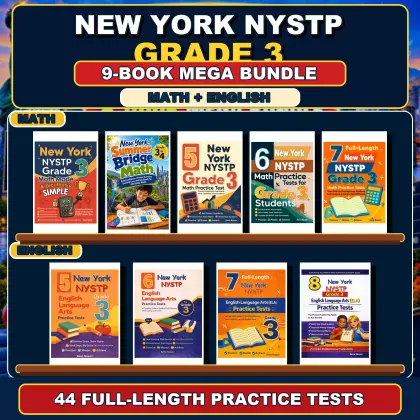
New York NYSTP Grade 3 Math & ELA Mega Bundle
9 books and 44 full-length practice tests in one TPT bundle.
New York NYSTP Grade 3 Math FAQ
What is the NYSTP Grade 3 math test?
The NYSTP (New York State Testing Program) is New York’s Grade 3 mathematics assessment. The linked activities are independent Grade 3 practice. Their question count, timer, scoring, and item types may differ from the official assessment. Use the directions inside each activity.
Can I use a calculator?
Calculator rules depend on the grade, assessment, test segment, and approved accommodations. Follow the current assessment guidance and ask your school which rules apply. A tool available in independent practice does not establish permission on the official test.
How long is each practice test?
Read the timer and question count shown in the practice activity you open. These are practice settings, not a statement of the official assessment’s duration or scoring.
Is it free?
The linked general practice and topic resources are available separately from optional books. Check each activity’s directions and access requirements. The study guide and bundle are optional next steps.
Grade 3 Math in Other States
Explore Grade 3 math standards, practice tests, and worksheets for every state.
- Alabama
- Alaska
- Arizona
- Arkansas
- California
- Colorado
- Connecticut
- Delaware
- Florida
- Georgia
- Hawaii
- Idaho
- Illinois
- Indiana
- Iowa
- Kansas
- Kentucky
- Louisiana
- Maine
- Maryland
- Massachusetts
- Michigan
- Minnesota
- Mississippi
- Missouri
- Montana
- Nebraska
- Nevada
- New Hampshire
- New Jersey
- New Mexico
- North Carolina
- North Dakota
- Ohio
- Oklahoma
- Oregon
- Pennsylvania
- Rhode Island
- South Carolina
- South Dakota
- Tennessee
- Texas
- Utah
- Vermont
- Virginia
- Washington
- West Virginia
- Wisconsin
- Wyoming
- District of Columbia
Make This Your New York NYSTP Starting Point
Take a timed practice test, find your weakest topic, and study it with the linked lessons, worksheets, and the NYSTP study guide.
Start a practice testNew York Grade 3 Math: 10-Question Challenge
Ten fresh questions on the skills New York 3rd graders work on most. Pick an answer, check it, and read the explanation either way.
Look at the tens digit, which is 0. Since 0 is less than 5, round down. 703 rounds to 700.
The numerators are the same. When the same amount is split into fewer parts, each part is larger, so \(\frac{1}{4}\) is greater than \(\frac{1}{8}\).
Multiply the numerator and denominator by 3: \(\frac{1}{2}\) = \(\frac{3}{6}\).
Choose another state
Grade 3 Math in Every State
Select a state on the map to open its Grade 3 Math page. You are viewing New York.
All states A–Z
A USEFUL NEXT STEP
New York Grade 3 Math: study questions
How should I choose a Grade 3 math study target?
Choose a current classroom target, find the matching learning reference, and use a lesson or available practice resource to check understanding. State documents control local wording and placement; shared reference codes are not a certified crosswalk.
Official source ↗Are these activities official state assessments?
These are independently published learning resources. A practice score does not predict or replace an official state score. Use the directions in each activity and consult your school for official testing and accommodation rules.
Resources from Effortless Math · Editorial standards