LEARN · PRACTICE · EXPLORE
Washington Grade 4 Math
Test folds of a non-square rectangle and explain why equal areas alone do not establish symmetry, using a selected Washington 2026 Grade 4 reference.
State resources · Focused study · Clear next steps
What do Washington 4th graders learn in math?
In 4th grade, Washington math centers on multi-digit multiplication and division, equivalent fractions, adding fractions with like denominators, decimals to hundredths, and angles. Students take the Smarter Balanced (SBA) grade 4 math test in the spring. This page explains each Washington grade 4 math standard and pairs it with short lessons, skill quizzes and printable worksheets.
Printable Washington grade 4 math books:
- 5 Washington Smarter Balanced Grade 4 Math Practice Tests
- 6 Washington Smarter Balanced Grade 4 Math Practice Tests
- 7 Full-Length Washington Smarter Balanced Grade 4 Math Practice Tests
- Washington Smarter Balanced Grade 4 Math Preparation Bundle
- Washington Smarter Balanced 4th Grade Math Workbook
- Washington Smarter Balanced Grade 4 Math Made Ridiculously Simple
- Washington Smarter Balanced Grade 4 Math in 30 Days
Standards source: Washington mathematics standards.
Start with Grade 4 Math Practice
Use this general Grade 4 math practice test to check your skills, then review the missed topics below. It is independent practice, not an official state assessment or a replica of its timing, scoring, or question types.
Open the Grade 4 practice test Explore Grade 4 lessons and worksheetsClassroom practice and state assessment
OSPI’s state-testing overview lists Smarter Balanced mathematics and English in Grades 3–8 and 10. Grade 4 is included in that listed mathematics range; follow current school directions and accommodations. Independently published practice has its own timing, tools, question count, and scoring. This original activity is not an official state assessment question, and a practice result does not establish a state performance level. Read official assessment guidance.
Distinguish Equal Areas from Line Symmetry
Test folds of a non-square rectangle and explain why equal areas alone do not establish symmetry, using a selected Washington 2026 Grade 4 reference.
A diagonal divides equally but does not make a matching fold
Use an ideal rectangle 8 units long and 4 units wide. Compare a fold along its vertical middle line with a fold along a diagonal joining opposite corners. A student says both are lines of symmetry because each divides the area in half. Explain what the fold must do.
Follow the reasoning
The middle line divides the rectangle into two 4-by-4 regions. Folding across it matches corresponding edges and corners, so it is a line of symmetry. A diagonal also divides the rectangle into two equal-area triangles, but folding over that diagonal does not superimpose the non-square rectangle’s boundary. The remaining corners do not match: reflecting a corner across that slanted line places it away from the opposite corner. Equal area is therefore insufficient. A symmetry fold requires the two parts to match in position after the fold, not merely to contain the same amount of area. The horizontal middle line also gives a matching fold.
Check the explanation
The figure is an ideal non-square rectangle. Its diagonal is not a symmetry line, although a square’s diagonal is. The equal-area triangles are congruent through a different motion; that fact does not make reflection in this particular diagonal a symmetry of the rectangle.
Try the next step
Compare with a square. Explain why its middle lines and diagonals match the parts after folding. Use a teacher-approved paper model or trace corresponding corners, keeping the fold line visible.
Washington reference for this worked activity
The Washington mathematics standards directory links the adopted 2026 standards. The PDF records adoption on June 18, 2026. OSPI says educators can explore, learn about, and begin using the new standards during 2026–27, with required use with students in 2027–28. Ask the school which learning sequence it follows during the transition. Read the complete requirements and the school’s current curriculum sequence. The reference below selects one worked focus.
| Selected reference | Activity focus | Complete requirement |
|---|---|---|
| M.4.SR.G.3 | Identify a line of symmetry through matching folded parts | Read the state-linked PDF page 37 |
This selected reference identifies the activity focus. The complete standard and grade curriculum include additional work. These labels do not certify alignment of every independent lesson, worksheet, or quiz in the broader directory.
Choose a next task from the student’s explanation
Use changed values or a different figure to check whether the student can explain the same relationship. If the explanation is unclear, return to the model; if the reasoning is sound but a calculation is wrong, work through a shorter calculation and check it against the model. Use the related learning resources alongside the teacher’s assigned goals.
OSPI’s state-testing overview lists Smarter Balanced mathematics and English in Grades 3–8 and 10. Grade 4 is included in that listed mathematics range; follow current school directions and accommodations. Independently published practice has its own timing, tools, question count, and scoring. This original activity is not an official state assessment question, and a practice result does not establish a state performance level. Read Washington assessment guidance.
State sources and the selected complete PDF page checked October 6, 2026. OSPI separates classroom standards implementation from assessment updates: new media-literacy, digital-citizenship, and data-science assessment changes are planned no earlier than 2028–29, beginning with pilots. This does not establish a changed current test format or question count. Read standards and assessment transition guidance. Confirm later guidance and local assignments.
Washington Grade 4 Math Topics
Choose a related lesson, printable resource, or quiz. This broader directory may include review and enrichment. Compare the task with the school’s learning goals; use the separately linked state reference for the worked activity above.
Official source: Washington mathematics standards and guidance.
Place Value & Number Sense
Multi-Digit Operations
Multiplicative Thinking
Fractions
Decimals & Fractions
Measurement, Area & Data
Angles
Washington Grade 4 Math Books and Resources
Compare each resource’s contents, edition, and worked explanations with the student’s current assignment before choosing a book.
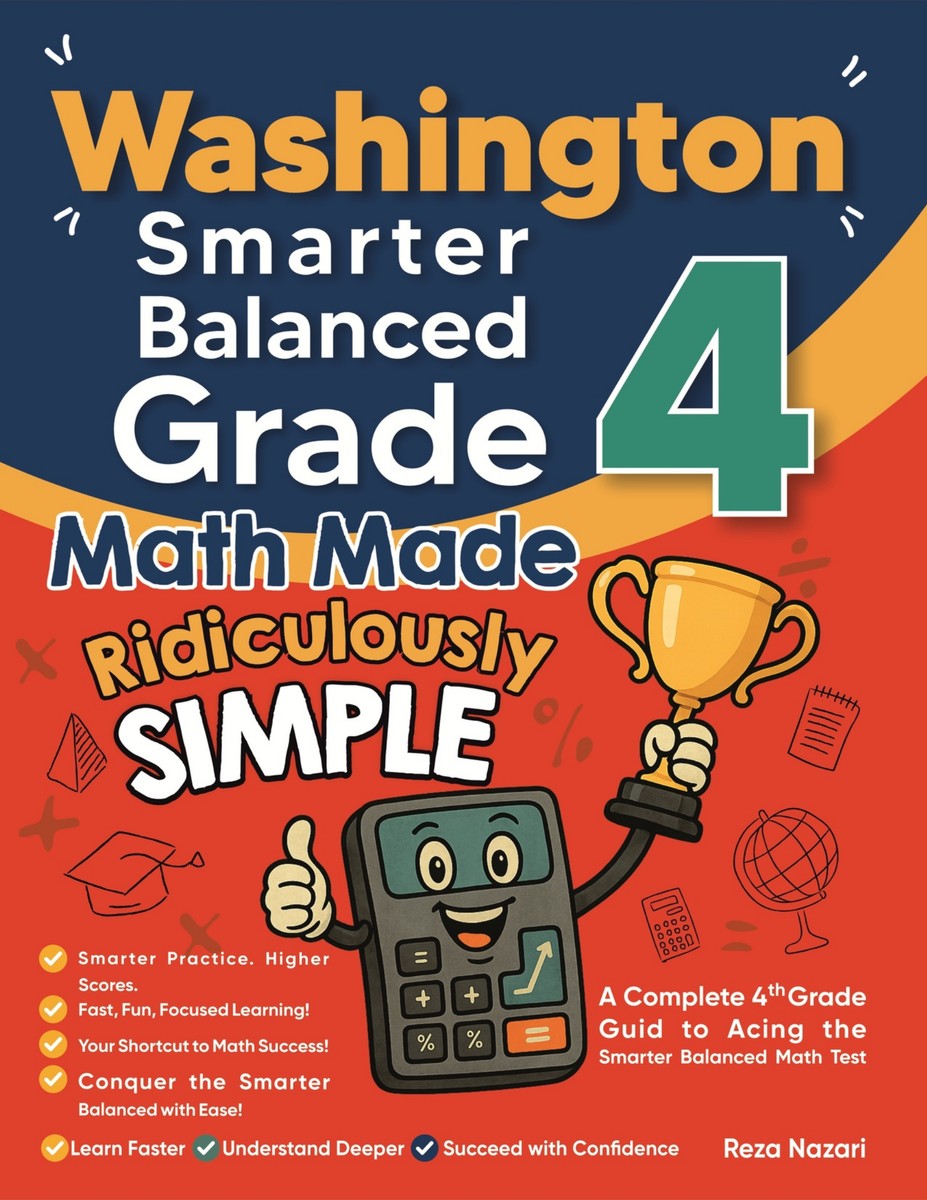
Washington Smarter Balanced Grade 4 Math Made Ridiculously Simple
An independently published Grade 4 mathematics resource. Compare its contents and worked explanations with the current classroom unit and complete state requirements.
- Best starting point for the Smarter Balanced math test
- Pairs with Washington flashcards and worksheets
- Use it before full timed practice tests
- Organized for students who need examples before drills
Step-by-step lessons
Short explanations show the move before the student practices it.
✍Worked examples
Read an explanation, try a related problem, and compare the reasoning with the classroom method.
Targeted practice
Rebuild one skill at a time instead of jumping around.
Test-day bridge
After each topic, connect to formulas, flashcards, and practice questions.
How to use it
- Read one lesson and copy the worked example.
- Do a short worksheet set on the same topic.
- Review the matching flashcards or formulas.
- Try a mixed quiz and mark every miss.
Choose the right Washington Grade 4 math book

Washington Smarter Balanced Grade 4 Math Made Ridiculously Simple
Start here for Washington Grade 4 math, step by step.
Washington Smarter Balanced Grade 4 Math Preparation Bundle
Study guide, workbook, and practice tests together.
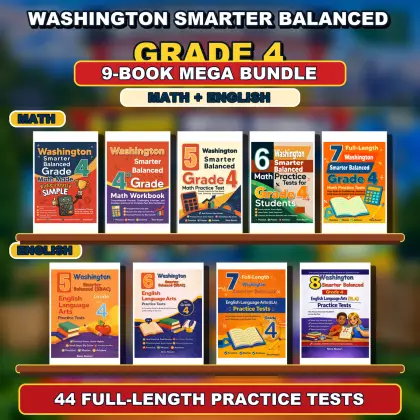
Washington Smarter Balanced Grade 4 Math & ELA Mega Bundle
Check the collection’s current contents and editions before choosing resources for classroom review or independent practice.
Grade 4 math: useful planning questions
Is dividing a shape into equal areas enough for line symmetry?
No. Reflection across the proposed line must match the two parts. A non-square rectangle’s diagonal divides its area equally but fails that matching condition.
How does Grade 4 mathematics connect with state assessment?
OSPI’s state-testing overview lists Smarter Balanced mathematics and English in Grades 3–8 and 10. Grade 4 is included in that listed mathematics range; follow current school directions and accommodations. Independently published practice has its own timing, tools, question count, and scoring. This original activity is not an official state assessment question, and a practice result does not establish a state performance level.
Grade 4 Math in Other States
Explore Grade 4 math standards, practice tests, and worksheets for every state.
- Alabama
- Alaska
- Arizona
- Arkansas
- California
- Colorado
- Connecticut
- Delaware
- Florida
- Georgia
- Hawaii
- Idaho
- Illinois
- Indiana
- Iowa
- Kansas
- Kentucky
- Louisiana
- Maine
- Maryland
- Massachusetts
- Michigan
- Minnesota
- Mississippi
- Missouri
- Montana
- Nebraska
- Nevada
- New Hampshire
- New Jersey
- New Mexico
- New York
- North Carolina
- North Dakota
- Ohio
- Oklahoma
- Oregon
- Pennsylvania
- Rhode Island
- South Carolina
- South Dakota
- Tennessee
- Texas
- Utah
- Vermont
- Virginia
- West Virginia
- Wisconsin
- Wyoming
- District of Columbia
Choose the Next Topic to Review
Review a practice response alongside classroom work. Choose a related lesson or printable task, explain the method, and check a new example with the teacher.
Start a practice testA USEFUL NEXT STEP
Washington Grade 4 Math: study questions
Is dividing a shape into equal areas enough for line symmetry?
No. Reflection across the proposed line must match the two parts. A non-square rectangle’s diagonal divides its area equally but fails that matching condition.
How does Grade 4 mathematics connect with state assessment?
OSPI’s state-testing overview lists Smarter Balanced mathematics and English in Grades 3–8 and 10. Grade 4 is included in that listed mathematics range; follow current school directions and accommodations. Independently published practice has its own timing, tools, question count, and scoring. This original activity is not an official state assessment question, and a practice result does not establish a state performance level.
Official source ↗Resources from Effortless Math · Editorial standards