LEARN · PRACTICE · EXPLORE
Michigan Grade 4 Math
Use equivalent fractions to combine tenths and hundredths of a meter, explain the common unit, and find Michigan Grade 4 math worksheets and quizzes.
State resources · Focused study · Clear next steps
What do Michigan 4th graders learn in math?
In 4th grade, Michigan math centers on multi-digit multiplication and division, equivalent fractions, adding fractions with like denominators, decimals to hundredths, and angles. Students take the M-STEP grade 4 math test in the spring. This page explains each Michigan grade 4 math standard and pairs it with short lessons, skill quizzes, printable worksheets and a full-length practice test.
Printable Michigan grade 4 math books:
- 5 Michigan M STEP Grade 4 Math Practice Tests
- 6 Michigan M-STEP Grade 4 Math Practice Tests
- 7 Full-Length Michigan M STEP Grade 4 Math Practice Tests
- Michigan M-STEP Grade 4 Math Preparation Bundle
- Michigan M-STEP 4th Grade Math Workbook
- Michigan M-STEP Grade 4 Math Made Ridiculously Simple
- Michigan M-STEP Grade 4 Math in 30 Days
Standards source: Michigan Mathematics Standards, Michigan Department of Education.
Start with Grade 4 Math Practice
Use this general Grade 4 math practice test to check your skills, then review the missed topics below. It is independent practice, not an official state assessment or a replica of its timing, scoring, or question types.
Open the Grade 4 practice test Explore Grade 4 lessons and worksheetsClassroom practice and state assessment information
The currently linked 2025–26 state guide identifies M-STEP English language arts and mathematics in Grades 3–7, including Grade 4. Follow the school’s current assigned assessment pathway and directions. Independently published practice may use its own timer, tools, question count, and scoring; these are not official administration specifications or a prediction of a state performance level. Read the currently linked state assessment guide for official guidance.
Use the worked activity and lesson directory to choose a skill. Confirm the directions of an independent practice resource before assigning it.
Rename tenths as hundredths before adding
Can the two piece counts be added immediately?
A ribbon piece is 4/10 meter long. A second piece is 17/100 meter long. Find their combined length, leaving out any overlap or extra length for joining. A learner writes 21/110 meter by adding both numerators and both denominators. Explain why that method does not describe the two measured lengths.
Explain the solution
The two fractions initially count differently sized units. Four tenths of a meter is forty hundredths of a meter because each tenth contains ten hundredths. Rename 4/10 as 40/100 without changing its length. Now both amounts use hundredths: 40/100 + 17/100 = 57/100 meter. The combined length is 0.57 meter. The denominator stays 100 because the unit being counted is still a hundredth of a meter. On a meter strip partitioned into one hundred equal parts, the first piece covers forty parts and the second covers seventeen; together they cover fifty-seven. The sum is shorter than one whole meter, which also agrees with the model.
| Quantity | Hundredths of a meter | Decimal meters |
|---|---|---|
| First piece: 4/10 | 40/100 | 0.40 |
| Second piece: 17/100 | 17/100 | 0.17 |
| Combined length | 57/100 | 0.57 |
Notice the reasoning
Adding denominators would create a new unit size that was not used to measure either piece. Ask the learner to identify what a tenth and a hundredth mean before calculating. Multiplying the numerator and denominator of 4/10 by ten produces an equivalent fraction; it does not make the ribbon ten times longer. Decimal notation must preserve the place values: 0.4 equals 0.40, while 0.04 represents only four hundredths. The worked activity uses denominators ten and one hundred, the specific scope of this selected Grade 4 expectation. General fraction addition with all unlike denominators is not required by this expectation.
Try a related task
Replace the second piece with 23/100 meter. Forty hundredths plus twenty-three hundredths gives 63/100 meter, or 0.63 meter. Check the new answer by shading a separate hundred-part strip. Then ask how much more ribbon would complete one meter: thirty-seven hundredths remain. State that this follow-up uses the same whole meter and the same hundredth units. Choose related equivalent-fraction and decimal practice from the lesson directory, and keep the student’s model with the numerical answer to show whether the common unit is understood.
Selected references from Michigan mathematics standards
The Michigan mathematics standards directory links the current mathematics document, adopted by the State Board of Education in 2010 and currently linked in the state’s academic standards directory. These selected references identify the worked activity’s focus. The expectations include numbered requirements, examples, and mathematical practices. Read the full document and confirm the school’s current instructional sequence.
| Adopted-document reference | Activity focus | Official document |
|---|---|---|
| 4.NF.5 | Use equivalent tenths and hundredths to add decimal fractions | Read the state PDF, page 33 |
| 4.NF.6 | Use decimal notation for tenths and hundredths | Read the state PDF, page 33 |
Sources checked October 6, 2026. Read complete requirements, clarifications, limitations, and mathematical practices alongside the school’s sequence. This selected activity is an entry point for instruction.
Connect the explanation with practice
Use the lesson, worksheet, and quiz directory to choose a related skill. The existing resource links remain available; open each activity’s directions to understand its timer, tools, question count, and scoring.
The currently linked 2025–26 state guide identifies M-STEP English language arts and mathematics in Grades 3–7, including Grade 4. Follow the school’s current assigned assessment pathway and directions. Independently published practice may use its own timer, tools, question count, and scoring; these are not official administration specifications or a prediction of a state performance level. Read the currently linked state assessment guide.
Read MDE assessment updates for later guidance. Keep one example of the student’s reasoning with the practice result. Choose a smaller model, a related question, or a new context according to the difficulty revealed in the worked activity.
Michigan Grade 4 Math Topics
Choose a lesson, printable worksheet collection, or topic quiz. This broader library includes review and enrichment. Use the school’s current sequence and the adopted Michigan document when choosing skills; these rows are not a certified full-course crosswalk.
Standards source: Michigan Academic Standards, Michigan Department of Education.
Place Value & Number Sense
Multi-Digit Operations
- Adding Multi Digit Whole NumbersWorksheetsQuiz
- Subtracting Multi Digit Whole NumbersWorksheetsQuiz
- Multiplying By A One Digit NumberWorksheetsQuiz
- Multiplying Two Two Digit NumbersWorksheetsQuiz
- Dividing With RemaindersWorksheetsQuiz
- Finding Factors And MultiplesWorksheetsQuiz
- Prime And Composite NumbersWorksheetsQuiz
Multiplicative Thinking
Fractions
- Equivalent FractionsWorksheetsQuiz
- Comparing FractionsWorksheetsQuiz
- Adding Fractions Like DenominatorsWorksheetsQuiz
- Subtracting Fractions Like DenominatorsWorksheetsQuiz
- Decomposing FractionsWorksheetsQuiz
- Adding And Subtracting Mixed NumbersWorksheetsQuiz
- Multiplying A Fraction By A Whole NumberWorksheetsQuiz
- Fraction Word ProblemsWorksheetsQuiz
Decimals & Fractions
Measurement, Area & Data
Angles
Best Michigan M-STEP Grade 4 Math Books
Each book has a job: start from scratch, drill weak skills, or build pacing with full tests. All of them pair with the free tools on this page.
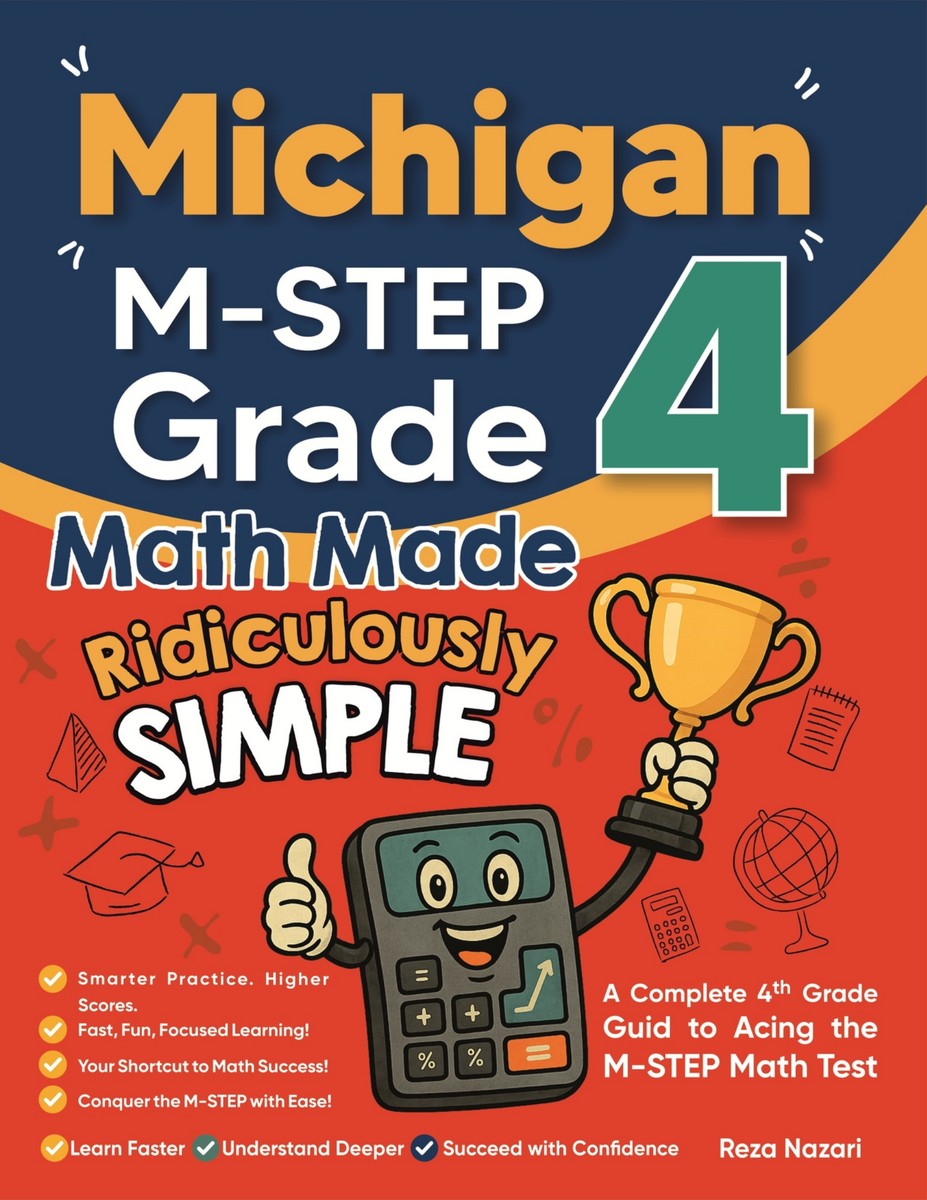
Michigan M-STEP Grade 4 Math Made Ridiculously Simple
An independently published Grade 4 mathematics resource. Check its edition and contents against Michigan’s adopted document and the school’s course before choosing preparation.
- Best starting point for the M-STEP math test
- Pairs with Michigan flashcards and worksheets
- Use it before full timed practice tests
- Organized for students who need examples before drills
Step-by-step lessons
Short explanations show the move before the student practices it.
✍Worked examples
Check the listed book’s contents and edition against the learner’s course before choosing it.
Targeted practice
Rebuild one skill at a time instead of jumping around.
Test-day bridge
After each topic, connect to formulas, flashcards, and practice questions.
How to use it
- Read one lesson and copy the worked example.
- Do a short worksheet set on the same topic.
- Review the matching flashcards or formulas.
- Try a mixed quiz and mark every miss.
Pair it with free tools
Choose the right Michigan Grade 4 math book
Michigan M-STEP Grade 4 Math Made Ridiculously Simple
Start here for Michigan Grade 4 math, step by step.
Michigan M-STEP Grade 4 Math Preparation Bundle
Study guide, workbook, and practice tests together.
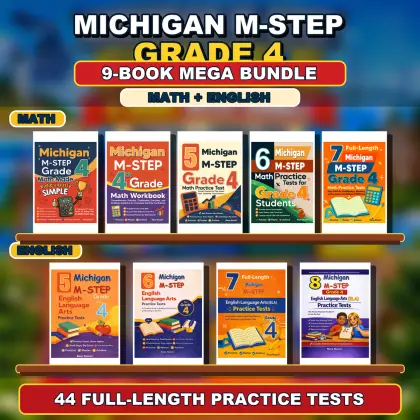
Michigan M STEP Grade 4 Math & ELA Mega Bundle
9 books and 44 full-length practice tests in one TPT bundle.
Michigan Grade 4 math: useful study questions
Why does the denominator stay one hundred when these fractions are added?
After renaming the tenths, both fractions count hundredths of the same meter. Forty hundredths plus seventeen hundredths equals fifty-seven hundredths.
Which statewide mathematics assessment pathway applies to Michigan Grade 4?
The currently linked 2025–26 state guide identifies M-STEP English language arts and mathematics in Grades 3–7, including Grade 4. Follow the school’s current assigned assessment pathway and directions. Independently published practice may use its own timer, tools, question count, and scoring; these are not official administration specifications or a prediction of a state performance level.
Grade 4 Math in Other States
Explore Grade 4 math standards, practice tests, and worksheets for every state.
- Alabama
- Alaska
- Arizona
- Arkansas
- California
- Colorado
- Connecticut
- Delaware
- Florida
- Georgia
- Hawaii
- Idaho
- Illinois
- Indiana
- Iowa
- Kansas
- Kentucky
- Louisiana
- Maine
- Maryland
- Massachusetts
- Minnesota
- Mississippi
- Missouri
- Montana
- Nebraska
- Nevada
- New Hampshire
- New Jersey
- New Mexico
- New York
- North Carolina
- North Dakota
- Ohio
- Oklahoma
- Oregon
- Pennsylvania
- Rhode Island
- South Carolina
- South Dakota
- Tennessee
- Texas
- Utah
- Vermont
- Virginia
- Washington
- West Virginia
- Wisconsin
- Wyoming
- District of Columbia
Make This Your Michigan M-STEP Starting Point
Choose a related practice resource, compare its feedback with classroom explanations, and follow the school’s current learning and assessment guidance.
Start a practice testA USEFUL NEXT STEP
Michigan Grade 4 Math: study questions
Why does the denominator stay one hundred when these fractions are added?
After renaming the tenths, both fractions count hundredths of the same meter. Forty hundredths plus seventeen hundredths equals fifty-seven hundredths.
Which statewide mathematics assessment pathway applies to Michigan Grade 4?
The currently linked 2025–26 state guide identifies M-STEP English language arts and mathematics in Grades 3–7, including Grade 4. Follow the school’s current assigned assessment pathway and directions. Independently published practice may use its own timer, tools, question count, and scoring; these are not official administration specifications or a prediction of a state performance level.
Official source ↗Resources from Effortless Math · Editorial standards