LEARN · PRACTICE · EXPLORE
Utah Grade 4 Math
Build an add-four pattern, explain why its terms stay odd, and test a changed starting number using a selected Utah Grade 4 reference.
State resources · Focused study · Clear next steps
What do Utah 4th graders learn in math?
In 4th grade, Utah math centers on multi-digit multiplication and division, equivalent fractions, adding fractions with like denominators, decimals to hundredths, and angles. Students take the RISE grade 4 math test in the spring. This page explains each Utah grade 4 math standard and pairs it with short lessons, skill quizzes, printable worksheets and a full-length practice test.
Printable Utah grade 4 math books:
Standards source: Utah mathematics standards.
Start with Grade 4 Math Practice
Use this general Grade 4 math practice test to check your skills, then review the missed topics below. It is independent practice, not an official state assessment or a replica of its timing, scoring, or question types.
Open the Grade 4 practice test Explore Grade 4 lessons and worksheetsClassroom practice and state assessment
The Utah RISE overview lists mathematics summative assessment in Grades 3–8, including this grade. Follow the school’s current directions and accommodations. Independently published practice has its own timing, tools, question count, and scoring; its result does not establish a state performance level. This original activity is not an official state assessment question. Read official assessment guidance.
Explain What Stays True in an Add-Four Pattern
Build an add-four pattern, explain why its terms stay odd, and test a changed starting number using a selected Utah Grade 4 reference.
Adding four changes the number but preserves its parity
Start with 3 and repeatedly add 4. Write the first six terms, including the starting number. A student says, “Every term will be odd, even after our list ends.” Explain whether the rule supports that claim. Then decide what would change if the starting number were 2.
| Term | 1 | 2 | 3 | 4 | 5 | 6 |
|---|---|---|---|---|---|---|
| Value | 3 | 7 | 11 | 15 | 19 | 23 |
Follow the reasoning
Each new term is four more than the previous term: 3, 7, 11, 15, 19, 23. Each listed value is odd, but listing six values alone is not the reason every later value is odd. An odd number can be arranged in pairs with one left over. Adding four adds two complete pairs and leaves that single leftover unchanged. Therefore, the next term is also odd, and the same reasoning applies each time the rule is used. Starting at 2 instead gives 2, 6, 10, 14, 18, 22: complete pairs stay complete when two more pairs are added, so all those terms are even.
Check the claim’s scope
The add-four rule preserves whether the starting number is odd or even. It does not make every possible starting value odd. Keep the stated starting number in the explanation. The first term is the starting value; counting six additions would produce seven terms. This activity selects number-pattern reasoning, while the complete reference also includes shape patterns.
Try a changed rule
Start at 3 again but add 5 each time. The first six terms are 3, 8, 13, 18, 23, 28. Explain why odd and even alternate: adding an odd number changes whether an unpaired object remains. Compare the two rules with paired objects or a drawing before making a claim about later terms.
Utah reference for this worked activity
The Utah mathematics standards directory identifies January 2016 adoption and lists a revision process that is still underway. The elementary PDF says revised April 2016; the middle-school PDF says revised September 2015–April 2016. These file revision labels do not establish adoption of a new 2026 edition. Use the school’s current learning sequence and consult later department updates.
| Selected reference | Activity focus | Complete requirement |
|---|---|---|
| 4.OA.5 | Generate a pattern and explain a feature beyond the stated rule | Read the state-linked PDF page 41 |
This selected reference identifies the activity focus. The complete standard and grade curriculum include additional work. These labels do not certify alignment of every independent lesson, worksheet, or quiz in the broader directory.
Choose a next task from the student’s explanation
Use a different set of numbers to check whether the student can explain the same relationship. If the explanation is unclear, return to the model; if the reasoning is sound but a calculation is wrong, work through a shorter calculation and check it against the model. Use the related learning resources alongside the teacher’s assigned goals.
The Utah RISE overview lists mathematics summative assessment in Grades 3–8, including this grade. Follow the school’s current directions and accommodations. Independently published practice has its own timing, tools, question count, and scoring; its result does not establish a state performance level. This original activity is not an official state assessment question. Read Utah assessment guidance.
State sources and the selected complete PDF page checked October 6, 2026. Confirm later guidance and local assignments before planning assessment preparation.
Utah Grade 4 Math Topics
Choose a related lesson, printable resource, or quiz. This broader directory may include review and enrichment. Compare the task with the school’s learning goals; use the separately linked state reference for the worked activity above.
Official source: Utah mathematics standards and guidance.
Place Value & Number Sense
Multi-Digit Operations
Multiplicative Thinking
Fractions
Decimals & Fractions
Measurement, Area & Data
Angles
Utah Grade 4 Math Books and Resources
Each book has a job: start from scratch, drill weak skills, or build pacing with full tests. All of them pair with the free tools on this page.
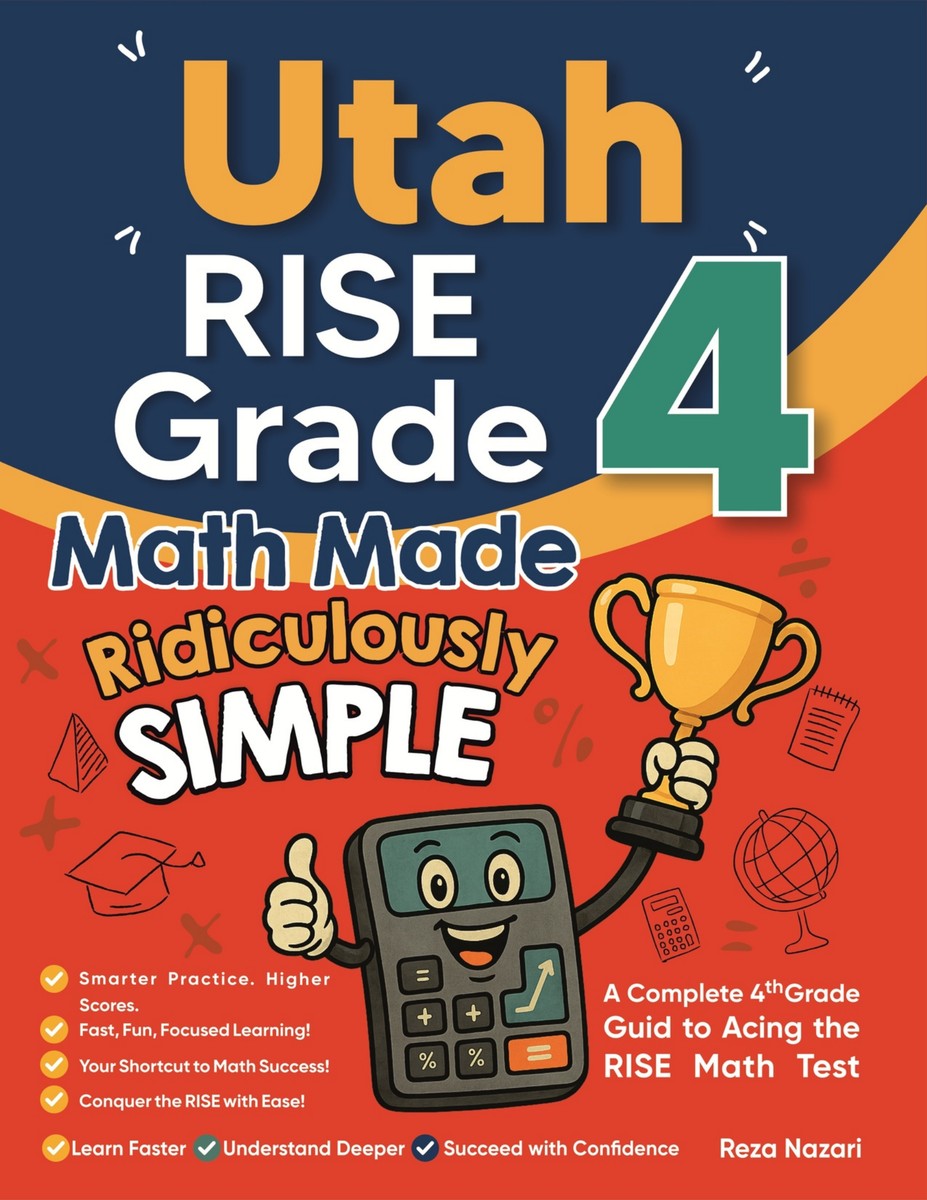
Utah RISE Grade 4 Math Made Ridiculously Simple
An independently published Grade 4 mathematics resource. Compare its contents and worked explanations with the current classroom unit and complete state requirements.
- Best starting point for the RISE math test
- Pairs with Utah flashcards and worksheets
- Use it before full timed practice tests
- Organized for students who need examples before drills
Step-by-step lessons
Short explanations show the move before the student practices it.
✍Worked examples
Read an explanation, try a related problem, and compare the reasoning with the classroom method.
Targeted practice
Rebuild one skill at a time instead of jumping around.
Test-day bridge
After each topic, connect to formulas, flashcards, and practice questions.
How to use it
- Read one lesson and copy the worked example.
- Do a short worksheet set on the same topic.
- Review the matching flashcards or formulas.
- Try a mixed quiz and mark every miss.
Pair it with free tools
Choose the right Utah Grade 4 math book
Utah RISE Grade 4 Math Made Ridiculously Simple
Start here for Utah Grade 4 math, step by step.
Utah RISE Grade 4 Math Preparation Bundle
Study guide, workbook, and practice tests together.

Utah RISE Grade 4 Math & ELA Mega Bundle
9 books and 44 full-length practice tests in one TPT bundle.
Grade 4 math: useful planning questions
Does seeing six odd terms prove every later term is odd?
The list illustrates the pattern. The explanation comes from the rule: adding four adds two complete pairs and preserves the odd starting number’s single leftover.
How does Grade 4 mathematics connect with state assessment?
The Utah RISE overview lists mathematics summative assessment in Grades 3–8, including this grade. Follow the school’s current directions and accommodations. Independently published practice has its own timing, tools, question count, and scoring; its result does not establish a state performance level. This original activity is not an official state assessment question.
Grade 4 Math in Other States
Explore Grade 4 math standards, practice tests, and worksheets for every state.
- Alabama
- Alaska
- Arizona
- Arkansas
- California
- Colorado
- Connecticut
- Delaware
- Florida
- Georgia
- Hawaii
- Idaho
- Illinois
- Indiana
- Iowa
- Kansas
- Kentucky
- Louisiana
- Maine
- Maryland
- Massachusetts
- Michigan
- Minnesota
- Mississippi
- Missouri
- Montana
- Nebraska
- Nevada
- New Hampshire
- New Jersey
- New Mexico
- New York
- North Carolina
- North Dakota
- Ohio
- Oklahoma
- Oregon
- Pennsylvania
- Rhode Island
- South Carolina
- South Dakota
- Tennessee
- Texas
- Vermont
- Virginia
- Washington
- West Virginia
- Wisconsin
- Wyoming
- District of Columbia
Choose the Next Topic to Review
Review a practice response alongside classroom work. Choose a related lesson or printable task, explain the method, and check a new example with the teacher.
Start a practice testA USEFUL NEXT STEP
Utah Grade 4 Math: study questions
Does seeing six odd terms prove every later term is odd?
The list illustrates the pattern. The explanation comes from the rule: adding four adds two complete pairs and preserves the odd starting number’s single leftover.
How does Grade 4 mathematics connect with state assessment?
The Utah RISE overview lists mathematics summative assessment in Grades 3–8, including this grade. Follow the school’s current directions and accommodations. Independently published practice has its own timing, tools, question count, and scoring; its result does not establish a state performance level. This original activity is not an official state assessment question.
Official source ↗Resources from Effortless Math · Editorial standards