LEARN · PRACTICE · EXPLORE
Iowa Grade 4 Math
Use an original divided right-angle diagram, solve for a missing measure, and explain non-overlapping angle addition using an Iowa Grade 4 expectation.
State resources · Focused study · Clear next steps
What do Iowa 4th graders learn in math?
In 4th grade, Iowa math centers on multi-digit multiplication and division, equivalent fractions, adding fractions with like denominators, decimals to hundredths, and angles. Students take the ISASP grade 4 math test in the spring. This page explains each Iowa grade 4 math standard and pairs it with short lessons, skill quizzes, printable worksheets and a full-length practice test.
Printable Iowa grade 4 math books:
Standards source: Iowa Mathematics Standards, Iowa Department of Education.
Start with Grade 4 Math Practice
Use this general Grade 4 math practice test to check your skills, then review the missed topics below. It is independent practice, not an official state assessment or a replica of its timing, scoring, or question types.
Open the Grade 4 practice test Explore Grade 4 lessons and worksheetsClassroom practice and state assessment information
Grade 4 is within Iowa’s ISASP mathematics testing range. The linked learning resources have their own directions and scoring; a practice score does not establish an official state performance level. Read the state assessment overview for official guidance.
Use the worked activity and lesson directory to choose a skill. Confirm the directions of an independent practice resource before assigning it.
Find an unknown angle without counting an overlap twice
A teacher draws two perpendicular rays meeting at O. A third ray lies inside their 90° angle and divides it into two non-overlapping parts. One part measures 35°. Find the other part, labeled x°. The diagram is an original mathematical example, and its labels supply the measurements.
Write and check the equation
The two parts fill the whole right angle, so 35 + x = 90. Subtract 35 from 90 to obtain x = 55. Check by adding 35° and 55°: the result is 90°. The unknown is the angle between OA and OC, while the 35° label describes the part between OC and OB. Naming the rays makes the intended regions clear.
Check the conditions for addition
Both parts share vertex O and the dividing ray OC. Their interiors do not overlap. That is why their measures can be added to give the whole angle. Adding 35° to the entire 90° angle would count the 35° region twice and answer a different question. The unknown angle is not 90 − 55 unless 55 is already known; use the actual given measure when forming the first equation.
Separate angle size from ray length
Extending OB farther would not change the amount of turn between the rays. Nor should a child use the apparent length of a line in this drawing to decide which angle is larger. The right-angle mark and numerical label establish the whole angle in the task. A protractor activity can provide a separate measurement check, but a resized screen image should not replace the problem’s stated measurements.
Transfer the reasoning
Draw another divided right angle with one part labeled 28°. Write an equation for the unknown part, solve it, and check that 28° + 62° = 90°. Next, consider a stated 120° angle divided into 45° and y°; the same reasoning gives y = 75. Explain what stays the same about non-overlapping parts even though the whole angle is no longer a right angle. This task selects addition of angle measures, while Iowa’s wider geometry work also includes drawing and measuring angles and other shapes.
Selected references from Iowa’s April 29, 2024 mathematics standards
The Iowa mathematics standards directory links the Iowa mathematics standards adopted April 29, 2024. These selected references identify the worked activity’s focus. The expectations include numbered requirements, examples, and mathematical practices. Read the full document and confirm the school’s current instructional sequence.
| Adopted-document reference | Activity focus | Official document |
|---|---|---|
| 4.MD.C.7 | Add non-overlapping angle parts and find an unknown measure | Read the state PDF, page 55 |
Sources checked October 6, 2026. Read complete requirements, clarifications, limitations, and mathematical practices alongside the school’s sequence. This selected activity is an entry point for instruction.
Connect the explanation with practice
Use the lesson, worksheet, and quiz directory to choose a related skill. The existing resource links remain available; open each activity’s directions to understand its timer, tools, question count, and scoring.
Grade 4 is within Iowa’s ISASP mathematics testing range. The linked learning resources have their own directions and scoring; a practice score does not establish an official state performance level. Read Iowa’s assessment overview.
Keep one example of the student’s reasoning with the practice result. Choose a smaller model, a related question, or a new context according to the difficulty revealed in the worked activity.
Iowa Grade 4 Math Topics
Choose a lesson, printable worksheet collection, or topic quiz. This broader library includes review and enrichment. Use the school’s current sequence and the adopted Iowa document when choosing skills; these rows are not a certified full-course crosswalk.
Standards source: Iowa Academic Standards, Iowa Department of Education.
Place Value & Number Sense
Multi-Digit Operations
- Adding Multi Digit Whole NumbersWorksheetsQuiz
- Subtracting Multi Digit Whole NumbersWorksheetsQuiz
- Multiplying By A One Digit NumberWorksheetsQuiz
- Multiplying Two Two Digit NumbersWorksheetsQuiz
- Dividing With RemaindersWorksheetsQuiz
- Finding Factors And MultiplesWorksheetsQuiz
- Prime And Composite NumbersWorksheetsQuiz
Multiplicative Thinking
Fractions
- Equivalent FractionsWorksheetsQuiz
- Comparing FractionsWorksheetsQuiz
- Adding Fractions Like DenominatorsWorksheetsQuiz
- Subtracting Fractions Like DenominatorsWorksheetsQuiz
- Decomposing FractionsWorksheetsQuiz
- Adding And Subtracting Mixed NumbersWorksheetsQuiz
- Multiplying A Fraction By A Whole NumberWorksheetsQuiz
- Fraction Word ProblemsWorksheetsQuiz
Decimals & Fractions
Measurement, Area & Data
Angles
Best Iowa ISASP Grade 4 Math Books
Each book has a job: start from scratch, drill weak skills, or build pacing with full tests. All of them pair with the free tools on this page.
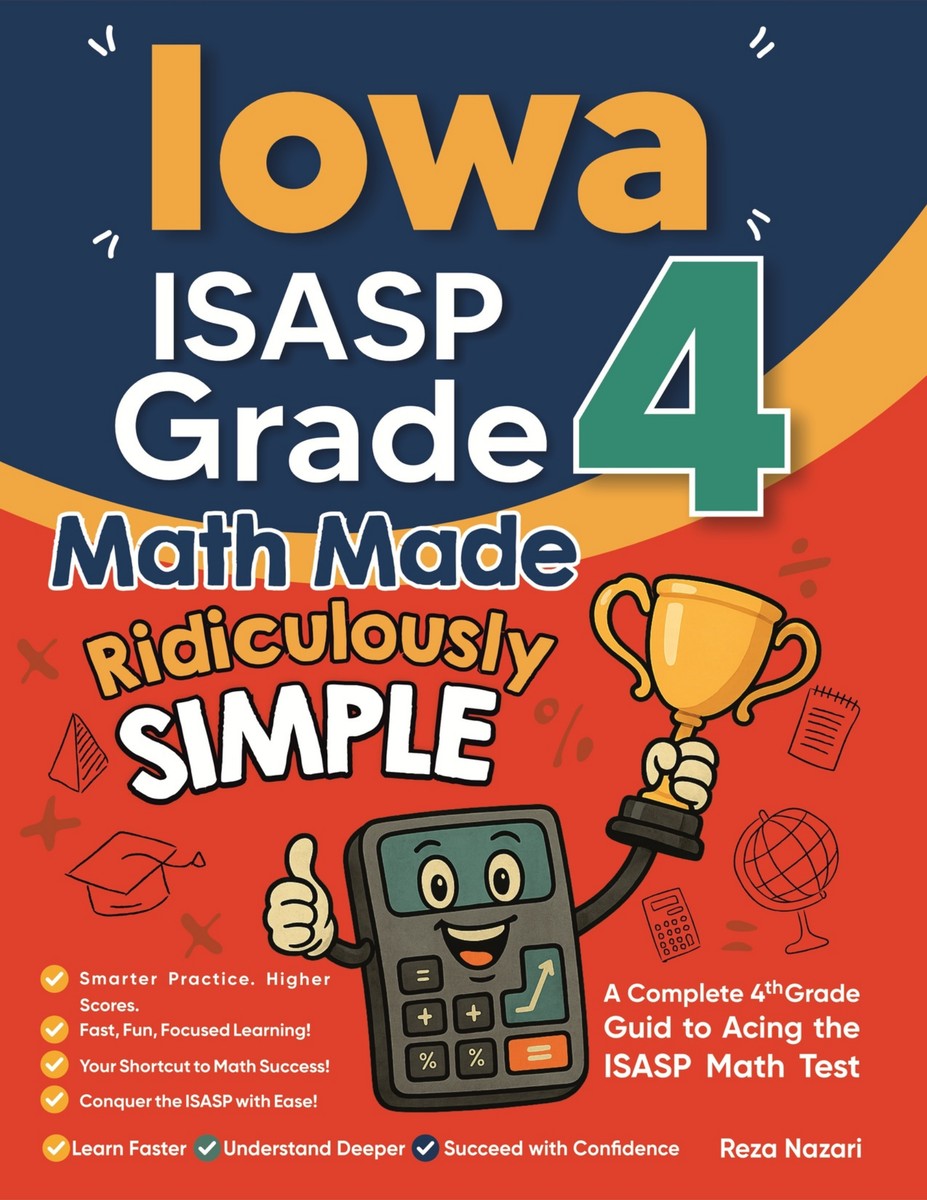
Iowa ISASP Grade 4 Math Made Ridiculously Simple
An independently published Grade 4 mathematics resource. Check its edition and contents against Iowa’s adopted document and the school’s course before choosing preparation.
- Best starting point for the ISASP math test
- Pairs with Iowa flashcards and worksheets
- Use it before full timed practice tests
- Organized for students who need examples before drills
Step-by-step lessons
Short explanations show the move before the student practices it.
✍Worked examples
Examples translate ISASP-style wording into clear math steps.
Targeted practice
Rebuild one skill at a time instead of jumping around.
Test-day bridge
After each topic, connect to formulas, flashcards, and practice questions.
How to use it
- Read one lesson and copy the worked example.
- Do a short worksheet set on the same topic.
- Review the matching flashcards or formulas.
- Try a mixed quiz and mark every miss.
Pair it with free tools
Choose the right Iowa Grade 4 math book

Iowa ISASP Grade 4 Math Made Ridiculously Simple
Start here for Iowa Grade 4 math, step by step.
Iowa ISASP Grade 4 Math Preparation Bundle
Study guide, workbook, and practice tests together.
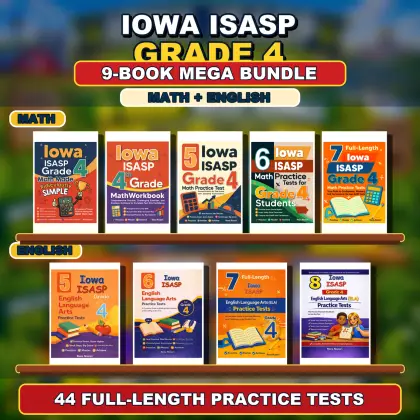
Iowa ISASP Grade 4 Math & ELA Mega Bundle
9 books and 44 full-length practice tests in one TPT bundle.
Iowa Grade 4 math: useful study questions
Can adjacent angle measures be added if their interiors overlap?
The simple addition rule here requires non-overlapping parts. The diagram’s 35° part and unknown part together fill the stated 90° angle without overlap.
Is Grade 4 included in Iowa ISASP math testing?
Yes. Grade 4 is within Iowa’s ISASP range of Grades 3–11. The linked activities are independently published practice with separate directions and scoring.
Grade 4 Math in Other States
Explore Grade 4 math standards, practice tests, and worksheets for every state.
- Alabama
- Alaska
- Arizona
- Arkansas
- California
- Colorado
- Connecticut
- Delaware
- Florida
- Georgia
- Hawaii
- Idaho
- Illinois
- Indiana
- Kansas
- Kentucky
- Louisiana
- Maine
- Maryland
- Massachusetts
- Michigan
- Minnesota
- Mississippi
- Missouri
- Montana
- Nebraska
- Nevada
- New Hampshire
- New Jersey
- New Mexico
- New York
- North Carolina
- North Dakota
- Ohio
- Oklahoma
- Oregon
- Pennsylvania
- Rhode Island
- South Carolina
- South Dakota
- Tennessee
- Texas
- Utah
- Vermont
- Virginia
- Washington
- West Virginia
- Wisconsin
- Wyoming
- District of Columbia
Make This Your Iowa ISASP Starting Point
Take a timed practice test, find your weakest topic, and study it with the linked lessons, worksheets, and the ISASP study guide.
Start a practice testA USEFUL NEXT STEP
Iowa Grade 4 Math: study questions
Can adjacent angle measures be added if their interiors overlap?
The simple addition rule here requires non-overlapping parts. The diagram’s 35° part and unknown part together fill the stated 90° angle without overlap.
Is Grade 4 included in Iowa ISASP math testing?
Yes. Grade 4 is within Iowa’s ISASP range of Grades 3–11. The linked activities are independently published practice with separate directions and scoring.
Official source ↗Resources from Effortless Math · Editorial standards