LEARN · PRACTICE · EXPLORE
South Dakota Grade 4 Math
Use division and context to interpret a remainder. Work through an original example with an explained solution, printable practice, and separately identified South Dakota standards editions.
State resources · Focused study · Clear next steps
What do South Dakota 4th graders learn in math?
In 4th grade, South Dakota math centers on multi-digit multiplication and division, equivalent fractions, adding fractions with like denominators, decimals to hundredths, and angles. Students take the South Dakota state grade 4 math test in the spring. This page explains each South Dakota grade 4 math standard and pairs it with short lessons, skill quizzes and printable worksheets.
Printable South Dakota grade 4 math books:
- 5 South Dakota Smarter Balanced Grade 4 Math Practice Tests
- 6 South Dakota Smarter Balanced Grade 4 Math Practice Tests
- 7 Full-Length South Dakota Smarter Balanced Grade 4 Math Practice Tests
- South Dakota Smarter Balanced Grade 4 Math Preparation Bundle
- South Dakota Smarter Balanced 4th Grade Math Workbook
- South Dakota Smarter Balanced Grade 4 Math Made Ridiculously Simple
- South Dakota Smarter Balanced Grade 4 Math in 30 Days
Standards source: South Dakota mathematics standards.
Start with Grade 4 Math Practice
Use this general Grade 4 math practice test to check your skills, then review the missed topics below. It is independent practice, not an official state assessment or a replica of its timing, scoring, or question types.
Open the Grade 4 practice test Explore Grade 4 lessons and worksheetsClassroom practice and state assessment
The department’s current 2026–27 assessment table places the general English language arts and mathematics assessments in Grades 3–8, including Grade 4. Follow the school’s current directions and accommodations. Independently published practice has its own timing, tools, question count, and scoring; its result does not establish a state performance level. Read official assessment guidance.
Interpret a Remainder in Context
Use division and context to interpret a remainder. Work through an original example with an explained solution, printable practice, and separately identified South Dakota standards editions.
Seventeen students, packs of four
Two fictional groups of 9 and 8 students each need one pencil. Pencils are sold only in sealed packs of 4. There are no pencils already available. Find the fewest packs needed, then explain how many pencils remain after giving one to each student. Compare that answer with the number of complete groups of four students that can be formed.
Follow the reasoning
The two groups contain 9 + 8 = 17 students. Dividing 17 by 4 gives 4 with remainder 1: 17 = 4 × 4 + 1. Four packs contain only 16 pencils, leaving one student without a pencil. Buying five packs provides 20 pencils, and 20 − 17 = 3 pencils remain. Five is the fewest packs because four are insufficient and five cover the need. In contrast, 17 students form only 4 complete groups of four, with one student outside those complete groups. The same division supports different answers because the questions ask different things.
Read the question before rounding
Do not automatically round every division result up. Packs needed must include capacity for the remaining student; complete groups count only full groups. Buying 4.25 packs is not allowed by the stated sale condition. The example gives no price, so the calculation does not establish a purchase cost.
Try the next step
If one of the 17 students already has a pencil, only 16 pencils are needed. Four packs then suffice and no pencils remain. Explain which condition changed and write an equation for the new need before dividing.
South Dakota mathematics references and edition transition
The South Dakota mathematics directory links both its 2018 and newly adopted 2026 editions. The assessed-standards timeline identifies 2026–27 as the mathematics transition year, 2027–28 for implementation, and 2028–29 for assessment of the new edition. This activity links the selected 2018 requirement for current teaching and identifies a related 2026 reference separately. Follow the school’s adopted materials and transition plan.
| Edition and reference | Selected focus | Complete requirement |
|---|---|---|
| 2018: 4.OA.3 | Use division and context to interpret a remainder | Read 2018 PDF page 29 |
| 2026: 4.OA.6 | Interpret remainders in multistep whole-number problems | Read 2026 PDF page 20 |
The 2018 document places numbered clauses beneath grade/domain headings; the reference above combines that heading and clause number. The 2026 edition reorganizes and renumbers requirements. These are selected related references, not a complete edition crosswalk, full curriculum, or certified alignment of every practice resource.
Choose a next task from the student’s explanation
Use a different set of numbers to check whether the student can explain the same relationship. If the explanation is unclear, return to the model; if the reasoning is sound but a calculation is wrong, work through a shorter calculation and check it against the model. Use the related learning resources alongside the teacher’s assigned goals.
The department’s current 2026–27 assessment table places the general English language arts and mathematics assessments in Grades 3–8, including Grade 4. Follow the school’s current directions and accommodations. Independently published practice has its own timing, tools, question count, and scoring; its result does not establish a state performance level. Read the current South Dakota assessment table.
State sources and the selected complete PDF page checked October 6, 2026. Confirm later guidance and local assignments before planning assessment preparation.
South Dakota Grade 4 Math Topics
Choose a related lesson, printable resource, or quiz. This broader directory may include review and enrichment. Compare the task with the school’s learning goals; use the separately linked state reference for the worked activity above.
Official source: South Dakota mathematics standards and guidance.
Place Value & Number Sense
Multi-Digit Operations
Multiplicative Thinking
Fractions
Decimals & Fractions
Measurement, Area & Data
Angles
South Dakota Grade 4 Math Books and Resources
Each book has a job: start from scratch, drill weak skills, or build pacing with full tests. All of them pair with the free tools on this page.
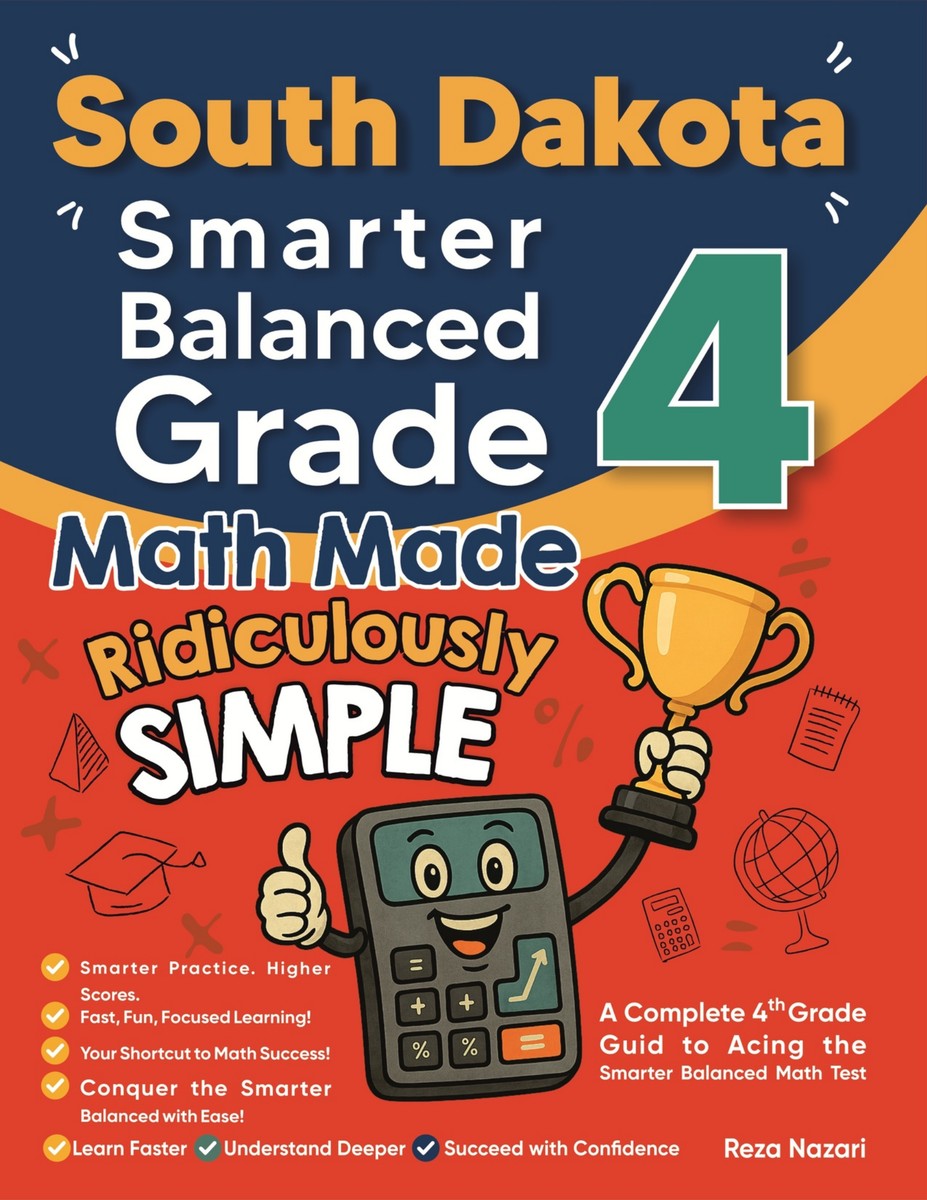
South Dakota Smarter Balanced Grade 4 Math Made Ridiculously Simple
An independently published Grade 4 mathematics resource. Compare its contents and worked explanations with the current classroom unit and complete state requirements.
- Best starting point for the Smarter Balanced math test
- Pairs with South Dakota flashcards and worksheets
- Use it before full timed practice tests
- Organized for students who need examples before drills
Step-by-step lessons
Short explanations show the move before the student practices it.
✍Worked examples
Read an explanation, try a related problem, and compare the reasoning with the classroom method.
Targeted practice
Rebuild one skill at a time instead of jumping around.
Test-day bridge
After each topic, connect to formulas, flashcards, and practice questions.
How to use it
- Read one lesson and copy the worked example.
- Do a short worksheet set on the same topic.
- Review the matching flashcards or formulas.
- Try a mixed quiz and mark every miss.
Choose the right South Dakota Grade 4 math book

South Dakota Smarter Balanced Grade 4 Math Made Ridiculously Simple
Start here for South Dakota Grade 4 math, step by step.
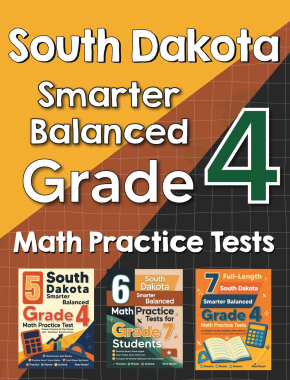
South Dakota Smarter Balanced Grade 4 Math Preparation Bundle
Study guide, workbook, and practice tests together.
Grade 4 math: useful planning questions
Should every remainder make the answer round up?
No. Determine what the question asks. Capacity needed can require an additional pack; the count of complete groups excludes an incomplete group.
How does Grade 4 mathematics connect with state assessment?
The department’s current 2026–27 assessment table places the general English language arts and mathematics assessments in Grades 3–8, including Grade 4. Follow the school’s current directions and accommodations. Independently published practice has its own timing, tools, question count, and scoring; its result does not establish a state performance level.
Grade 4 Math in Other States
Explore Grade 4 math standards, practice tests, and worksheets for every state.
- Alabama
- Alaska
- Arizona
- Arkansas
- California
- Colorado
- Connecticut
- Delaware
- Florida
- Georgia
- Hawaii
- Idaho
- Illinois
- Indiana
- Iowa
- Kansas
- Kentucky
- Louisiana
- Maine
- Maryland
- Massachusetts
- Michigan
- Minnesota
- Mississippi
- Missouri
- Montana
- Nebraska
- Nevada
- New Hampshire
- New Jersey
- New Mexico
- New York
- North Carolina
- North Dakota
- Ohio
- Oklahoma
- Oregon
- Pennsylvania
- Rhode Island
- South Carolina
- Tennessee
- Texas
- Utah
- Vermont
- Virginia
- Washington
- West Virginia
- Wisconsin
- Wyoming
- District of Columbia
Choose the Next Topic to Review
Review a practice response alongside classroom work. Choose a related lesson or printable task, explain the method, and check a new example with the teacher.
Start a practice testA USEFUL NEXT STEP
South Dakota Grade 4 Math: study questions
Should every remainder make the answer round up?
No. Determine what the question asks. Capacity needed can require an additional pack; the count of complete groups excludes an incomplete group.
How does Grade 4 mathematics connect with state assessment?
The department’s current 2026–27 assessment table places the general English language arts and mathematics assessments in Grades 3–8, including Grade 4. Follow the school’s current directions and accommodations. Independently published practice has its own timing, tools, question count, and scoring; its result does not establish a state performance level.
Official source ↗Resources from Effortless Math · Editorial standards