LEARN · PRACTICE · EXPLORE
New Mexico Grade 6 Math
Find an L-shaped area using two explained methods in New Mexico Grade 6 math, then explore lessons, worksheets, quizzes, and selected state geometry references.
Focused lessons · Useful practice · Clear next steps
Standards source: New Mexico adopted content standards.
Explore Independent Grade 6 Math Practice
Six independently published, timed New Mexico NM-MSSA-named Grade 6 math practice tests, 40 questions each, instant scoring, a topic-by-topic breakdown, and full step-by-step solutions. Each one opens right here in a popup. Calculator: Scientific calculator (on part). These are the practice sets’ own specifications; follow the school’s current assigned assessment pathway and official directions.
NM-MSSA Practice Test 1
An independently published practice set across a range of math topics.
Start Test 1 →
NM-MSSA Practice Test 2
Fresh questions and problem types to build accuracy.
Start Test 2 →
NM-MSSA Practice Test 3
Additional independent practice across a range of skills.
Start Test 3 →
NM-MSSA Practice Test 4
Another independently published, timed practice set.
Start Test 4 →
NM-MSSA Practice Test 5
A brand-new mixed set to test your readiness.
Start Test 5 →
NM-MSSA Practice Test 6
Another independent practice set; compare its feedback with classroom work.
Start Test 6 →
New Mexico Grade 6 Math Study Tools
A few minutes of quick review, flip through flashcards or read a selected formula reference. Both open right here.
New Mexico Grade 6 Math Skill Quizzes
Short, focused quizzes, pick one skill, answer 10 questions, get instant scoring and full solutions, then jump to the matching lesson. Each opens right here.
Ratios, Rates & Proportions
A quick 10-question check on Ratios, Rates & Proportions with instant scoring and step-by-step solutions.
Start Quiz →
Fractions & Decimals
A quick 10-question check on Fractions & Decimals with instant scoring and step-by-step solutions.
Start Quiz →
Integers & the Coordinate Plane
A quick 10-question check on Integers & the Coordinate Plane with instant scoring and step-by-step solutions.
Start Quiz →
Factors, Multiples & Percents
A quick 10-question check on Factors, Multiples & Percents with instant scoring and step-by-step solutions.
Start Quiz →
Expressions, Equations & Inequalities
A quick 10-question check on Expressions, Equations & Inequalities with instant scoring and step-by-step solutions.
Start Quiz →
Geometry: Area, Surface Area & Volume
A quick 10-question check on Geometry: Area, Surface Area & Volume with instant scoring and step-by-step solutions.
Start Quiz →
Statistics & Data
A quick 10-question check on Statistics & Data with instant scoring and step-by-step solutions.
Start Quiz →
Mixed Grade 6 Review
A quick 10-question check on Mixed Grade 6 Review with instant scoring and step-by-step solutions.
Start Quiz →
Classroom practice and state assessment information
The current state NM-MSSA resource page describes statewide mathematics and ELA assessment at the end of Grades 3–8, including Grade 6. Scores are one measure and should be considered alongside classroom and other assessment evidence. Confirm the learner’s assigned pathway and school directions. The assessment directory is updating resources for 2026–2027; this guide does not claim Spring2027 administration specifications from a Spring2026 manual. Independently published practice may use its own timer, tools, question count, and scoring; these are not official administration specifications or a prediction of a state performance level. Read the official NM-MSSA resource page for official guidance.
Use the worked activity and lesson directory to choose a skill. Confirm the directions of an independent practice resource before assigning it.
Find a composite area with two methods that agree
A shape can be divided into simpler regions or completed to a larger familiar region. Either method must account for the same area exactly once. This original L-shaped example uses rectangular parts and stated dimensions.
Try this original activity
An L-shaped region fits inside an eight-unit by six-unit rectangle. A three-unit by two-unit corner at the upper right is removed. Find the remaining area by subtraction. Then show a second method by dividing the L into two rectangles.
Work through the reasoning
The outer rectangle has area 8 × 6 = 48 square units. The missing corner has area 3 × 2 = 6 square units, so the remaining area is 48 − 6 = 42 square units. For a second method, draw a vertical line down from the inside corner. The left rectangle has width 8 − 3 = 5 and height 6, giving 30 square units. The lower-right rectangle has width 3 and height 6 − 2 = 4, giving 12. These nonoverlapping regions total 30 + 12 = 42. Both methods count the same remaining region, so their agreement checks the dimension interpretation. The removed corner is outside the filled L, not a separate piece added to it.
Check the common mistake
Subtracting the corner’s perimeter from the outer area mixes linear and square units. Adding two rectangles that overlap counts the shared area twice. Use the full outer dimensions and derive five and four from the removed corner’s width and height; do not measure the screen. The task uses invented dimensions and a narrow rectangular case of broader Grade 6 area work.
Try a related case
Keep the eight-by-six outer rectangle but remove a two-by-two corner. The remaining area becomes 48 − 4 = 44 square units. Decompose it as a six-by-six rectangle plus a two-by-four rectangle: 36 + 8 = 44. Explain why changing the removed width changes the derived widths in the second method.
Selected New Mexico mathematics references for this activity
The current New Mexico adopted content standards directory links the Common Core mathematics standards. The selected references below were checked in the state-hosted 2010 standards document. They identify this activity’s focus, rather than a complete course. Read the full requirements, mathematical practices, examples, and progression alongside the school’s curriculum.
| Selected reference | Activity focus | State-hosted document |
|---|---|---|
| 6.G.1 | Find polygon area through composition and decomposition | Read the state-hosted PDF, page 44 |
Sources checked October 6, 2026. Read complete requirements, clarifications, limitations, and mathematical practices alongside the school’s sequence. This selected activity is an entry point for instruction.
Connect the explanation with practice
Use the lesson, worksheet, and quiz directory to choose a related skill. The existing resource links remain available; open each activity’s directions to understand its timer, tools, question count, and scoring.
The current state NM-MSSA resource page describes statewide mathematics and ELA assessment at the end of Grades 3–8, including Grade 6. Scores are one measure and should be considered alongside classroom and other assessment evidence. Confirm the learner’s assigned pathway and school directions. The assessment directory is updating resources for 2026–2027; this guide does not claim Spring2027 administration specifications from a Spring2026 manual. Independently published practice may use its own timer, tools, question count, and scoring; these are not official administration specifications or a prediction of a state performance level. Read the official NM-MSSA resource page.
Read New Mexico adopted content standards for later guidance. Keep one example of the student’s reasoning with the practice result. Choose a smaller model, a related question, or a new context according to the difficulty revealed in the worked activity.
New Mexico Grade 6 Math Topics
Choose a lesson, printable worksheet collection, or topic quiz. This broader library includes review and enrichment. Use the school’s current sequence and the complete state standards when choosing skills; these rows are not a certified full-course crosswalk.
Ratios And Proportional Relationships
The Number System, Fractions
- Simplifying FractionsWorksheetsQuiz
- Adding Fractions with Unlike DenominatorsWorksheetsQuiz
- Subtracting Fractions with Unlike DenominatorsWorksheetsQuiz
- Adding and Subtracting Mixed NumbersWorksheetsQuiz
- Multiplying FractionsWorksheetsQuiz
- Multiplying Mixed NumbersWorksheetsQuiz
- Dividing FractionsWorksheetsQuiz
- Dividing Mixed NumbersWorksheetsQuiz
The Number System, Decimals
- Decimal Place ValueWorksheetsQuiz
- Comparing and Ordering DecimalsWorksheetsQuiz
- Adding and Subtracting DecimalsWorksheetsQuiz
- Multiplying DecimalsWorksheetsQuiz
- Dividing Decimals by Whole NumbersWorksheetsQuiz
- Dividing Decimals by DecimalsWorksheetsQuiz
- Converting Fractions to DecimalsWorksheetsQuiz
- Converting Decimals to Fractions (resource currently unavailable)WorksheetsQuiz
The Number System, Integers And The Coordinate Plane
The Number System, Factors And Multiples
Ratios And Percents
Expressions And Equations
- Writing Algebraic ExpressionsWorksheetsQuiz
- Evaluating Algebraic ExpressionsWorksheetsQuiz
- Order of OperationsWorksheetsQuiz
- The Distributive PropertyWorksheetsQuiz
- Combining Like TermsWorksheetsQuiz
- Writing Equations from Word ProblemsWorksheetsQuiz
- Solving One-Step Addition and Subtraction EquationsWorksheetsQuiz
- Solving One-Step Multiplication and Division EquationsWorksheetsQuiz
- Writing and Graphing InequalitiesWorksheetsQuiz
- Solving One-Step InequalitiesWorksheetsQuiz
Geometry, Area
Geometry, 3D Figures, Surface Area, And Volume
New Mexico Grade 6 Math Books and Resources
Each book has a job: start from scratch, drill weak skills, or build pacing with full tests. All of them pair with the free tools on this page.
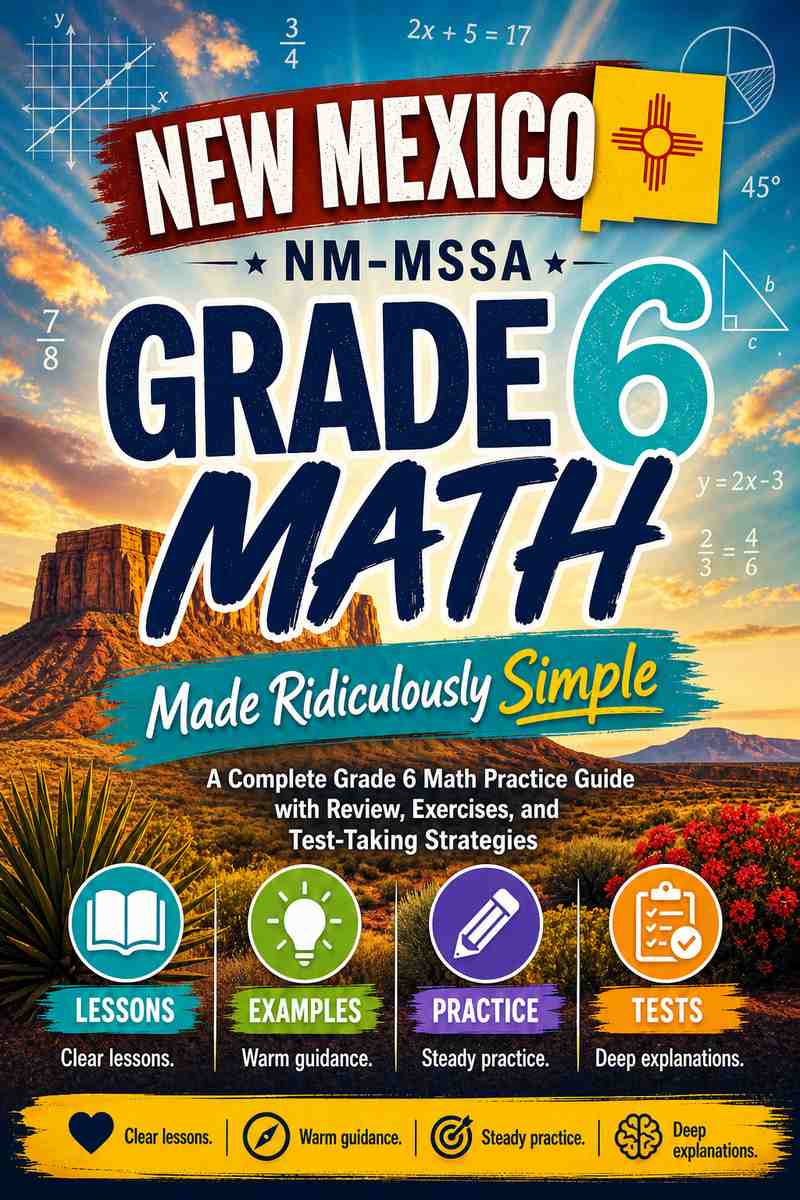
New Mexico NM-MSSA Grade 6 Math Made Ridiculously Simple
An independently published Grade 6 mathematics resource. Check its edition and contents against New Mexico’s adopted document and the school’s course before choosing preparation.
- Best starting point for the NM-MSSA math test
- Pairs with New Mexico flashcards and worksheets
- Use it before full timed practice tests
- Organized for students who need examples before drills
Step-by-step lessons
Short explanations show the move before the student practices it.
✍Worked examples
Check the listed book’s contents and edition against the learner’s course before choosing it.
Targeted practice
Rebuild one skill at a time instead of jumping around.
Test-day bridge
After each topic, connect to formulas, flashcards, and practice questions.
How to use it
- Read one lesson and copy the worked example.
- Do a short worksheet set on the same topic.
- Review the matching flashcards or formulas.
- Try a mixed quiz and mark every miss.
Pair it with free tools
Choose the right New Mexico Grade 6 math book
New Mexico NM-MSSA Grade 6 Math Made Ridiculously Simple
Choose a resource that fits the learner’s current Grade 6 mathematics work.
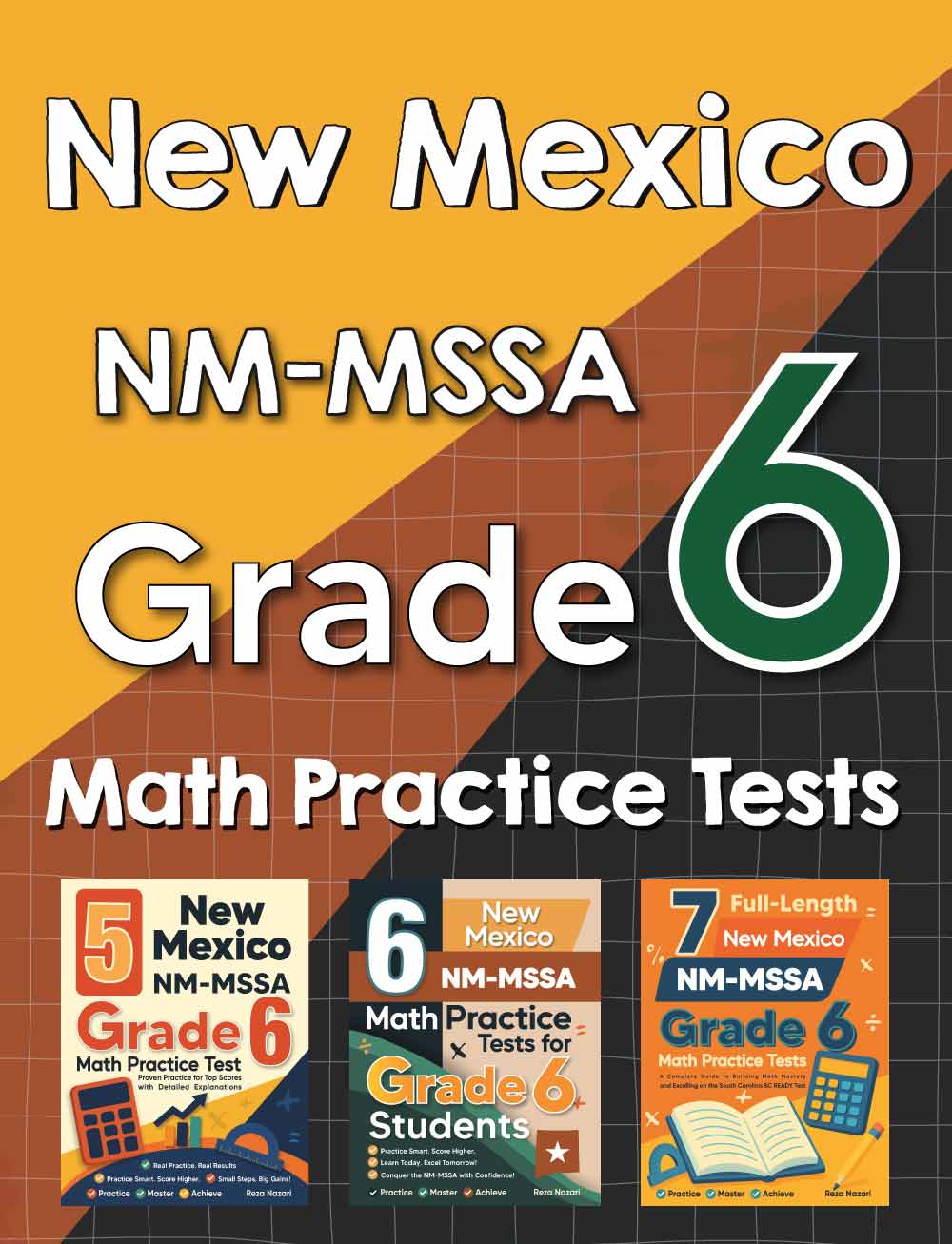
New Mexico NM-MSSA Grade 6 Math Preparation Bundle
The full prep library, study guide, workbook, and practice tests together.
7 New Mexico NM-MSSA Grade 6 Math Practice Tests
Use after topic review to build pacing and test stamina.
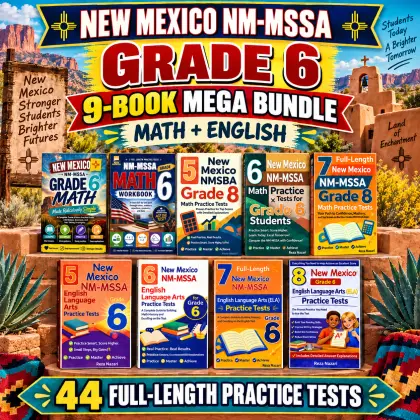
New Mexico NM-MSSA Grade 6 Math & ELA Mega Bundle
9 books and 44 full-length practice tests in one TPT bundle.
Read the complete mathematics requirements
The New Mexico standards directory links the Common Core mathematics document with grade-level requirements, examples, clarifications, and mathematical practices. Read these alongside the school’s learning sequence. This activity and the broader independent lesson library are not a certified full curriculum crosswalk.
New Mexico Grade 6 math: useful study questions
Why should two area methods give the same result?
They account for the same region. If they differ, check dimensions, omitted pieces, overlap, and units before assuming that one formula is wrong.
Which statewide mathematics assessment pathway applies to New Mexico Grade 6?
The current state NM-MSSA resource page describes statewide mathematics and ELA assessment at the end of Grades 3–8, including Grade 6. Scores are one measure and should be considered alongside classroom and other assessment evidence. Confirm the learner’s assigned pathway and school directions. The assessment directory is updating resources for 2026–2027; this guide does not claim Spring2027 administration specifications from a Spring2026 manual. Independently published practice may use its own timer, tools, question count, and scoring; these are not official administration specifications or a prediction of a state performance level.
Grade 6 Math in Other States
Explore Grade 6 math standards, practice tests, and worksheets for every state.
- Alabama
- Alaska
- Arizona
- Arkansas
- California
- Colorado
- Connecticut
- Delaware
- Florida
- Georgia
- Hawaii
- Idaho
- Illinois
- Indiana
- Iowa
- Kansas
- Kentucky
- Louisiana
- Maine
- Maryland
- Massachusetts
- Michigan
- Minnesota
- Mississippi
- Missouri
- Montana
- Nebraska
- Nevada
- New Hampshire
- New Jersey
- New York
- North Carolina
- North Dakota
- Ohio
- Oklahoma
- Oregon
- Pennsylvania
- Rhode Island
- South Carolina
- South Dakota
- Tennessee
- Texas
- Utah
- Vermont
- Virginia
- Washington
- West Virginia
- Wisconsin
- Wyoming
- District of Columbia
Plan Your Next Grade 6 Math Task
Choose a related practice resource, compare its feedback with classroom explanations, and follow the school’s current learning and assessment guidance.
Start a practice testA USEFUL NEXT STEP
New Mexico Grade 6 Math: study questions
Why should two area methods give the same result?
They account for the same region. If they differ, check dimensions, omitted pieces, overlap, and units before assuming that one formula is wrong.
Which statewide mathematics assessment pathway applies to New Mexico Grade 6?
The current state NM-MSSA resource page describes statewide mathematics and ELA assessment at the end of Grades 3–8, including Grade 6. Scores are one measure and should be considered alongside classroom and other assessment evidence. Confirm the learner’s assigned pathway and school directions. The assessment directory is updating resources for 2026–2027; this guide does not claim Spring2027 administration specifications from a Spring2026 manual. Independently published practice may use its own timer, tools, question count, and scoring; these are not official administration specifications or a prediction of a state performance level.
Official source ↗Resources from Effortless Math · Editorial standards