LEARN · PRACTICE · EXPLORE
North Carolina Grade 6 Math
Free North Carolina Grade 6 math practice: short lessons, skill quizzes and printable worksheets for every standard, plus full-length practice tests with step-by-step solutions.
Focused lessons · Useful practice · Clear next steps
What do North Carolina 6th graders learn in math?
In 6th grade, North Carolina math centers on ratios and rates, dividing fractions, negative numbers, expressions and one-step equations, area, and statistics. Students take the EOG grade 6 math test in the spring. This page explains each North Carolina grade 6 math standard and pairs it with short lessons, skill quizzes, printable worksheets and a full-length practice test.
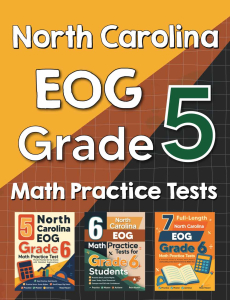
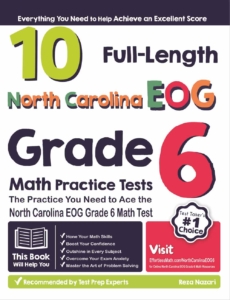
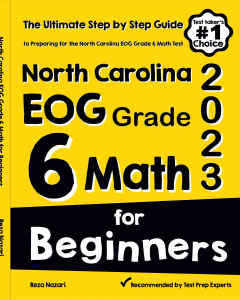
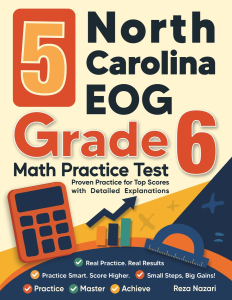
Printable North Carolina grade 6 math books:
North Carolina EOG Grade 6 Mathematics: Test Facts
North Carolina 6th graders take the End-of-Grade (EOG) test in mathematics during the last ten days of the school year. Results are reported in four achievement levels; Level 3 or higher is grade-level proficient, and Levels 4 and 5 are on track for college and career readiness.
| Test | North Carolina End-of-Grade, Grade 6 Mathematics |
|---|---|
| When | Last ten days of the school year |
| Format | Online (paper only for a documented accessibility need) |
| Time | Most students finish in about 120 minutes; up to 180 minutes allowed, in one school day |
Achievement levels
| Level | What it means |
|---|---|
| Level 5 | Comprehensive understanding; on track for college and career readiness |
| Level 4 | Thorough understanding; on track for college and career readiness |
| Level 3 | Sufficient understanding; grade-level proficient |
| Not Proficient | Inconsistent understanding |
Practice on this page: Practice testsSkill quizzesNorth Carolina standardsTopics and lessons
Facts from the North Carolina Department of Public Instruction, checked November 23, 2026: NCDPI: End-of-Grade Tests Assessment Brief (2025–26); NCDPI: 2024–25 Technical Guide for Accountability and Testing Results (achievement levels); NCDPI: End-of-Grade (EOG) tests.
Standards source: Standard Course of Study, North Carolina Department of Public Instruction.
Start With a EOG Practice Test
Six full, timed North Carolina EOG Grade 6 math practice tests, 40 questions each, instant scoring, a topic-by-topic breakdown, and full step-by-step solutions. Each one opens right here in a popup. Calculator: Calculator (on part).
EOG Practice Test 1
A full diagnostic across every North Carolina Grade 6 math topic.
Start Test 1 →
EOG Practice Test 2
Fresh questions and problem types to build accuracy.
Start Test 2 →
EOG Practice Test 3
New problems to add speed and confidence on every skill.
Start Test 3 →
EOG Practice Test 4
Another complete, timed exam to build pacing and stamina.
Start Test 4 →
EOG Practice Test 5
A brand-new mixed set to test your readiness.
Start Test 5 →
EOG Practice Test 6
A final full-length simulation to confirm you are ready.
Start Test 6 →
North Carolina Grade 6 Math Study Tools
A few minutes of quick review, flip through flashcards or scan every key formula. Both open right here.
North Carolina Grade 6 Math Skill Quizzes
Short, focused quizzes, pick one skill, answer 10 questions, get instant scoring and full solutions, then jump to the matching lesson. Each opens right here.
Ratios, Rates & Proportions
A quick 10-question check on Ratios, Rates & Proportions with instant scoring and step-by-step solutions.
Start Quiz →
Fractions & Decimals
A quick 10-question check on Fractions & Decimals with instant scoring and step-by-step solutions.
Start Quiz →
Integers & the Coordinate Plane
A quick 10-question check on Integers & the Coordinate Plane with instant scoring and step-by-step solutions.
Start Quiz →
Factors, Multiples & Percents
A quick 10-question check on Factors, Multiples & Percents with instant scoring and step-by-step solutions.
Start Quiz →
Expressions, Equations & Inequalities
A quick 10-question check on Expressions, Equations & Inequalities with instant scoring and step-by-step solutions.
Start Quiz →
Geometry: Area, Surface Area & Volume
A quick 10-question check on Geometry: Area, Surface Area & Volume with instant scoring and step-by-step solutions.
Start Quiz →
Statistics & Data
A quick 10-question check on Statistics & Data with instant scoring and step-by-step solutions.
Start Quiz →
Mixed Grade 6 Review
A quick 10-question check on Mixed Grade 6 Review with instant scoring and step-by-step solutions.
Start Quiz →
North Carolina EOG Grade 6 Math Snapshot
North Carolina Grade 6 Math Topics
Student-friendly Grade 6 math skills connected to the North Carolina standards, each tagged with its EOG standard code and a focused lesson.
Ratios And Proportional Relationships
- NC.6.RP.1Understanding RatiosWorksheetsQuiz
- NC.6.RP.1Writing Ratios in Different FormsWorksheetsQuiz
- NC.6.RP.2Equivalent RatiosWorksheetsQuiz
- NC.6.RP.2Ratio TablesWorksheetsQuiz
- NC.6.RP.2Unit RatesWorksheetsQuiz
- NC.6.RP.2Comparing Unit RatesWorksheetsQuiz
- NC.6.RP.3Solving Ratio ProblemsWorksheetsQuiz
- NC.6.RP.2Proportions and Cross MultiplicationWorksheetsQuiz
The Number System, Fractions
- NC.6.RP.3Simplifying FractionsWorksheetsQuiz
- NC.6.NS.3Adding Fractions with Unlike DenominatorsWorksheetsQuiz
- NC.6.NS.3Subtracting Fractions with Unlike DenominatorsWorksheetsQuiz
- NC.6.NS.3Adding and Subtracting Mixed NumbersWorksheetsQuiz
- NC.6.RP.3Multiplying FractionsWorksheetsQuiz
- NC.6.EE.7Multiplying Mixed NumbersWorksheetsQuiz
- NC.6.RP.3Dividing FractionsWorksheetsQuiz
- NC.6.EE.7Dividing Mixed NumbersWorksheetsQuiz
The Number System, Decimals
- NC.6.NS.3Decimal Place ValueWorksheetsQuiz
- NC.6.NS.7Comparing and Ordering DecimalsWorksheetsQuiz
- NC.6.NS.3Adding and Subtracting DecimalsWorksheetsQuiz
- NC.6.NS.3Multiplying DecimalsWorksheetsQuiz
- NC.6.NS.3Dividing Decimals by Whole NumbersWorksheetsQuiz
- NC.6.NS.3Dividing Decimals by DecimalsWorksheetsQuiz
- NC.6.NS.3Converting Fractions to DecimalsWorksheetsQuiz
- NC.6.NS.3Converting Decimals to Fractions (resource currently unavailable)WorksheetsQuiz
The Number System, Integers And The Coordinate Plane
- NC.6.EE.7Understanding Positive and Negative NumbersWorksheetsQuiz
- NC.6.NS.6Integers on a Number LineWorksheetsQuiz
- NC.6.NS.8Opposites and Absolute ValueWorksheetsQuiz
- NC.6.NS.7Comparing and Ordering IntegersWorksheetsQuiz
- NC.6.NS.8Graphing on the Coordinate PlaneWorksheetsQuiz
- NC.6.NS.8Reflecting Points on the Coordinate PlaneWorksheetsQuiz
The Number System, Factors And Multiples
Ratios And Percents
- NC.6.RP.4Understanding PercentsWorksheetsQuiz
- NC.6.RP.4Fractions, Decimals, and PercentsWorksheetsQuiz
- NC.6.RP.2Finding the Percent of a NumberWorksheetsQuiz
- NC.6.RP.3Finding the Whole Given a PercentWorksheetsQuiz
- NC.6.RP.1Percent Increase and DecreaseWorksheetsQuiz
- NC.6.RP.1Discounts, Tax, and TipsWorksheetsQuiz
Expressions And Equations
- NC.6.EE.6Writing Algebraic ExpressionsWorksheetsQuiz
- NC.6.EE.1Evaluating Algebraic ExpressionsWorksheetsQuiz
- NC.6.EE.3Order of OperationsWorksheetsQuiz
- NC.6.EE.3The Distributive PropertyWorksheetsQuiz
- NC.6.EE.3Combining Like TermsWorksheetsQuiz
- NC.6.EE.7Writing Equations from Word ProblemsWorksheetsQuiz
- NC.6.EE.7Solving One-Step Addition and Subtraction EquationsWorksheetsQuiz
- NC.6.EE.7Solving One-Step Multiplication and Division EquationsWorksheetsQuiz
- NC.6.EE.1Writing and Graphing InequalitiesWorksheetsQuiz
- NC.6.EE.7Solving One-Step InequalitiesWorksheetsQuiz
Geometry, Area
Geometry, 3D Figures, Surface Area, And Volume
- NC.6.G.4Nets of 3D FiguresWorksheetsQuiz
- NC.6.G.4Surface Area of Rectangular PrismsWorksheetsQuiz
- NC.6.G.4Surface Area of Triangular PrismsWorksheetsQuiz
- NC.6.G.4Surface Area of PyramidsWorksheetsQuiz
- NC.6.G.2Volume of Rectangular PrismsWorksheetsQuiz
- NC.6.G.2Volume with Fractional Edge LengthsWorksheetsQuiz
Statistics
- NC.6.SP.1Statistical QuestionsWorksheetsQuiz
- NC.6.SP.3MeanWorksheetsQuiz
- NC.6.SP.3Median and ModeWorksheetsQuiz
- NC.6.SP.1RangeWorksheetsQuiz
- NC.6.SP.1Mean Absolute DeviationWorksheetsQuiz
- NC.6.SP.4Dot PlotsWorksheetsQuiz
- NC.6.SP.4HistogramsWorksheetsQuiz
- NC.6.SP.4Box PlotsWorksheetsQuiz
- NC.6.SP.2Summarizing and Describing DistributionsWorksheetsQuiz
Best North Carolina EOG Grade 6 Math Books
Each book has a job: start from scratch, drill weak skills, or build pacing with full tests. All of them pair with the free tools on this page.
North Carolina EOG Grade 6 Math Made Ridiculously Simple
A step-by-step EOG Grade 6 math book that rebuilds every tested skill clearly and in order, built to match the North Carolina standards.
- Best starting point for the EOG math test
- Pairs with North Carolina flashcards and worksheets
- Use it before full timed practice tests
- Organized for students who need examples before drills
Step-by-step lessons
Short explanations show the move before the student practices it.
✍Worked examples
Examples translate EOG-style wording into clear math steps.
Targeted practice
Rebuild one skill at a time instead of jumping around.
Test-day bridge
After each topic, connect to formulas, flashcards, and practice questions.
How to use it
- Read one lesson and copy the worked example.
- Do a short worksheet set on the same topic.
- Review the matching flashcards or formulas.
- Try a mixed quiz and mark every miss.
Pair it with free tools
Choose the right North Carolina Grade 6 math book
North Carolina EOG Grade 6 Math Made Ridiculously Simple
Start here to rebuild EOG math from the ground up.
North Carolina EOG Grade 6 Math Preparation Bundle
The full prep library, study guide, workbook, and practice tests together.
10 Full-Length North Carolina EOG Grade 6 Math Practice Tests: The Practice You Need to Ace the North Carolina EOG Grade 6 Math Test
Use after topic review to build pacing and test stamina.
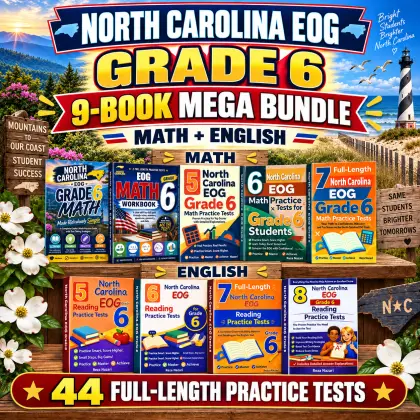
North Carolina EOG Grade 6 Math & ELA Mega Bundle
9 books and 44 full-length practice tests in one TPT bundle.
North Carolina Grade 6 Math Standards
The official North Carolina Grade 6 math standards, grouped by domain with the exact code and description for each expectation.
NC.6
- NC.6.RP.1Understand the concept of a ratio and use ratio language to:
- NC.6.RP.2Understand that ratios can be expressed as equivalent unit ratios by finding and interpreting both unit ratios in context
- NC.6.RP.3Use ratio reasoning with equivalent whole-number ratios to solve real-world and mathematical problems by:
- NC.6.RP.4Use ratio reasoning to solve real-world and mathematical problems with percents by:
- NC.6.NS.1Use visual models and common denominators to:
- NC.6.NS.2Fluently divide using long division with a minimum of a four-digit dividend and interpret the quotient and remainder in context
- NC.6.NS.3Apply and extend previous understandings of decimals to develop and fluently use the standard algorithms for addition, subtraction, multiplication and division of decimals
- NC.6.NS.4Understand and use prime factorization and the relationships between factors to:
- NC.6.NS.5Understand and use rational numbers to:
- NC.6.NS.6Understand rational numbers as points on the number line and as ordered pairs on a coordinate plane
- NC.6.NS.7Understand ordering of rational numbers
- NC.6.NS.8Solve real-world and mathematical problems by graphing points in all four quadrants of the coordinate plane. Include use of coordinates and absolute value to find distances between points with the same first coordinate or the same second coordinate
- NC.6.NS.9Apply and extend previous understandings of addition and subtraction
- NC.6.EE.1Write and evaluate numerical expressions, with and without grouping symbols, involving whole-number exponents
- NC.6.EE.2Write, read, and evaluate algebraic expressions
- NC.6.EE.3Apply the properties of operations to generate equivalent expressions without exponents
- NC.6.EE.4Identify when two expressions are equivalent and justify with mathematical reasoning
- NC.6.EE.5Use substitution to determine whether a given number in a specified set makes an equation true
- NC.6.EE.6Use variables to represent numbers and write expressions when solving a real-world or mathematical problem
- NC.6.EE.7Solve real-world and mathematical problems by writing and solving equations of the form: x+p = q in which p, q and x are all nonnegative rational numbers; and px = q for cases in which p, q and x are all nonnegative rational numbers
- NC.6.EE.8Reason about inequalities by:
- NC.6.EE.9Represent and analyze quantitative relationships by:
- NC.6.G.1Create geometric models to solve real-world and mathematical problems to:
- NC.6.G.2Apply and extend previous understandings of the volume of a right rectangular prism to find the volume of right rectangular prisms with fractional edge lengths. Apply this understanding to the context of solving real-world and mathematical problems
- NC.6.G.3Use the coordinate plane to solve real-world and mathematical problems by:
- NC.6.G.4Represent right prisms and right pyramids using nets made up of rectangles and triangles, and use the nets to find the surface area of these figures. Apply these techniques in the context of solving real-world and mathematical problems
- NC.6.SP.1Recognize a statistical question as one that anticipates variability in the data related to the question and accounts for it in the answers
- NC.6.SP.2Understand that a set of data collected to answer a statistical question has a distribution which can be described by its center, spread, and overall shape
- NC.6.SP.3Understand that both a measure of center and a description of variability should be considered when describing a numerical data set
- NC.6.SP.4Display numerical data in plots on a number line
- NC.6.SP.5Summarize numerical data sets in relation to their context
Standards: North Carolina Standard Course of Study. Official source ↗
North Carolina EOG Grade 6 Math FAQ
What is the EOG Grade 6 math test?
The EOG (End-of-Grade Tests) is North Carolina's Grade 6 mathematics assessment. The linked activities are independent Grade 6 practice. Their question count, timer, scoring, and item types may differ from the official assessment. Use the directions inside each activity.
Can I use a calculator?
Calculator rules depend on the grade, assessment, test segment, and approved accommodations. Follow the current assessment guidance and ask your school which rules apply. A tool available in independent practice does not establish permission on the official test.
How long is each practice test?
Read the timer and question count shown in the practice activity you open. These are practice settings, not a statement of the official assessment’s duration or scoring.
Is it free?
The linked general practice and topic resources are available separately from optional books. Check each activity’s directions and access requirements. The study guide and bundle are optional next steps.
Grade 6 Math in Other States
Explore Grade 6 math standards, practice tests, and worksheets for every state.
- Alabama
- Alaska
- Arizona
- Arkansas
- California
- Colorado
- Connecticut
- Delaware
- Florida
- Georgia
- Hawaii
- Idaho
- Illinois
- Indiana
- Iowa
- Kansas
- Kentucky
- Louisiana
- Maine
- Maryland
- Massachusetts
- Michigan
- Minnesota
- Mississippi
- Missouri
- Montana
- Nebraska
- Nevada
- New Hampshire
- New Jersey
- New Mexico
- New York
- North Dakota
- Ohio
- Oklahoma
- Oregon
- Pennsylvania
- Rhode Island
- South Carolina
- South Dakota
- Tennessee
- Texas
- Utah
- Vermont
- Virginia
- Washington
- West Virginia
- Wisconsin
- Wyoming
- District of Columbia
Make This Your North Carolina EOG Starting Point
Take a timed practice test, find your weakest topic, and study it with the linked lessons, worksheets, and the EOG study guide.
Start a practice testNorth Carolina Grade 6 Math: 10-Question Challenge
Ten fresh questions on the skills North Carolina 6th graders work on most. Pick an answer, check it, and read the explanation either way.
Subtract 3 from both sides: 4x = 16. Divide both sides by 4: x = 4.
Area of a triangle = ½ × base × height = ½ × 10 × 10 = 50 square centimeters.
Put the numbers in order: 8, 24, 25, 26, 27. The middle number is 25.
Subtract 2 from both sides: x > 11. Only 12 is greater than 11.
Choose another state
Grade 6 Math in Every State
Select a state on the map to open its Grade 6 Math page. You are viewing North Carolina.
All states A–Z
A USEFUL NEXT STEP
North Carolina Grade 6 Math: study questions
How should I choose a Grade 6 math study target?
Choose a current classroom target, find the matching learning reference, and use a lesson or available practice resource to check understanding. State documents control local wording and placement; shared reference codes are not a certified crosswalk.
Official source ↗Are these activities official state assessments?
These are independently published learning resources. A practice score does not predict or replace an official state score. Use the directions in each activity and consult your school for official testing and accommodation rules.
Resources from Effortless Math · Editorial standards