 NEW JERSEYTHE GARDEN STATE
New Jersey High School Geometry Online Center
Five free full-length Geometry practice tests for New Jersey students, plus flashcards, a quick review and a formula sheet. Use them alongside your course as you prepare for the NJSLA Geometry.
New Jersey Geometry: 10-Question Challenge
Ten questions that check the ideas New Jersey Geometry students need to know cold. Try each one on paper first, then check yourself.
The scale factor is DE ÷ AB = 18 ÷ 6 = 3. So EF = 6 × 3 = 18.
In a 45°-45°-90° triangle, the hypotenuse is the leg times \(\sqrt{2}\): \(10\sqrt{2}\).
An inscribed angle is half of its intercepted arc: 80 ÷ 2 = 40°.
Sector area = \(\frac{\theta}{360}\pi r^2\): \(\frac{90}{360}\cdot\pi\cdot 9^2=\frac{81}{4}\pi\).
Volume of a cone = \(\frac{1}{3}\pi r^2h\): \(\frac{1}{3}\pi(4)^2(12)=64\pi\).
Sine is opposite over hypotenuse: \(\sin A=\frac{3}{5}\).
Average the coordinates: \(\left(\frac{2+10}{2},\frac{-3-1}{2}\right)\) = (6, −2).
Corresponding angles formed by parallel lines are congruent, so the angle also measures 110°.
Jump into New Jersey Geometry
New Jersey Geometry Practice Tests
New Jersey gives a state Geometry test, the NJSLA-Adaptive Geometry. These practice tests are not copies of that exam. They are full-length Geometry tests from the Effortless Math Geometry books, built on the same high-school course content, so you can check what you know and find your gaps before test day.
Each test has 40 multiple-choice questions with diagrams, an optional 80-minute timer you can switch off, and a worked explanation for every question. Your score report breaks results down by topic, so you know what to review next. Tests open right here on the page.
New Jersey Geometry Study Tools
Three free tools that open right here on the page. Use them between practice tests to close the gaps your score report shows.
Geometry Flashcards
96 cards across all ten topics: the definitions, postulates, theorems and formulas a Geometry course expects you to know on sight. Flip, shuffle, filter by topic and mark the ones you know.
Geometry Quick Review
40 review cards, each with the big idea, the must-know facts, an easy-to-confuse pair and a common trap. Built for the week before a test.
Geometry Formula Sheet
49 formulas and rules grouped by topic, from slope and distance to the Law of Cosines and the volume of a cone. Print it or save it as a PDF.
The NJSLA Geometry may come with its own reference sheet. Check which formulas it gives you and which you need to know by heart.
Join students who study with a clearer path
This online center is part of the Effortless Math library for high-school geometry. We connect lessons, worksheets, practice tests, books, and tools so students can study with a clearer next step.

Effortless Math is an independent educational publisher. Test names, state exams, standards names, and trademarks are used only to identify the relevant study topic; their owners do not sponsor, endorse, or approve this page.
New Jersey Geometry Topics
These ten units are the shape of a full high-school Geometry course. The New Jersey Student Learning Standards for Mathematics cover this ground, though your teacher may take the units in a different order or use different names.
Geometric Tools and Concepts
- Points, Lines, and Planes
- Line Segments and Measurements
- Midpoint and Distance
- Parallel Lines and Transversals
- Perpendicular Lines
- Lines, Rays, and Angles
- Types of Angles
- Complementary and Supplementary Angles
- Bisecting an Angle
- Constructing a Triangle Given Its Sides
- The Circumscribed Circle
- The Inscribed Circle of a Triangle
- Inscribing Regular Polygons
Reasoning and Proofs
- Conjectures and Counterexamples
- Inductive Reasoning from Patterns
- Conditional Statements
- Logic and Truth Tables
- Converse, Inverse, and Contrapositive
- Biconditionals and Definitions
- Deductive Reasoning
- Properties of Equality and Congruence
- Two-Column Proofs
- Proving Angles Congruent
Coordinate Geometry
- Finding Slope
- Writing Linear Equations
- Finding Midpoint
- Finding Distance of Two Points
- Finding a Graph's Slope
- Graphing Lines Using Slope-Intercept Form
- Writing Linear Equations from Graphs
- Converting Between Standard and Slope-Intercept Forms
- Slope-intercept Form and Point-slope Form
- Write a Point-slope Form Equation from a Graph
- Writing Linear Equations From y-Intercept and a Slope
- Comparison of Linear Functions: Equations and Graphs
- Equations of Horizontal and Vertical Lines
- Graph of a Horizontal or Vertical Line
- Equation of Parallel and Perpendicular Lines
Transformations, Rigid Motions, and Congruence
- Transformations on the Coordinate Plane
- Translations on the Coordinate Plane
- Reflections on the Coordinate Plane
- Rotations on the Coordinate Plane
- Dilation on the Coordinate Plane
- Dilations: Scale Factor and Center
- Dilations: Finding a Coordinate
- Congruence and Rigid Motions
- Symmetries of a Figure
Quadrilaterals and Polygons
- Classifying Polygons
- Angles in Quadrilaterals
- Properties of Trapezoids
- Properties of Parallelograms
- Properties of Rectangles
- Properties of the Rhombus
- Properties of Squares
- Areas of Triangles and Quadrilaterals
- Perimeter of Polygons
- Polygons and Angles
Triangles
- Triangles
- Classifying Triangles
- Triangle Angle Sum
- Triangle Midsegment
- Angle Bisectors of Triangles
- Isosceles and Equilateral Triangles
- Right Triangles and the Pythagorean Theorem
- Special Right Triangles
- Pythagorean Theorem Converse: Is This a Right Triangle?
- Geometric Mean in Triangles
- Exterior Angle Theorem
- Medians
- Centroid
- The Triangle Inequality Theorem
- SSS and SAS Congruence
- ASA and AAS Congruence
- Hypotenuse-Leg Congruences
Dilation and Similarity
- Dilations
- Dilations and Angles
- Similarity
- Similarity Criteria
- Congruent and Similar Figures
- Area and Perimeter: Scale Changes
- The Side Splitter Theorem
- Similarity Transformations
- Partitioning a Line Segment
- Similar Polygons
- Right Triangles and Similarity
- Similar Solids
Trigonometry
- Pythagorean Identities
- Special Right Triangles
- Trigonometric Ratios
- Trigonometric Ratios for General Angles
- Trigonometry and the Calculator
- Inverse Trigonometric Ratios
- Solving Right Triangles
- Trigonometry and Area of Triangles
- Law of Sines
- Law of Cosines
- Trigonometric Applications
Circle Geometry
- The Unit Circle
- Arc Length and Sector Area
- Arcs and Central Angles
- Arcs and Chords
- Inscribed Angles
- Tangents to Circles
- Secant Angles
- Secant-tangent and Tangent-tangent Angles
- Segment Lengths in Circles
- Segment Measures
- Standard Form of a Circle
- Finding the Center and the Radius of Circles
- Radian Angle Measure
Surface Area and Volume
- Circumference and Area of a Circle
- Area of a Trapezoid
- Area of Polygons
- Nets of 3-D Figures
- Cubes
- Rectangular Prisms
- Cylinder
- Surface Area of Prisms and Cylinders
- Volume of Cones and Pyramids
- Surface Area of Pyramids and Cones
- Volume of Spheres
- Sphere Surface Area
- Solids and Their Cross-Sections
- Volume of a Truncated Cone
New Jersey Geometry Standards and Assessment
New Jersey tests Geometry with the NJSLA-Adaptive Geometry. Here is what we found in the state’s own published materials.
| Standards | New Jersey Student Learning Standards for Mathematics |
|---|---|
| Course name | Geometry |
| State Geometry test | NJSLA-Adaptive Geometry |
| Format | Computer-adaptive (NJSLA-Adaptive); NJDOE posts mathematics blueprints |
What this means for you
Your course follows the New Jersey Student Learning Standards for Mathematics, and the NJSLA Geometry measures them. Our practice tests are a study aid, not a copy of the exam. For the current blueprint, testing window, accommodations and graduation rules, use the state links below and ask your school counselor.
New Jersey Geometry FAQ
Does New Jersey have a state Geometry test?
Yes. New Jersey gives the NJSLA-Adaptive Geometry. Check with your school for your testing window and the rules that apply to you. Our practice tests cover the same course content but are not the state exam.
What is on these practice tests?
Each test has 40 multiple-choice questions drawn from a full high-school Geometry course: lines, angles and constructions, logic and proof, coordinate geometry, transformations, polygons, triangles and congruence, similarity, right-triangle trigonometry, circles, and surface area and volume. Many questions come with a diagram, and every question has a worked explanation.
How long does a test take?
About 80 minutes if you use the optional timer, which is our suggested pace rather than a state time limit. The first time, try it untimed. You learn more from working a problem all the way through than from racing the clock.
Are the five tests different from each other?
Yes. Each test is its own set of 40 questions. Test 4 repeats a few questions from Test 1, and some tests reuse a question type with new numbers, which is useful practice in its own right.
Do I need an account?
No. The tests, flashcards, quick review and formula sheet are free and open, with no login and nothing to install. They open in a window on this page, and your score and explanations appear as soon as you submit.
Is my score here the same as a NJSLA Geometry score?
No. Your score here is a practice raw score from our own questions. It tells you which topics need work, but it is not a NJSLA Geometry score, a scaled score or a course grade.
Geometry in Other States
Explore Geometry standards, practice tests and study tools for every state.
- Alabama
- Alaska
- Arizona
- Arkansas
- California
- Colorado
- Connecticut
- Delaware
- District of Columbia
- Florida
- Georgia
- Hawaii
- Idaho
- Illinois
- Indiana
- Iowa
- Kansas
- Kentucky
- Louisiana
- Maine
- Maryland
- Massachusetts
- Michigan
- Minnesota
- Mississippi
- Missouri
- Montana
- Nebraska
- Nevada
- New Hampshire
- New Jersey
- New Mexico
- New York
- North Carolina
- North Dakota
- Ohio
- Oklahoma
- Oregon
- Pennsylvania
- Rhode Island
- South Carolina
- South Dakota
- Tennessee
- Texas
- Utah
- Vermont
- Virginia
- Washington
- West Virginia
- Wisconsin
- Wyoming
Make This Your New Jersey Geometry Starting Point
Take a practice test, find the topic that pulled your score down, and study it with the flashcards and quick review. Then take the next test and see the difference.
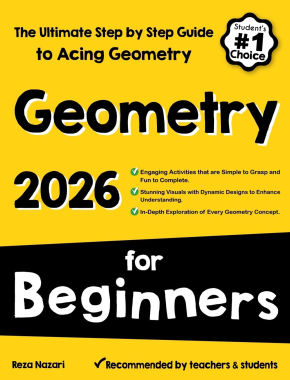
Want every lesson in one place? Geometry for Beginners walks through the whole course step by step, with worked examples, practice for each skill and full-length practice tests with answer explanations.
Start a practice test See Geometry for Beginners
Geometry usually sits between New Jersey Algebra 1 and New Jersey Algebra 2.
Choose another state
Geometry in Every State
Select a state on the map to open its Geometry page. You are viewing New Jersey.