Michigan M-STEP Grade 6 Math: Free Worksheets and Practice Topics
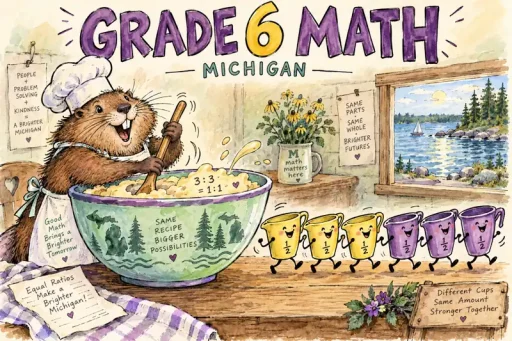
Somewhere in the first couple of months of sixth grade, a Michigan student notices that math is asking for something it never asked for before. The problems are not just longer. They are about relationships now. A ratio ties two quantities together. A rate turns one quantity into another. An expression holds a calculation in suspense, with a letter where a number used to be. That is the real story of sixth-grade math: it shifts from doing operations to reasoning with structure.
The whole year leans that way. Percents arrive alongside ratios and unit rates. Dividing a fraction by a fraction becomes a genuine skill with its own logic. Negative numbers stop being an abstraction and become specific points on a number line, and the coordinate plane stretches into all four quadrants. One-step equations and simple inequalities ask students to work with the unknown, and area, volume, and surface area call for spatial reasoning, not memorized formulas. A capable kid in Detroit or Grand Rapids can manage every piece of it, given practice that is patient and well-ordered.
These worksheets are built to be exactly that. One skill per page, explained in plain words, with enough problems to turn unfamiliar into routine, useful in a classroom in Warren, at a kitchen table in Ann Arbor, or anywhere the work gets done.
Choose your Grade 6 math practice
Use the topic links below to find the skill you want to practice. The collection includes core Grade 6 topics, prerequisite review and extensions; the bracketed codes are topic references rather than a certification that every linked resource belongs on the Grade 6 assessment.
Each PDF starts with a one-page Quick Review, the skill stated plainly, with a worked example carried straight through. Then twenty practice problems build from easy to genuinely challenging, and four word problems set the skill into a situation a sixth grader can actually picture. The last page is a student-facing answer key, written as short, friendly explanations rather than a bare list, so a kid can grade their own work and learn from the parts they got wrong.
Plan your review: use ratios, fraction division, expressions, equations, geometry and statistical thinking as your Grade 6 starting points. This collection also includes prerequisite review and extension topics. Scale drawings, circle area, probability and full integer operations extend into Grade 7; their existing labels should not be treated as an official M-STEP checklist. Choose those when assigned or for enrichment.
Ratios, Rates, and Percents
- What Is a Ratio?, [6.RP.1] compare two quantities and write the comparison three ways
- Using Ratio Language, [6.RP.1] describe a ratio in words, ‘for every,’ ‘to,’ and ‘per’
- What Is a Rate?, [6.RP.2] a ratio that compares two different units, like miles per hour
- Finding the Unit Rate, [6.RP.2] divide to find the cost or amount for exactly one
- Tables of Equivalent Ratios, [6.RP.3] build a ratio table and fill in the missing values
- Graphing Ratios, [6.RP.3] plot a ratio table and see the straight line it makes
- What Is a Percent?, [6.RP.3] a percent is just a ratio out of 100, and how to read it
- Solving Percent Problems, [6.RP.3] find the part, the percent, or the whole
- Solving Rate and Ratio Word Problems, [6.RP.3] turn a real-world story into a ratio you can solve
- Converting Measurement Units, [6.RP.3] use ratios to switch between units like feet and inches
- Personal Financial Literacy, [6.RP.3] real-money math: prices, tips, and simple percent work
- Proportional vs. Non-Proportional Relationships, [6.RP.2] tell which relationships keep a constant ratio and which don’t
- Financial Literacy: Budgeting and Saving, [6.RP.3] plan a budget, track spending, and set a savings goal
- Ratios with Scale Drawings, [6.RP.3] use a scale to move between a drawing and real life
The Number System
- Dividing Fractions by Fractions, [6.NS.1] multiply by the reciprocal, and understand why it works
- Multi-Digit Division, [6.NS.2] the standard algorithm for dividing large whole numbers
- Decimal Operations, [6.NS.3] add, subtract, multiply, and divide decimals cleanly
- Greatest Common Factor and Least Common Multiple, [6.NS.4] find the GCF and LCM and know when to use each
- The Distributive Property with Common Factors, [6.NS.4] rewrite a sum by pulling out the greatest common factor
- Understanding Positive and Negative Numbers, [6.NS.5] what negative numbers mean in temperature, money, and elevation
- Opposites and Absolute Value, [6.NS.7] opposites flip the sign; absolute value is distance from zero
- Rational Numbers on the Number Line, [6.NS.6] place fractions, decimals, and negatives exactly where they go
- The Coordinate Plane, [6.NS.6] plot points in all four quadrants using ordered pairs
- Comparing and Ordering Rational Numbers, [6.NS.7] use the number line to order positives, negatives, and fractions
- Distance on the Coordinate Plane, [6.NS.8] find the distance between two points that share a line
- Integer Addition and Subtraction, [6.NS.5] add and subtract positives and negatives with confidence
- Integer Multiplication and Division, [6.NS.5] the sign rules for multiplying and dividing integers
- Compute with Integers in Context, [6.NS.5] real situations where negative numbers do the work
Expressions and Equations
- Exponents and Order of Operations, [6.EE.1] evaluate powers and run PEMDAS in the right order
- Translating Words into Expressions, [6.EE.2] turn a phrase into an algebraic expression
- Terms, Factors, and Coefficients, [6.EE.2] name the parts of an expression so you can talk about them
- Evaluating Expressions, [6.EE.2] substitute a value for the variable and compute
- Equivalent Expressions, [6.EE.3] use properties to show two expressions are the same
- Variables in Real-World Problems, [6.EE.6] let a letter stand for an unknown and model a situation
- Solving One-Step Equations, [6.EE.7] undo one operation to isolate the variable
- Writing Inequalities, [6.EE.8] translate ‘at least,’ ‘no more than,’ and ‘fewer than’ into symbols
- Graphing Inequalities on a Number Line, [6.EE.8] open or closed circle, then shade the right direction
- Two Quantities That Change Together, [6.EE.9] independent and dependent variables, tables, and graphs
Geometry
- Area of Triangles, [6.G.1] one-half base times height, for every kind of triangle
- Area of Parallelograms and Trapezoids, [6.G.1] the area formulas for two more four-sided shapes
- Volume of Rectangular Prisms, [6.G.2] volume with fractional edge lengths, using unit cubes
- Polygons on the Coordinate Plane, [6.G.3] draw a polygon from coordinates and find its side lengths
- Finding Area on the Coordinate Plane, [6.G.3] use coordinates to find the area of a plotted figure
- Nets and Surface Area, [6.G.4] unfold a solid into a net and add up every face
- Transformations on the Coordinate Plane, [6.G.3] slide and reflect figures and track the new coordinates
- Area of Circles Introduction, [6.G.1] a first look at radius, diameter, and the area of a circle
Statistics and Probability
- Statistical Questions, [6.SP.1] tell a question that has variability from one that does not
- Describing Data: Center, Spread, and Shape, [6.SP.2] the three things every data set has, and how to name them
- Mean and Median, [6.SP.3] two measures of center and when each one tells the truth
- Measures of Spread, [6.SP.3] range and mean absolute deviation, how spread out the data is
- Dot Plots and Histograms, [6.SP.4] two ways to picture how often each value shows up
- Box Plots, [6.SP.4] the five-number summary and the box it builds
- Summarizing Data and Making Comparisons, [6.SP.5] describe a data set in a sentence and compare two of them
- Introduction to Probability, [6.SP.5] how likely is it, from impossible to certain, as a number
- Stem-and-Leaf Plots, [6.SP.4] organize a data set while keeping every original value
- Circle Graphs, [6.SP.4] read a pie chart and connect each slice to a percent
- Data Displays Extended, [6.SP.4] choose the right graph and read it carefully
Number and Operations Practice
- Writing Ratios in Different Forms, [6.RP.1] the same ratio as a fraction, with a colon, and in words
- Equivalent Ratios, [6.RP.3] scale a ratio up or down and keep it the same
- Comparing Unit Rates, [6.RP.2] find the better buy by comparing rates for one
- Proportions and Cross Multiplication, [6.RP.3] set two ratios equal and solve for the missing value
- Simplifying Fractions, [6.NS.4] divide out the common factor to write a fraction lowest-terms
- Adding Fractions with Unlike Denominators, [6.NS.4] find a common denominator, then add
- Subtracting Fractions with Unlike Denominators, [6.NS.4] find a common denominator, then subtract
- Adding and Subtracting Mixed Numbers, [6.NS.4] work with the whole and fraction parts, including regrouping
- Multiplying Fractions, [6.NS.1] multiply across, and simplify before or after
- Multiplying Mixed Numbers, [6.NS.1] rename as improper fractions, then multiply
- Dividing Fractions, [6.NS.1] keep, change, flip, divide by multiplying the reciprocal
- Dividing Mixed Numbers, [6.NS.1] rename as improper fractions, then divide
- Decimal Place Value, [6.NS.3] name each digit’s value, from tenths to thousandths
- Comparing and Ordering Decimals, [6.NS.7] line up the place values and order decimals correctly
- Area of Rectangles and Squares, [6.G.1] length times width, including fractional and decimal sides
How to use these worksheets at home
You do not need a complicated routine. You need a dependable one. Two afternoons a week, one PDF each, around fifteen minutes a sitting. That steady pace does more across a semester than any all-at-once effort, and short sessions are the kind a sixth grader will actually agree to.
Sequencing is the quiet trick. Pair a foundation skill with the one that grows from it: “Writing and Evaluating Expressions” before “Solving One-Step Equations,” or “Understanding Integers” before “Plotting Points in Four Quadrants.” When you run them on consecutive days, the second worksheet reads as the next step in one idea rather than a brand-new topic, and the student gets to feel their own progress, which is what keeps them going.
Then put the answer key to work. Across Michigan, the Detroit and Grand Rapids districts, the schools in Warren, the smaller systems up north, the families who get the most from these are the ones who let the student grade their own work and read the explanation on each miss. That short habit at the end of a session is where a wrong answer turns into a real skill.
A note about M-STEP at Grade 6
Michigan students take the Michigan Student Test of Educational Progress (M-STEP) Mathematics assessment in the spring. It is built on the Michigan Mathematics Standards, so the skills these worksheets practice and the skills M-STEP measures come from the same place, what you work on at home lines up with what the test expects.
At Grade 6, M-STEP asks for reasoning, not just answers. Students interpret ratio and percent situations, work with expressions and equations, reason about area and volume, and read statistical displays closely enough to draw a sound conclusion. Use classroom feedback to choose two or three skills to review, rather than assuming every topic listed here appears on the test.
Check official practice and grade expectations
The Grade 6 standards overview provides a planning reference for ratios, fraction division, rational numbers, expressions and statistical thinking. The Grade 7 overview identifies later work such as scale drawings, circle area, probability and operations with rational numbers.
For the test interface, follow the Michigan Department of Education online practice directions. Use Chrome, choose M-STEP, Online Tools Training, Sample Item Sets, Grade 6 and mathematics, and enter the login shown on screen. Paper review and official interface practice serve different purposes; neither guarantees a test result.
A short closing
Sixth-grade math is a climb, but it is the kind a kid takes one step at a time, one skill, one short afternoon, one checked page. Bookmark this page, print a single PDF tonight, and let your student start somewhere small. Michigan kids do hard things well when the next step is clear, and a worksheet on the table makes that step about as clear as it gets.
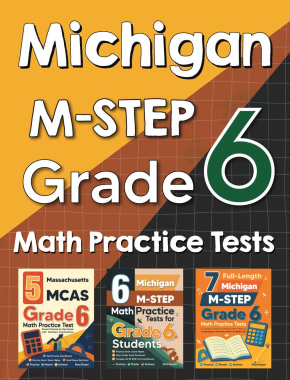
Best Bundle to Ace the Michigan M-STEP Grade 6 Math Test
Want the fastest path through Michigan M-STEP Grade 6 math? This bundle pulls it together, four full practice-test books with complete, step-by-step answer keys, instant PDF download.

Related to This Article
More math articles
- Function Grapher — Plot y = f(x) Online (Free)
- Division of Labor, Alienation, Labor Markets, and Professions
- Question order
- How to Multiply Binomials? (+FREE Worksheet!)
- Senate majority leader
- Free Grade 5 English Worksheets for Florida Students
- How to Understand Dot Product and Cross-Product
- Informal Work and Development Beyond Economic Growth
- Multiplying 3-Digit by 1-Digit Numbers for 4th Grade
- Advanced Vocabulary Words: Precocious to Redoubt







What people say about "Michigan M-STEP Grade 6 Math: Free Worksheets"?
No one replied yet.