Hawaii SBAC Third-Grade Math: 49 Free Printable Worksheets, Chapter by Chapter
TL;DR: 49 free printable Hawaii SBAC Grade 3 math worksheets, organized chapter by chapter – multiplication, division, fractions, area, time, measurement, and word problems aligned with the Hawaii Common Core math standards.
Key takeaways:
- Grade 3 is the first Smarter Balanced math testing year in Hawaii.
- 49 single-skill worksheets organized chapter by chapter for easy planning.
- All worksheets are free PDFs with step-by-step answer keys.
- Aligned with the Hawaii Common Core State Standards for Mathematics at grade 3.
- Short daily practice (15-20 minutes) builds the fluency the grade-3 SBAC expects.
Third grade is where math takes a big step up. Multiplication shows up for the first time, fractions become real numbers on a number line, and word problems start asking for two steps instead of one. These shifts reward steady, single-skill practice more than long packets.
These 49 worksheets were built to make third-grade math walkable, one skill at a time. Whether your third grader is in Honolulu, Hilo, Kailua, or Pearl City, each PDF gives them a single idea, a clear example, and enough practice to make it feel ordinary.
What’s on this page
Forty-nine single-skill PDFs, each aligned to the Hawaii Mathematics Standards (Common Core-aligned) at Grade 3. Every file does one job. A student practicing multiplication facts is not also being quizzed on area, and a student working through fractions is not getting pulled sideways into time. One skill, one page of practice, one clear focus.
Each PDF opens with a one-page Quick Review that explains the skill in plain language and walks through a fully worked example. Then come around 12 practice problems and 2 word problems that put the skill in a real situation. The last section is a student-facing answer key, not bare answers, but short, friendly explanations a third grader can read alone and actually learn from.
Place Value and Number Sense
- Place Value and the Base-Ten System, [3.NBT.A.1] find the value of every digit in a multi-digit number
- Reading and Writing Whole Numbers, [3.NBT.A.1] switch between standard, expanded, and word forms
- Comparing and Ordering Whole Numbers, [3.NBT.A.1] use <, >, and = to compare numbers up to four digits
- Rounding Whole Numbers, [3.NBT.A.1] round to the nearest ten or hundred
- Even and Odd Numbers, [2.OA.C.3] spot even vs.\ odd by the ones digit
Addition and Subtraction Within 1,000
- Addition Within 1,000, [3.NBT.A.2] regroup with confidence using place-value columns
- Subtraction Within 1,000, [3.NBT.A.2] borrow once or many times, the steps are the same
- Estimating Sums and Differences, [3.NBT.A.1] round first, then add or subtract for a quick check
- Word Problems: Addition and Subtraction, [3.OA.D.8] turn one- and two-step stories into number sentences
Multiplication
- Understanding Multiplication, [3.OA.A.1] \(a \times b\) as equal groups and as an array
- Multiplication Facts and Strategies, [3.OA.C.7] skip-count, double, and the \(\times 9\) trick
- Properties of Multiplication, [3.OA.B.5] commutative, associative, identity, zero, distributive
- Multiplying by Multiples of 10, [3.NBT.A.3] basic fact, then add the zero on the end
- Multiplying Two-Digit by One-Digit, [3.NBT.A.3] break-apart strategy with tens and ones
- Multiplication Word Problems, [3.OA.A.3] equal groups, arrays, and “times as many”
Division
- Understanding Division, [3.OA.A.2] share equally or count groups
- Division Facts and Strategies, [3.OA.C.7] ask the multiplication twin to find each quotient
- Relating Multiplication and Division, [3.OA.B.6] fact families and missing factors
- Division Word Problems, [3.OA.A.3] sharing stories vs.\ grouping stories
Fractions
- Understanding Fractions, [3.NF.A.1] name a fraction by counting equal parts
- Fractions on a Number Line, [3.NF.A.2] find a fraction by jumping along $0$ to $1$
- Equivalent Fractions, [3.NF.A.3] make different fractions that mean the same amount
- Comparing Fractions, [3.NF.A.3.D] same denominator vs.\ same numerator rules
- Whole Numbers as Fractions, [3.NF.A.3.C] write any whole number as a fraction
Patterns and Equations
- Number Patterns and Sequences, [3.OA.D.9] find the rule, then continue the list
- Two-Step Word Problems, [3.OA.D.8] split into Step 1 and Step 2 and write each result
- Unknown Numbers in Equations, [3.OA.A.4] use the inverse operation to find the missing number
- Input-Output Tables, [3.OA.D.9] find the rule that turns input into output
Measurement
- Measuring Length, [3.MD.B.4] inches, feet, yards, centimeters, meters
- Liquid Volume and Mass, [3.MD.A.2] liters, milliliters, grams, kilograms
- Time and Elapsed Time, [3.MD.A.1] count up on a clock to find the gap
- Temperature, [2.MD.D.9] degrees Fahrenheit with rise, drop, and compare
- Money and Making Change, [2.MD.C.8] count coins and find change
Area and Perimeter
- Understanding Area, [3.MD.C.5] count unit squares to find area
- Area of Rectangles, [3.MD.C.7] area \(= \) length \(\times\) width
- Perimeter of Polygons, [3.MD.D.8] add up every side length
- Area and Perimeter of Composite Figures, [3.MD.C.7.D] break into rectangles, then add
Geometry
- Classifying Two-Dimensional Shapes, [3.G.A.1] name polygons by the number of sides
- Classifying Quadrilaterals, [3.G.A.1] squares, rectangles, rhombuses, trapezoids
- Points, Lines, Line Segments, and Rays, [4.G.A.1] the four building blocks of geometry
- Parallel and Perpendicular Lines, [4.G.A.1] side-by-side vs.\ \(90^{\circ}\) crossing
- Classifying Angles, [4.G.A.1] right, acute, obtuse, and straight
- Lines of Symmetry, [4.G.A.3] find the fold lines that match a shape
- Three-Dimensional Shapes, [K.G.A.3] count faces, edges, and vertices
- Partitioning Shapes Into Equal Parts, [3.G.A.2] split into halves, thirds, fourths, and beyond
Data
- Pictographs and Bar Graphs, [3.MD.B.3] read graph values and compare categories
- Line Plots, [3.MD.B.4] find mode, range, and total from the Xs
- Probability and Chance, [7.SP.C.5] label events impossible, unlikely, equally likely, likely, certain
Personal Financial Literacy
- Personal Financial Literacy, [, ] earn, save, spend, and figure how long it takes
How to use these worksheets at home
The trick with third-grade math is sequence. Skills here build on each other in tight families. Try Understanding Multiplication before Multiplication Facts and Strategies, once the picture of “equal groups” is solid, the facts feel like a shortcut rather than a list to memorize. Do Equivalent Fractions before Comparing Fractions; once your child knows that \(\tfrac{2}{4}\) and \(\tfrac{1}{2}\) name the same amount, comparing is much easier.
Keep the sessions short. Most of these PDFs take ten or fifteen minutes, which is about as long as a third grader’s full attention lasts on a school night. Two afternoons a week, done steadily, will move a student further than a long Saturday session that nobody enjoys. Let them keep a pencil and scratch paper handy and resist the urge to correct mid-problem, the answer key is there for after.
One more habit worth building: when a worksheet goes well, do the next skill in the same family the following session, while the idea is still warm. When one goes badly, don’t pile on, set it aside and come back to that single page in a few days. Practice doesn’t have to be perfect to be useful; it just has to keep happening.
A note about SBAC at Grade 3
Hawaii students take Hawaii SBAC, Mathematics in spring. SBAC is built on the Hawaii Mathematics Standards (Common Core-aligned), the same framework these worksheets are aligned to, so the skills your student practices here and the skills the test asks about come from one source.
At Grade 3, SBAC expects students to fluently add and subtract within \(1{,}000\), multiply and divide within $100$, understand fractions as numbers on a number line, tell and solve elapsed time problems, find the area and perimeter of rectangles, classify two-dimensional shapes, and read pictographs and bar graphs. Because each PDF on this page targets exactly one of those skills, the testing window doubles as a checklist.
A short closing
Third-grade math is a year of new ideas, but it is not a year a student has to face all at once. Bookmark this page, print one PDF tonight, and let your third grader start with a single skill. Hawaii kids handle hard things well when the next step is clear — and a worksheet on the table is about as clear as it gets.
Best Bundle to Ace the Hawaii SBAC Grade 3 Math Test
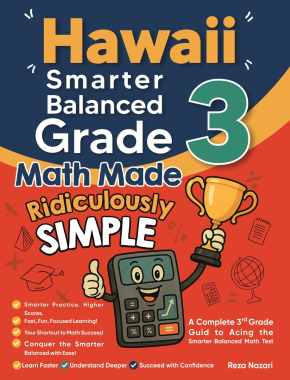
Want the fastest path through Hawaii SBAC Grade 3 math? This bundle pulls it together, practice-test books, full-length practice tests, and complete step-by-step answer keys, instant PDF download.
Recommended EffortlessMath Books
For a workbook to use alongside these printable practice pages, Mastering Grade 3 Math covers every third-grade topic with worked examples and plenty of practice. For the multi-step word problems that trip up most third graders, see Mastering Grade 3 Math Word Problems.
Frequently Asked Questions
What topics are covered in these Hawaii Grade 3 worksheets?
Multiplication and division within \(100\), the relationship between the two operations, place value to \(10{,}000\), multi-digit addition and subtraction, unit fractions and equivalence, area and perimeter of rectangles, telling time to the minute, mass and liquid volume, simple graphs, and one- and two-step word problems.
Is a calculator allowed on Hawaii’s SBAC grade 3 math test?
No. Smarter Balanced doesn’t allow calculators at grade 3. The test measures fact fluency and mental math, so build those by hand from the first worksheet.
Are these worksheets free?
Yes – every worksheet is a free PDF. No login, no email, no paywall. Print as many copies as you need for home or your classroom.
Are these aligned with the Hawaii math standards?
Yes. Hawaii uses the Common Core State Standards for Mathematics, and every worksheet maps to a grade-3 cluster – operations and algebraic thinking, base-ten, fractions, measurement and data, and geometry. SBAC grade-3 items draw straight from these standards.
How often should my third grader practice?
15-20 minutes a day, four or five days a week, works well. In the month before SBAC, swap one weekday page for a longer mixed-review session – the real test mixes topics, so practice that way too.
What if my child gets stuck?
Pause and walk through one problem together. If a topic is genuinely too hard, drop back a level and practice the prerequisite for a few days before returning. The frustration usually means a grade-2 skill needs more time.
Is there an answer key?
Yes – every worksheet PDF includes a step-by-step answer key, not just final answers. Walk through it together so the reasoning sticks.
How can we prep for Hawaii SBAC math?
Build skill by skill with these worksheets, then take one full-length timed practice test about three weeks out. Spend the last two weeks on the two weakest topics from that diagnostic.
Any tips for Hawaii parents?
Drill multiplication facts five minutes a day until they’re automatic. Read every word problem aloud first. Ask your child to estimate before they calculate. Those three habits prevent most of the careless errors that drop SBAC scores.
Where can we find more grade 3 practice?
EffortlessMath has more grade 3 worksheets by topic, the Mastering Grade 3 Math workbook, and a Grade 3 Math Word Problems book. The Related Lessons section below links to step-by-step explanations of the biggest grade-3 topics.
Related EffortlessMath Lessons
If a topic on this page feels rusty, these short lessons go deeper:
- How to multiply and divide within 100
- Place value to the thousands
- Adding and subtracting fractions
- How to find area of a rectangle
- How to solve word problems

Related to This Article
More math articles
- Objects on a Coordinate Plane
- Full-Length 6th Grade PARCC Math Practice Test-Answers and Explanations
- Chapter 20: Freedom of Speech and Press
- 5th Grade New York State Assessments Math Worksheets: FREE & Printable
- The Best Grade 5 ELA Practice Tests for South Carolina Students
- How to Use a Venn Diagram to Classify Rational Numbers?
- How to Use Area Models to Add Fractions with Like Denominators
- The Best Grade 4 Math Book for Massachusetts Students
- Number Properties Puzzle -Critical Thinking 4
- Riemann Sums Made Easy: Step-by-Step Tutorial








What people say about "Hawaii SBAC Grade 3 Math: Free Worksheets"?
No one replied yet.