The Ultimate TSI Math Formula Cheat Sheet
TL;DR: The TSI 2.0 places you into the right Texas college math course. It’s adaptive, untimed, and gives you a built-in calculator on some questions. This cheat sheet covers every formula you should know.
Key takeaways:
- TSI 2.0 Math is the Mathematics CRC (College Readiness Classification) test.
- 20 multiple-choice CRC questions, plus a 12-question diagnostic if your CRC score is below college-ready.
- Untimed; most testers finish in 60-90 minutes.
- On-screen calculator provided for certain questions.
- College-ready cut score is 950 on the CRC, with diagnostic level 6 on the diagnostic test.
Mixed Numbers
A number is composed of a whole number and a fraction. Example: \(2 \frac{2}{ 3}\) Converting between improper fractions and mixed numbers: \(a \frac{c}{b}=a+\frac{c}{b}= \frac{ab+ c}{b}\)
Factoring Numbers
Factor a number means breaking it up into numbers that can be multiplied together to get the original number. Example:\(12=2×2×3\)
Integers
\( \{…,-3,-2,-1,0,1,2,3,…\} \)
Includes: zero, counting numbers, and the negative of the counting numbers
Real Numbers
All numbers that are on a number line. Integers plus fractions, decimals, and irrationals, etc.) (\(\sqrt{2},\sqrt{3},π\), etc.)
Order of Operations
PEMDAS
(parentheses/ exponents/ multiply/ divide/ add/ subtract)
Absolute Value
Refers to the distance of a number from \(0\) on the number line. The distances are positive as the absolute value of a number cannot be negative. \(|-22|=22\)
or \(|x| =\begin{cases}x \ for \ x≥0 \\x \ for \ x < 0\end{cases} \)
\(|x|<n⇒-n<x<n\)
\(|x|>n⇒x<-n or x>n\)
Ratios
A ratio is a comparison of two numbers by division.
Example: \(3: 5\), or \(\frac{3}{5}\)
Percentages
Use the following formula to find part, whole, or percent
part \(=\frac{percent}{100}×whole\)
Proportional Ratios
A proportion means that two ratios are equal. It can be written in two ways:
\(\frac{a}{b}=\frac{c}{d}\), \(a: b = c: d \)
Percent of Change
\(\frac{New \ Value \ – \ Old \ Value}{Old Value}×100\%\)
Expressions and Variables
A variable is a letter that represents unspecified numbers. One may use a variable in the same manner as all other numbers: Addition: \(2+a\): \(2\) plus a
Subtraction: \(y-3\): \(y\) minus \(3\)
Division: \(\frac{4}{x}\): 4 divided by x
Multiplication: \(5a\): \(5\) times a
Distributive Property
\(a(b+c)=ab+ac\)
Equations
The values of the two mathematical expressions are equal.
\(ax+b=c\)
Distance from A to B:
\(\sqrt{(x_{1}-x_{2})^2+(y_{1}-y_{2})^2 }\)
Parallel and Perpendicular lines:
Have equal slopes. Perpendicular lines (i.e., those that make a \(90^° \) angle where they intersect) have negative reciprocal slopes: \(m_{1}\).\(m_{2}=-1\).
Parallel Lines (l \(\parallel\) m)
Mid-point of the segment AB:
M (\(\frac{x_{1}+x_{2}}{2}, \frac{y_{1}+y_{2}}{2}\))
Slope of the line:
\(\frac{y_{2}- y_{1}}{x_{2} – x_{1} }=\frac{rise}{run}\)
Point-slope form:
Given the slope m and a point \((x_{1},y_{1})\) on the line, the equation of the line is
\((y-y_{1})=m \ (x-x_{1})\).
Slope-intercept form:
given the slope m and the y-intercept b, then the equation of the line is:
\(y=mx+b\).
Factoring:
“FOIL”
\((x+a)(x+b)\)
\(=x^2+(b+a)x +ab\) “Difference of Squares”
\(a^2-b^2= (a+b)(a-b)\)
\(a^2+2ab+b^2=(a+b)(a+b) \)
\(a^2-2ab+b^2=(a-b)(a-b)\) “Reverse FOIL”
\(x^2+(b+a)x+ab=\) \((x+a)(x+b)\)
You can use Reverse FOIL to factor a polynomial by thinking about two numbers a and b which add to the number in front of the x, and which multiply to give the constant. For example, to factor \(x^2+5x+6\), the numbers add to 5 and multiply to 6, i.e.: \(a=2\) and \(b=3\), so that \(x^2+5x+6=(x+2)(x+3)\). To solve a quadratic such as \(x^2+bx+c=0\), first factor the left side to get \((x+a)(x+b)=0\), then set each part in parentheses equal to zero. For example, \(x^2+4x+3= (x+3)(x+1)=0\) so that \(x=-3\) or \(x=-1\).
To solve two linear equations in x and y: use the first equation to substitute for a variable in the second. E.g., suppose \(x+y=3\) and \(4x-y=2\). The first equation gives y=3-x, so the second equation becomes \(4x-(3-x)=2 ⇒ 5x-3=2\) \(⇒ x=1,y=2\).
Exponents:
Refers to the number of times a number is multiplied by itself.
\(8 = 2 × 2 × 2 = 2^3\)
Scientific Notation:
It is a way of expressing numbers that are too big or too small to be conveniently written in decimal form.
In scientific notation all numbers are written in this form: \(m \times 10^n\)
Decimal notation:
5
\(-25,000\)
0.5
2,122.456
Scientific notation:
\(5×10^0\)
\(-2.5×10^4\)
\(5×10^{-1}\)
\(2,122456×10^3\)
Square:
The number we get after multiplying an integer (not a fraction) by itself. Example: \(2×2=4,2^2=4\)
Square Roots:
A square root of \(x\) is a number r whose square is \(x: r^2=x\)
\(r\) is a square root of \(x\)
Pythagorean Theorem:
For any right triangle with legs \(a\) and \(b\) and hypotenuse \(c\): \(a^2+b^2=c^2\)
Solving for the hypotenuse: \(c=\sqrt{a^2+b^2}\)
Solving for a leg: \(a=\sqrt{c^2-b^2}\)
Common Pythagorean triples: \(3,4,5\); \(5,12,13\); \(8,15,17\); \(7,24,25\)
Triangles
Area: \(A=\frac{1}{2}bh\) where \(b\) is the base and \(h\) is the height.
Perimeter: \(P=a+b+c\) (sum of all three sides).
Pythagorean Theorem (right triangles): \(a^2+b^2=c^2\) where \(c\) is the hypotenuse.
Sum of interior angles: \(180°\)
All triangles:
Area \(=\frac{1}{2}\) b. H
Angles on the inside of any triangle add up to \(180^\circ\).
The length of one side of any triangle is always less than the sum and more than the difference between the lengths of the other two sides.
An exterior angle of any triangle is equal to the sum of the two remote interior angles. Other important triangles:
Equilateral:
These triangles have three equal sides, and all three angles are \(60^\circ\).
Isosceles:
An isosceles triangle has two equal sides. The “base” angles (the ones opposite the two sides) are equal (see the \(45^\circ\) triangle above).
Circles

Area \(=πr^2\)
Circumference \(=2πr\)
Full circle \(=360^\circ\)
Rectangles
(Square if l=w)
Area=lw
Parallelogram
(Rhombus if l=w)
Area=lh
Regular polygons are n-sided figures with all sides equal and all angles equal.
The sum of the inside angles of an n-sided regular polygon is
\((n-2).180^\circ\).
Area of a trapezoid:
\(A =\frac{1}{2} h (b_{1}+b_{2})\)
Surface Area and Volume of a Rectangular/right prism:
\(SA=ph+2B\)
\(V=Bh\)
Surface Area and Volume of a Cylinder:
\(SA =2πrh+2πr^2\)
\(V =πr^2 h \)
Surface Area and Volume of a Cone
\(SA =πrs+πr^2\)
\(V=\frac{1}{3} \ πr^2 \ h\)
Surface Area and Volume of a Sphere
\(SA =4πr^2\)
\(V =\frac{4}{3} \ πr^3\)
(p \(=\) perimeter of base B; \(π ~ 3.14 \))

Simple interest:
\(I=prt\)
(I = interest, p = principal, r = rate, t = time)
mean:
mean: \(\frac{sum \ of \ the \ data}{of \ data \ entires}\)
mode:
value in the list that appears most often
range:
largest value \(-\) smallest value
Median
The middle value in the list (which must be sorted)
Example: median of
\( \{3,10,9,27,50\} = 10\)
Example: median of
\( \{3,9,10,27\}=\frac{(9+10)}{2}=9.5 \)
Average
\( \frac{sum \ of \ terms}{number \ of \ terms}\)
Average speed
\(\frac{total \ distance}{total \ time}\)
Probability
\(\frac{number \ of \ desired \ outcomes}{number \ of \ total \ outcomes}\)
The probability of two different events A and B both happening are:
P(A and B)=p(A).p(B)
as long as the events are independent (not mutually exclusive).
Powers, Exponents, Roots
\(x^a.x^b=x^{a+b}\)
\(\frac{x^a}{x^b} = x^{a-b}\)
\(\frac{1}{x^b }= x^{-b}\)
\((x^a)^b=x^{a.b}\)
\((xy)^a= x^a.y^a\)
\(x^0=1\)
\(\sqrt{xy}=\sqrt{x}.\sqrt{y}\)
\((-1)^n=-1\), if n is odd.
\((-1)^n=+1\), if n is even.
If \(0<x<1\), then
\(0<x^3<x^2<x<\sqrt{x}<\sqrt{3x}<1\).
Simple Interest
The charge for borrowing money or the return for lending it.
Interest = principal \(×\) rate \(×\) time
OR
\(I=prt\)
Powers/ Exponents
\(x^a×x^b=x^{a+b}\)
\(\frac{x^a}{x^b}=x^{a-b}\)
\((x^a)^b=x^{ab}\)
\(x^0=1\)
\(x^{-a}=\frac{1}{x^a}\)
\(x^{\frac{1}{n}}=\sqrt[n]{x}\)
Positive Exponents
An exponent is simply shorthand for multiplying that number of identical factors. So \(4^3\) is the same as (4)(4)(4), three identical factors of 4. And \(x^3\) is just three factors of \(x\), \((x)(x)(x)\).
Negative Exponents
A negative exponent means to divide by that number of factors instead of multiplying.
So \(4^{-3}\) is the same as \( \frac{1}{4^3}\) and
\(x^{-3}=\frac{1}{x^3}\)
Factorials
Factorial- the product of a number and all counting numbers below it.
8 factorial \(=8!=\)
\(8×7×6×5×4×3×2×1=40,320\)
5 factorial \(=5!=\)
\(5×4×3×2×1=120\)
2 factorial \(=2!=2× 1=2\)
Multiplying Two Powers of the SAME Base
When the bases are the same, you find the new power by just adding the exponents
\(x^a.x^b=x^{a+b }\)
Powers of Powers
For the power of power: you multiply the exponents.
\((x^a)^b=x^{(ab)}\)
Dividing Powers
\(\frac{x^a}{x^b} =x^a x^{-b}= x^{a-b}\)
The Zero Exponent
Anything to the 0 power is 1.
\(x^0= 1\)
More from Effortless Math for TSI Test …
Have you taken the TSI but failed?
Do not worry! We will help you prepare for this test again with the Top 10 Tips You MUST Know to Retake the TSI Math.
Do you wish to pass the TSI math test?
Be successful by following the tips in the article How to Pass TSI Test: Top Tips and Key Tactics!
Looking for the best TSI math practice questions, have you browsed all the websites?
What you have in mind is designed by our team: TSI Math Practice Test Questions
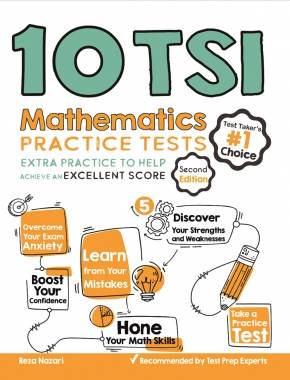
The Perfect Prep Books for the TSI Math Test
Have any questions about the TSI Test?
Write your questions about the TSI or any other topics below and we’ll reply!
Recommended EffortlessMath Books
For a step-by-step workbook on every TSI 2.0 math topic, see the TSI Math for Beginners (resource currently unavailable). For complete Texas placement-test prep with timed practice, the TSI Math Test Prep Bundle includes the workbook plus practice tests.
Frequently Asked Questions
What is the TSI 2.0 math test?
The TSI 2.0 (Texas Success Initiative Assessment) is the placement exam Texas public colleges use to decide whether you need developmental math or can take college-level math. It replaced the original TSIA in 2021.
How many math questions are on the TSI?
20 questions on the CRC (College Readiness Classification) test. If your CRC score is below 950, you take an additional 12-question diagnostic to help your advisor place you in the right developmental course.
Is a calculator allowed on the TSI?
An on-screen calculator pops up for specific questions where it’s needed. You can’t bring your own. Many questions are designed to be solved without a calculator, so practice mental arithmetic and algebra fundamentals.
Is there a formula sheet on the TSI?
No. The TSI does not provide a formula reference. Memorize slope, the quadratic formula, area/perimeter/volume, the Pythagorean theorem, and exponent rules before test day.
How long is the TSI math test?
Untimed. Most testers complete the CRC in 30-60 minutes. If you also need the diagnostic, expect another 20-40 minutes. Plan for about 2 hours total at the testing center to be safe.
What’s a passing TSI math score?
The college-ready cut score is 950 on the CRC. Below 950, you’ll need to score Level 6 on the 12-question diagnostic to skip developmental math (Level 5 places you into a co-requisite college-credit course); Level 1-4 places you into developmental math at the corresponding level.
What math topics are on the TSI?
Four content areas: Quantitative Reasoning (number sense, ratios, percents), Algebraic Reasoning (linear and quadratic equations, exponents, polynomials), Geometric and Spatial Reasoning (area, volume, transformations), and Probabilistic and Statistical Reasoning (basic probability, mean/median, data interpretation).
Can I retake the TSI?
Yes. Texas allows unlimited retakes, but most colleges require you to wait 14 days between attempts and complete a Pre-Assessment Activity. Some require additional advising before re-testing.
How long should I study for the TSI math?
For a college-ready score from a developmental starting point, plan on 4 to 8 weeks of consistent study at 30-60 minutes a day. Focus on algebra mechanics (the largest content area) and basic geometry. Free TSI practice tests are widely available, use one as a diagnostic in week 1.
Do I have to take the TSI?
Most students do, but Texas exempts you if you scored: SAT 530+ Math (taken after March 2016); ACT 23+ composite with 19+ Math; STAAR Algebra II level 2 with 4000+ scale; or college-level dual-credit math course completion. Check with your college admissions office.
Related EffortlessMath Lessons
If a topic on this page feels rusty, these short lessons go deeper:

Related to This Article
More math articles
- Everything you Need to know about Limits
- Failures, Wet Packs, Recalls, and Corrective Action
- The Best Grade 2 English Worksheets for Wyoming Students
- House and Senate voting
- Direct Substitution in Limits: Everything you need to know
- PMP Business Environment: Connect Project Work to Outcomes (2027 Prep)
- How to Build Linear Functions from Tables, Graphs, and Points? (+FREE Worksheet!)
- The Best Strategies For Successful Math Tutoring Online
- Evaluating Variables and Expressions
- How to Identify Expressions and Equations?












What people say about "The Ultimate TSI Math Formula Cheat Sheet"?
No one replied yet.