 WASHINGTONTHE EVERGREEN STATE
Washington Algebra 1 Online Center
This Washington Algebra 1 Online Center brings together practice, lessons, worksheets, flashcards and review tools. Choose the resource that matches the skill you want to work on next.
Everything Washington Algebra 1 students need to master the math test, practice tests, lessons, worksheets, and step-by-step answer explanations.
Start With a Practice Test
Six full, timed Algebra 1 practice tests, 40 questions each, instant scoring, a topic-by-topic breakdown, and full step-by-step solutions. Each one opens right here in a popup. Calculator: Calculator section.
Practice Test 1
A full diagnostic across every Algebra 1 topic.
Start Test 1 →
Practice Test 2
Fresh questions and problem types to build accuracy.
Start Test 2 →
Practice Test 3
New problems to add speed and confidence on every skill.
Start Test 3 →
Practice Test 4
Another complete, timed exam to build pacing and stamina.
Start Test 4 →
Practice Test 5
A brand-new mixed set to test your readiness.
Start Test 5 →
Practice Test 6
A final full-length simulation to confirm you are ready.
Start Test 6 →
Jump into Algebra 1
Washington Algebra 1 Study Tools
A few minutes of quick review, flip through flashcards or scan every key formula. Both open right here.
Free Algebra 1 Formula Sheet PDF
Open the complete Algebra 1 formula guide, review the pages online, then print or save the PDF when you are ready.
Complete ReviewStudy the key formulas in one focused guide.›
Page-by-Page ReviewMove through the formulas at your own pace.›
Online StudyKeep the guide open while you practice problems.›
Print When ReadyUse the print option after you finish reviewing.›
Download for LaterSave the PDF when you want an offline copy.›
Washington Algebra 1 Skill Quizzes
Short, focused quizzes, pick one skill, answer 10 questions, get instant scoring and full solutions, then jump to the matching lesson. Each opens right here.
Expressions & Equations
A quick 10-question check on Expressions & Equations with instant scoring and step-by-step solutions.
Start Quiz →
Solving Linear Equations
A quick 10-question check on Solving Linear Equations with instant scoring and step-by-step solutions.
Start Quiz →
Inequalities
A quick 10-question check on Inequalities with instant scoring and step-by-step solutions.
Start Quiz →
Functions
A quick 10-question check on Functions with instant scoring and step-by-step solutions.
Start Quiz →
Linear Functions & Graphs
A quick 10-question check on Linear Functions & Graphs with instant scoring and step-by-step solutions.
Start Quiz →
Systems of Equations & Inequalities
A quick 10-question check on Systems of Equations & Inequalities with instant scoring and step-by-step solutions.
Start Quiz →
Exponents & Polynomials
A quick 10-question check on Exponents & Polynomials with instant scoring and step-by-step solutions.
Start Quiz →
Factoring
A quick 10-question check on Factoring with instant scoring and step-by-step solutions.
Start Quiz →
Quadratic Functions & Equations
A quick 10-question check on Quadratic Functions & Equations with instant scoring and step-by-step solutions.
Start Quiz →
Statistics & Probability
A quick 10-question check on Statistics & Probability with instant scoring and step-by-step solutions.
Start Quiz →
Exponential Functions
A quick 10-question check on Exponential Functions with instant scoring and step-by-step solutions.
Start Quiz →
Rational Expressions & Equations
A quick 10-question check on Rational Expressions & Equations with instant scoring and step-by-step solutions.
Start Quiz →
Geometry & Measurement
A quick 10-question check on Geometry & Measurement with instant scoring and step-by-step solutions.
Start Quiz →
Join students who study with a clearer path
This online center is part of the Effortless Math library for Algebra 1. We connect lessons, worksheets, practice tests, books, and tools so students can study with a clearer next step.

Effortless Math is an independent educational publisher. Test names, state exams, standards names, and trademarks are used only to identify the relevant study topic; their owners do not sponsor, endorse, or approve this page.
Washington Algebra 1 Topics
Student-friendly Algebra 1 skills aligned to the Washington Algebra 1 standards, each tagged with its standard code, a focused lesson, and an instant topic quiz.
standard codes
Foundations of Algebra
Solving Linear Equations
Inequalities and Absolute Value
Relations, Functions, and Sequences
- 9-12.HSF-IF.A.1Relations and FunctionsQuiz
- 9-12.HSF-IF.A.1Function Notation and Evaluating FunctionsQuiz
- 9-12.HSF-IF.A.1Domain and RangeQuiz
- 9-12.HSF-BF.B.3Graphing Functions and TransformationsQuiz
- 9-12.HSF-IF.A.3Arithmetic Sequences as Linear FunctionsQuiz
- 9-12.HSF-IF.A.3Geometric SequencesQuiz
- 9-12.HSF-IF.C.7bGraphing Square Root, Cube Root, and Piecewise FunctionsQuiz
- 9-12.HSF-IF.C.9Comparing FunctionsQuiz
- 9-12.HSF-BF.A.1bCombining FunctionsQuiz
- 9-12.HSF-BF.B.4aInverse FunctionsQuiz
Linear Functions and Their Graphs
- 9-12.HSF-IF.B.6Slope and Rate of ChangeQuiz
- 9-12.HSF-IF.C.7aSlope-Intercept FormQuiz
- 9-12.HSA-CED.A.2Point-Slope FormQuiz
- 9-12.HSA-CED.A.2Standard Form of a Linear EquationQuiz
- 9-12.HSA-CED.A.2Writing Linear Equations from Graphs and TablesQuiz
- 9-12.HSA-CED.A.2Parallel and Perpendicular LinesQuiz
- 9-12.HSA-CED.A.2Direct and Inverse VariationQuiz
- 9-12.HSA-REI.D.10Understanding Graphs as Solution SetsQuiz
Systems of Equations and Inequalities
- 9-12.HSA-REI.C.6Solving Systems by GraphingQuiz
- 9-12.HSA-REI.C.5Solving Systems by SubstitutionQuiz
- 9-12.HSA-REI.C.5Solving Systems by EliminationQuiz
- 9-12.HSA-REI.C.6Applications of Systems of EquationsQuiz
- 9-12.HSA-REI.D.12Systems of Linear InequalitiesQuiz
- 9-12.HSA-REI.C.7Solving Linear-Quadratic SystemsQuiz
Exponents, Polynomials, and Real Numbers
Factoring
Quadratic Functions and Equations
- 9-12.HSF-IF.C.7aGraphing Quadratic FunctionsQuiz
- 9-12.HSF-IF.B.4Characteristics of Quadratic FunctionsQuiz
- 9-12.HSA-REI.B.4bSolving Quadratics by FactoringQuiz
- 9-12.HSA-REI.B.4aSolving Quadratics by Completing the SquareQuiz
- 9-12.HSA-REI.B.4bQuadratic Formula and DiscriminantQuiz
- 9-12.HSA-REI.B.4bSolving Quadratics by Square RootsQuiz
- 9-12.HSF-TF.B.5Quadratic Applications and ModelingQuiz
Statistics and Probability
- 9-12.HSS-ID.A.1Measures of Center and SpreadQuiz
- 9-12.HSS-ID.A.1Displaying Data: Histograms and Box PlotsQuiz
- 9-12.HSS-ID.B.6aScatter Plots and CorrelationQuiz
- 9-12.HSS-ID.B.6aLines of Best Fit and PredictionsQuiz
- 9-12.HSS-ID.B.5Probability and Counting PrinciplesQuiz
- 9-12.HSS-ID.B.5Two-Way Frequency TablesQuiz
Best Washington Algebra 1 Books
Each book has a job: start from scratch, drill weak skills, or build pacing with full tests. All of them pair with the free tools on this page.
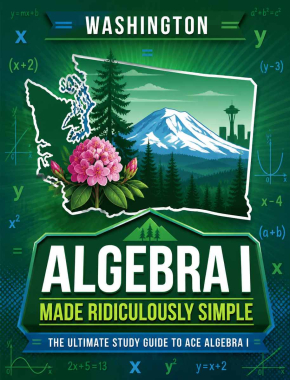
Washington Algebra I Made Ridiculously Simple: The Ultimate Step
A step-by-step Algebra 1 book that rebuilds every tested skill clearly and in order, built to match the standards.
- Best starting point for the math test
- Pairs with flashcards and worksheets
- Use it before full timed practice tests
- Organized for students who need examples before drills
Step-by-step lessons
Short explanations show the move before the student practices it.
✍Worked examples
Examples translate exam-style wording into clear math steps.
Targeted practice
Rebuild one skill at a time instead of jumping around.
Test-day bridge
After each topic, connect to formulas, flashcards, and practice questions.
How to use it
- Read one lesson and copy the worked example.
- Do a short worksheet set on the same topic.
- Review the matching flashcards or formulas.
- Try a mixed quiz and mark every miss.
Pair it with free tools
Choose the right Algebra 1 book


The Ultimate Algebra Bundle
The full prep library, study guide, workbook, and practice tests together.
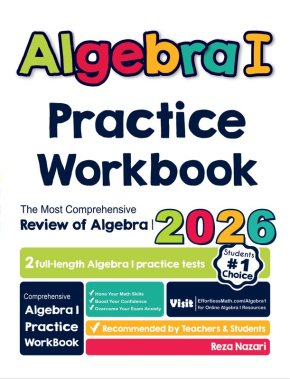
Algebra I Practice Workbook
Repeated practice by topic when a student needs more reps.
Washington Algebra I Made Ridiculously Simple
Built to match Washington Algebra 1 (standards-aligned), step by step.
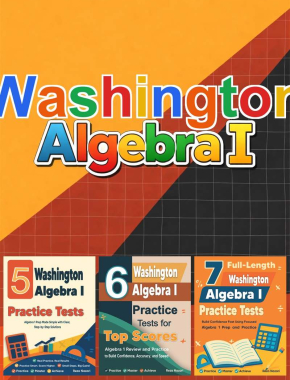
Washington Algebra I Preparation Bundle
Washington study guide, workbook, and full practice tests together.
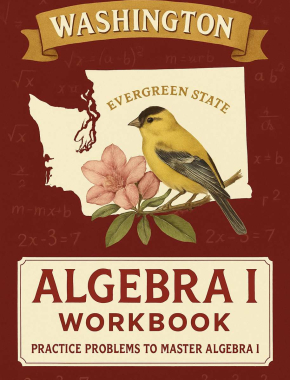
Washington Algebra I Workbook + 2 Full Length Practice Tests
Algebra 1 practice by topic, with answer keys.
Washington Algebra 1 Standards
The official Algebra 1 standards, grouped by domain with the exact code and description for each expectation.
N-RN · The Real Number System
- N-RN.1Explain how the definition of the meaning of rational exponents follows from extending the properties of integer exponents to those values, allowing for a notation for radicals in terms of rational exponents.
- N-RN.2Rewrite expressions involving radicals and rational exponents using the properties of exponents.
- N-RN.3Explain why the sum or product of two rational numbers is rational; that the sum of a rational number and an irrational number is irrational; and that the product of a nonzero rational number and an irrational number is irrational.
N-Q · Quantities
- N-Q.1Use units as a way to understand problems and to guide the solution of multi-step problems; choose and interpret units consistently in formulas; choose and interpret the scale and the origin in graphs and data displays.
- N-Q.2Define appropriate quantities for the purpose of descriptive modeling.
- N-Q.3Choose a level of accuracy appropriate to limitations on measurement when reporting quantities.
A-SSE · Seeing Structure in Expressions
- A-SSE.1.aInterpret parts of an expression, such as terms, factors, and coefficients.
- A-SSE.1.bInterpret complicated expressions by viewing one or more of their parts as a single entity.
- A-SSE.2Use the structure of an expression to identify ways to rewrite it.
- A-SSE.3.aFactor a quadratic expression to reveal the zeros of the function it defines.
- A-SSE.3.bComplete the square in a quadratic expression to reveal the maximum or minimum value of the function it defines.
- A-SSE.3.cUse the properties of exponents to transform expressions for exponential functions.
A-APR · Arithmetic with Polynomials & Rational Expressions
- A-APR.1Understand that polynomials form a system analogous to the integers, namely, they are closed under the operations of addition, subtraction, and multiplication; add, subtract, and multiply polynomials.
A-CED · Creating Equations
- A-CED.1Create equations and inequalities in one variable including ones with absolute value and use them to solve problems.
- A-CED.2Create equations in two or more variables to represent relationships between quantities; graph equations on coordinate axes with labels and scales.
- A-CED.3Represent constraints by equations or inequalities, and by systems of equations and/or inequalities, and interpret solutions as viable or non-viable options in a modeling context.
- A-CED.4Rearrange formulas to highlight a quantity of interest, using the same reasoning as in solving equations.
A-REI · Reasoning with Equations & Inequalities
- A-REI.1Explain each step in solving a simple equation as following from the equality of numbers asserted at the previous step, starting from the assumption that the original equation has a solution. Construct a viable argument to justify a solution method.
- A-REI.10Understand that the graph of an equation in two variables is the set of all its solutions plotted in the coordinate plane, often forming a curve (which could be a line).
- A-REI.11Explain why the x-coordinates of the points where the graphs of the equations y = f(x) and y = g(x) intersect are the solutions of the equation f(x) = g(x); find the solutions approximately, e.g., using technology to graph the functions, make tables of values, or find successive approximations.
- A-REI.12Graph the solutions to a linear inequality in two variables as a half-plane (excluding the boundary in the case of a strict inequality), and graph the solution set to a system of linear inequalities in two variables as the intersection of the corresponding half-planes.
- A-REI.3Solve linear equations and inequalities in one variable, including equations with coefficients represented by letters.
- A-REI.4.aUse the method of completing the square to transform any quadratic equation in x into an equation of the form (x - p)^2 = q that has the same solutions. Derive the quadratic formula from this form.
- A-REI.4.bSolve quadratic equations by inspection (e.g., for x^2 = 49), taking square roots, completing the square, the quadratic formula and factoring, as appropriate to the initial form of the equation. Recognize when the quadratic formula gives complex solutions and write them as a +/- bi for real numbers a and b.
- A-REI.5Prove that, given a system of two equations in two variables, replacing one equation by the sum of that equation and a multiple of the other produces a system with the same solutions.
- A-REI.6Solve systems of linear equations exactly and approximately (e.g., with graphs), focusing on pairs of linear equations in two variables.
- A-REI.7Solve a simple system consisting of a linear equation and a quadratic equation in two variables algebraically and graphically.
F-IF · Interpreting Functions
- F-IF.1Understand that a function from one set (called the domain) to another set (called the range) assigns to each element of the domain exactly one element of the range. If f is a function and x is an element of its domain, then f(x) denotes the output of f corresponding to the input x. The graph of f is the graph of the equation y = f(x).
- F-IF.2Use function notation, evaluate functions for inputs in their domains, and interpret statements that use function notation in terms of a context.
- F-IF.3Recognize that sequences are functions, sometimes defined recursively, whose domain is a subset of the integers.
- F-IF.4For a function that models a relationship between two quantities, interpret key features of graphs and tables in terms of the quantities, and sketch graphs showing key features given a verbal description of the relationship.
- F-IF.5Relate the domain of a function to its graph and, where applicable, to the quantitative relationship it describes.
- F-IF.6Calculate and interpret the average rate of change of a function (presented symbolically or as a table) over a specified interval. Estimate the rate of change from a graph.
- F-IF.7.aGraph linear and quadratic functions and show intercepts, maxima, and minima.
- F-IF.7.bGraph square root, cube root, and piecewise-defined functions, including step functions and absolute value functions.
- F-IF.7.eGraph exponential and logarithmic functions, showing intercepts and end behavior, and trigonometric functions, showing period, midline, and amplitude.
- F-IF.8.aUse the process of factoring and completing the square in a quadratic function to show zeros, extreme values, and symmetry of the graph, and interpret these in terms of a context.
- F-IF.8.bUse the properties of exponents to interpret expressions for exponential functions.
- F-IF.9Compare properties of two functions each represented in a different way (algebraically, graphically, numerically in tables, or by verbal descriptions).
F-BF · Building Functions
- F-BF.1.aDetermine an explicit expression, a recursive process, or steps for calculation from a context.
- F-BF.1.bCombine standard function types using arithmetic operations.
- F-BF.2Write arithmetic and geometric sequences both recursively and with an explicit formula, use them to model situations, and translate between the two forms.
- F-BF.3Identify the effect on the graph of replacing f(x) by f(x) + k, kf(x), f(kx), and f(x + k) for specific values of k (both positive and negative); find the value of k given the graphs. Experiment with cases and illustrate an explanation of the effects on the graph using technology.
- F-BF.4.aSolve an equation of the form f(x) = c for a simple function f that has an inverse and write an expression for the inverse.
F-LE · Linear, Quadratic & Exponential Models
- F-LE.1.aProve that linear functions grow by equal differences over equal intervals, and that exponential functions grow by equal factors over equal intervals.
- F-LE.1.bRecognize situations in which one quantity changes at a constant rate per unit interval relative to another.
- F-LE.1.cRecognize situations in which a quantity grows or decays by a constant percent rate per unit interval relative to another.
- F-LE.2Construct linear and exponential functions, including arithmetic and geometric sequences, given a graph, a description of a relationship, or two input-output pairs (include reading these from a table).
- F-LE.3Observe using graphs and tables that a quantity increasing exponentially eventually exceeds a quantity increasing linearly, quadratically, or (more generally) as a polynomial function.
- F-LE.5Interpret the parameters in a linear or exponential function in terms of a context.
- F-LE.6Apply quadratic functions to physical problems, such as the motion of an object under the force of gravity.
S-ID · Interpreting Data
- S-ID.1Represent data with plots on the real number line (dot plots, histograms, and box plots).
- S-ID.2Use statistics appropriate to the shape of the data distribution to compare center (median, mean) and spread (interquartile range, standard deviation) of two or more different data sets.
- S-ID.3Interpret differences in shape, center, and spread in the context of the data sets, accounting for possible effects of extreme data points (outliers).
- S-ID.5Summarize categorical data for two categories in two-way frequency tables. Interpret relative frequencies in the context of the data (including joint, marginal, and conditional relative frequencies). Recognize possible associations and trends in the data.
- S-ID.6.aFit a function to the data; use functions fitted to data to solve problems in the context of the data.
- S-ID.6.bInformally assess the fit of a function by plotting and analyzing residuals.
- S-ID.6.cFit a linear function for a scatter plot that suggests a linear association.
- S-ID.7Interpret the slope (rate of change) and the intercept (constant term) of a linear model in the context of the data.
- S-ID.8Compute (using technology) and interpret the correlation coefficient of a linear fit.
- S-ID.9Distinguish between correlation and causation.
Standards: High School Algebra 1. Official source ↗
Washington Algebra 1 FAQ
What is the Algebra 1 test?
The (Algebra 1 standards) is's Algebra 1 mathematics assessment. These free practice tests mirror its format with 40 questions and full solutions.
Can I use a calculator?
Most Algebra 1 end-of-course exams include a calculator section; check your state policy.
How long is each practice test?
Each test has a 100-minute timer and auto-submits at 0:00, then shows your score, a topic breakdown, and step-by-step solutions.
Is it free?
Yes, all six tests, lessons, and worksheets are free with no login. The study guide and bundle are optional next steps.
Algebra 1 in Other States
Explore Algebra 1 standards, practice tests, and worksheets for every state.
- Alabama
- Alaska
- Arizona
- Arkansas
- California
- Colorado
- Connecticut
- Delaware
- Florida
- Georgia
- Hawaii
- Idaho
- Illinois
- Indiana
- Iowa
- Kansas
- Kentucky
- Louisiana
- Maine
- Maryland
- Massachusetts
- Michigan
- Minnesota
- Mississippi
- Missouri
- Montana
- Nebraska
- Nevada
- New Hampshire
- New Jersey
- New Mexico
- New York
- North Carolina
- North Dakota
- Ohio
- Oklahoma
- Oregon
- Pennsylvania
- Rhode Island
- South Carolina
- South Dakota
- Tennessee
- Texas
- Utah
- Vermont
- Virginia
- Washington
- West Virginia
- Wisconsin
- Wyoming
- District of Columbia
Make This Your Starting Point
Take a timed practice test, find your weakest topic, and study it with the linked lessons, worksheets, and the study guide.
A USEFUL NEXT STEP
Washington Algebra 1: study questions
What can I study in this Washington Algebra 1 Online Center?
This Washington Algebra 1 Online Center includes practice, lessons, worksheets, flashcards and review tools. Topics on the page include Foundations of Algebra, Solving Linear Equations, Inequalities and Absolute Value.
How should I use the Washington Algebra 1 resources?
Choose a topic or practice activity from this Online Center. Review the linked explanation, try the practice, and use the result to decide what to study next. Check each resource’s directions for its format and access requirements.
Resources from Effortless Math · Editorial standards