 VIRGINIAOLD DOMINION
Virginia Algebra 2 Math Online Center
This Virginia Algebra 2 Math Online Center brings together practice, lessons, worksheets, flashcards and review tools. Choose the resource that matches the skill you want to work on next.
Everything Virginia Algebra 2 students need to master the math test, practice tests, lessons, worksheets, and step-by-step answer explanations.
Start With a Practice Test
Six full, timed Algebra 2 math practice tests, 40 questions each, instant scoring, a topic-by-topic breakdown, and full step-by-step solutions. Each one opens right here in a popup. Calculator: Calculator section.
Practice Test 1
A full diagnostic across every Algebra 2 math topic.
Start Test 1 →
Practice Test 2
Fresh questions and problem types to build accuracy.
Start Test 2 →
Practice Test 3
New problems to add speed and confidence on every skill.
Start Test 3 →
Practice Test 4
Another complete, timed exam to build pacing and stamina.
Start Test 4 →
Practice Test 5
A brand-new mixed set to test your readiness.
Start Test 5 →
Practice Test 6
A final full-length simulation to confirm you are ready.
Start Test 6 →
Jump into Algebra 2 Math
Virginia Algebra 2 Study Tools
A few minutes of quick review, flip through flashcards or scan every key formula. Both open right here.
Free Algebra 2 Formula Sheet PDF
Open the complete Algebra 2 formula guide, review the pages online, then print or save the PDF when you are ready.
Complete ReviewStudy the key formulas in one focused guide.›
Page-by-Page ReviewMove through the formulas at your own pace.›
Online StudyKeep the guide open while you practice problems.›
Print When ReadyUse the print option after you finish reviewing.›
Download for LaterSave the PDF when you want an offline copy.›
Virginia Algebra 2 Skill Quizzes
Short, focused quizzes, pick one skill, answer 10 questions, get instant scoring and full solutions, then jump to the matching lesson. Each opens right here.
Fundamentals and Building Blocks
A quick 10-question check on Fundamentals and Building Blocks with instant scoring and step-by-step solutions.
Start Quiz →
Equations and Inequalities
A quick 10-question check on Equations and Inequalities with instant scoring and step-by-step solutions.
Start Quiz →
Quadratic Functions
A quick 10-question check on Quadratic Functions with instant scoring and step-by-step solutions.
Start Quiz →
Complex Numbers
A quick 10-question check on Complex Numbers with instant scoring and step-by-step solutions.
Start Quiz →
Matrices
A quick 10-question check on Matrices with instant scoring and step-by-step solutions.
Start Quiz →
Polynomial Operations
A quick 10-question check on Polynomial Operations with instant scoring and step-by-step solutions.
Start Quiz →
Function Operations
A quick 10-question check on Function Operations with instant scoring and step-by-step solutions.
Start Quiz →
Exponential Functions
A quick 10-question check on Exponential Functions with instant scoring and step-by-step solutions.
Start Quiz →
Logarithms
A quick 10-question check on Logarithms with instant scoring and step-by-step solutions.
Start Quiz →
Radical Expressions
A quick 10-question check on Radical Expressions with instant scoring and step-by-step solutions.
Start Quiz →
Rational and Irrational Expressions
A quick 10-question check on Rational and Irrational Expressions with instant scoring and step-by-step solutions.
Start Quiz →
Conics
A quick 10-question check on Conics with instant scoring and step-by-step solutions.
Start Quiz →
Sequences and Series
A quick 10-question check on Sequences and Series with instant scoring and step-by-step solutions.
Start Quiz →
Trigonometric Functions
A quick 10-question check on Trigonometric Functions with instant scoring and step-by-step solutions.
Start Quiz →
More Topics in Trigonometric Functions
A quick 10-question check on More Topics in Trigonometric Functions with instant scoring and step-by-step solutions.
Start Quiz →
Graphs of Trigonometric Functions
A quick 10-question check on Graphs of Trigonometric Functions with instant scoring and step-by-step solutions.
Start Quiz →
Statistics
A quick 10-question check on Statistics with instant scoring and step-by-step solutions.
Start Quiz →
Probability
A quick 10-question check on Probability with instant scoring and step-by-step solutions.
Start Quiz →
Financial Literacy
A quick 10-question check on Financial Literacy with instant scoring and step-by-step solutions.
Start Quiz →
Join students who study with a clearer path
This state grade math Online Center is part of the Effortless Math library for Algebra 2 Math Center. We connect lessons, worksheets, practice tests, books, and tools so students can study with a clearer next step.

Effortless Math is an independent educational publisher. Test names, state exams, standards names, and trademarks are used only to identify the relevant study topic; their owners do not sponsor, endorse, or approve this page.
Virginia Algebra 2 Math Topics
Student-friendly Algebra 2 skills aligned to the Virginia Algebra 2 standards, each tagged with its code, a focused lesson, and an instant topic quiz.
standard codes
Fundamentals and Building Blocks
Equations and Inequalities
- Algebra 2Solving Multi, Step Equations
- Algebra 2Solving InequalitiesQuiz
- Algebra 2Graphing Linear InequalitiesQuiz
- Algebra 2Solving Compound InequalitiesQuiz
- A2.EI.1.aSolving Absolute Value EquationsQuiz
- A2.EI.1.cSolving Absolute Value InequalitiesQuiz
- A2.EI.1.dGraphing Absolute Value InequalitiesQuiz
- A2.EI.3.aSolving Systems of EquationsQuiz
- A2.EI.3.bSolving Special SystemsQuiz
- Algebra 2Systems of Equations Word ProblemsQuiz
- Algebra 2Systems of Three Linear Equations in Three VariablesQuiz
Quadratic Functions
- A2.EI.2.aSolving a Quadratic EquationQuiz
- Algebra 2Graphing Quadratic FunctionsQuiz
- Algebra 2Axis of Symmetry of Quadratic FunctionsQuiz
- A2.EI.2.dSolve a Quadratic Equation by GraphingQuiz
- Algebra 2Solving Quadratic Equations with Square RootsQuiz
- A2.EI.6.aBuild Quadratics from RootsQuiz
- A2.EI.2.aSolving Quadratic InequalitiesQuiz
- A2.EI.2.cGraphing Quadratic InequalitiesQuiz
- A2.EO.3.bFactoring the Difference of Two Perfect SquaresQuiz
Complex Numbers
Matrices
- Algebra 2Using Matrices to Represent DataQuiz
- Algebra 2Adding and Subtracting MatricesQuiz
- Algebra 2Matrix MultiplicationQuiz
- Algebra 2Finding Determinants of a MatrixQuiz
- Algebra 2Inverse of a MatrixQuiz
- Algebra 2Solving Linear Systems with Matrix EquationsQuiz
- Algebra 2Augmented Matrices and Gaussian EliminationQuiz
- Algebra 2Identity and Zero MatricesQuiz
Polynomial Operations
- Algebra 2Writing Polynomials in Standard FormQuiz
- Algebra 2Simplifying PolynomialsQuiz
- A2.EO.3.aAdding and Subtracting PolynomialsQuiz
- Algebra 2Multiplying and Dividing MonomialsQuiz
- A2.EO.3.aMultiplying a Polynomial and a MonomialQuiz
- A2.EO.3.aMultiplying BinomialsQuiz
- A2.EO.3.bFactoring PolynomialsQuiz
- A2.EO.3.bChoosing a Factoring Method for PolynomialsQuiz
- A2.EO.3.bFactoring by Greatest Common FactorQuiz
- Algebra 2Factors and Greatest Common FactorsQuiz
- A2.EO.3.aOperations with PolynomialsQuiz
- A2.EI.6.dEnd Behavior of Polynomial FunctionsQuiz
- Algebra 2Remainder and Factor TheoremsQuiz
- A2.EO.3.cPolynomial Division (Long Division)Quiz
- A2.EO.3.cPolynomial Division (Synthetic Division)Quiz
- A2.EI.6.aFinding Zeros of PolynomialsQuiz
- A2.EO.3.dPolynomial IdentitiesQuiz
Function Operations
- A2.F.2.fFunction NotationQuiz
- Algebra 2Adding and Subtracting FunctionsQuiz
- Algebra 2Multiplying and Dividing FunctionsQuiz
- A2.F.2.kComposition of FunctionsQuiz
- Algebra 2Writing FunctionsQuiz
- A2.F.1.aParent FunctionsQuiz
- A2.F.2.iFunction InversesQuiz
- A2.F.1.dInverse VariationQuiz
- A2.F.1.eGraphing FunctionsQuiz
- A2.F.2.aDomain and Range of FunctionQuiz
- A2.F.2.bPiecewise FunctionQuiz
- A2.F.2.bPositive, Negative, Increasing, and Decreasing FunctionsQuiz
- Algebra 2Average Rate of ChangeQuiz
- Algebra 2Even, Odd, and Symmetric FunctionsQuiz
- A2.F.1.bTransformations of Parent FunctionsQuiz
Exponential Functions
Logarithms
Radical Expressions
Rational and Irrational Expressions
- Algebra 2Rational and Irrational NumbersQuiz
- A2.EO.1.aSimplifying Rational ExpressionsQuiz
- A2.F.1.aGraphing Rational ExpressionsQuiz
- A2.EO.1.aMultiplying Rational ExpressionsQuiz
- A2.EO.1.aDividing Rational ExpressionsQuiz
- A2.EO.1.aAdding and Subtracting Rational ExpressionsQuiz
- A2.EI.4.aRational EquationsQuiz
- A2.EO.1.cSimplifying Complex FractionsQuiz
- A2.F.2.dMaximum and Minimum PointsQuiz
- A2.F.1.dDirect, Inverse, Joint, and Combined VariationQuiz
- A2.F.2.aAsymptotes of Rational FunctionsQuiz
Conics
- Algebra 2Equation of a ParabolaQuiz
- Algebra 2Focus, Vertex, and Directrix of a ParabolaQuiz
- Algebra 2Standard Form of a CircleQuiz
- Algebra 2Finding the Center and the Radius of CirclesQuiz
- Algebra 2Equation of an EllipseQuiz
- Algebra 2Hyperbola in Standard FormQuiz
- Algebra 2Classifying a Conic SectionQuiz
Sequences and Series
Trigonometric Functions
- Algebra 2Angles of Rotation: Coterminal and Reference AnglesQuiz
- Algebra 2Angles and Angle MeasureQuiz
- Algebra 2Right-Triangle TrigonometryQuiz
- Algebra 2Trigonometric RatiosQuiz
- Algebra 2Function Values and Ratios of Special and General AnglesQuiz
- Algebra 2Missing Sides and Angles of a Right TriangleQuiz
- Algebra 2The Reciprocal Trigonometric FunctionsQuiz
- Algebra 2Co-FunctionsQuiz
- Algebra 2Pythagorean IdentitiesQuiz
- Algebra 2The Unit Circle, Sine, and CosineQuiz
- Algebra 2Arc Length and Sector AreaQuiz
More Topics in Trigonometric Functions
- Algebra 2Domain and Range of Trigonometric FunctionsQuiz
- Algebra 2Inverse of Trigonometric FunctionsQuiz
- Algebra 2Review of Fundamental Trigonometric IdentitiesQuiz
- Algebra 2Solving Trigonometric EquationsQuiz
- Algebra 2Law of SinesQuiz
- Algebra 2Law of CosinesQuiz
- Algebra 2Double-Angle and Half-Angle IdentitiesQuiz
- Algebra 2Sum and Difference IdentitiesQuiz
Graphs of Trigonometric Functions
Statistics
- A2.ST.1.cFrequency and HistogramsQuiz
- Algebra 2Box-and-Whisker PlotsQuiz
- A2.ST.1.eMeasures of DispersionQuiz
- A2.ST.1.aOrganizing DataQuiz
- A2.ST.1.cData DistributionQuiz
- A2.ST.2.aFitting Regression Models to Scatter PlotsQuiz
- A2.ST.2.eUsing Regression Models for Prediction and InterpretationQuiz
- A2.ST.1.aStatistics as a Process for InferenceQuiz
- A2.ST.1.bSample Surveys, Experiments, and Observational StudiesQuiz
- A2.ST.2.hEvaluating Statistical ReportsQuiz
- A2.ST.1.dZ-Scores and the Normal DistributionQuiz
Probability
Best Virginia Algebra 2 Books
Each book has a job: start from scratch, drill weak skills, or build pacing with full tests. All of them pair with the free tools on this page.
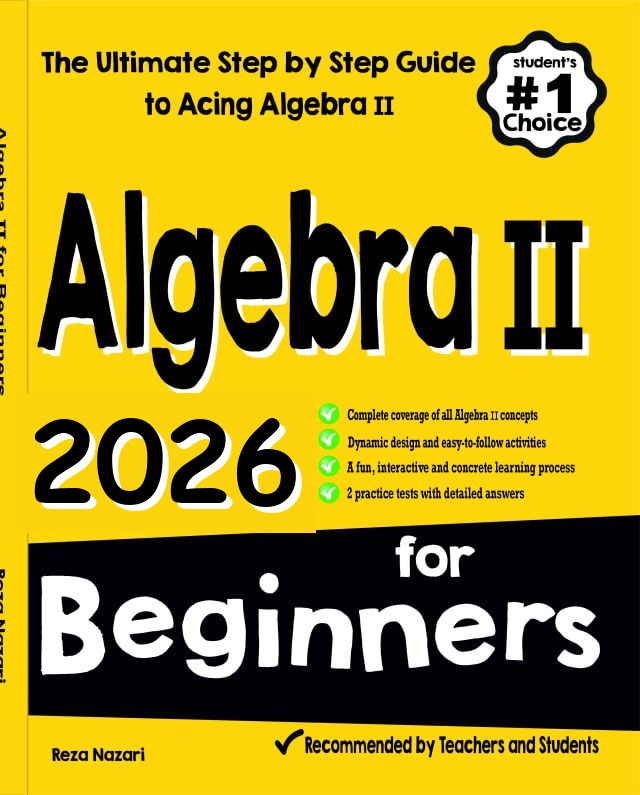
Algebra II for Beginners
A step-by-step Algebra 2 math book that rebuilds every tested skill clearly and in order, built to match the standards.
- Best starting point for the math test
- Pairs with flashcards and worksheets
- Use it before full timed practice tests
- Organized for students who need examples before drills
Step-by-step lessons
Short explanations show the move before the student practices it.
✍Worked examples
Examples translate exam-style wording into clear math steps.
Targeted practice
Rebuild one skill at a time instead of jumping around.
Test-day bridge
After each topic, connect to formulas, flashcards, and practice questions.
How to use it
- Read one lesson and copy the worked example.
- Do a short worksheet set on the same topic.
- Review the matching flashcards or formulas.
- Try a mixed quiz and mark every miss.
Pair it with free tools
Choose the right Algebra 2 math book

The Ultimate Algebra Bundle: From Pre-Algebra to Algebra II
The full prep library, study guide, workbook, and practice tests together.
 (resource currently unavailable)
Algebra II Practice Workbook (resource currently unavailable)
Repeated practice by topic when a student needs more reps.
Virginia Algebra 2 Standards
The official Algebra 2 math standards, grouped by domain with the exact code and description for each expectation.
N-CN · The Complex Number System
- N-CN.1Know there is a complex number \(i\) such that \(i^2 = -1\), and every complex number has the form \(a + bi\) with \(a\) and \(b\) real.
- N-CN.2Use the relation \(i^2 = -1\) and the commutative, associative, and distributive properties to add, subtract, and multiply complex numbers.
- N-CN.7Solve quadratic equations with real coefficients that have complex solutions.
- N-CN.8(+) Extend polynomial identities to the complex numbers. For example, rewrite \(x^2 + 4\) as \((x + 2i)(x - 2i)\).
- N-CN.9(+) Know the Fundamental Theorem of Algebra; show that it is true for quadratic polynomials.
A-SSE · Seeing Structure in Expressions
- A-SSE.1.aInterpret parts of an expression, such as terms, factors, and coefficients.
- A-SSE.1.bInterpret complicated expressions by viewing one or more of their parts as a single entity. For example, interpret \(P(1+r)^n\) as the product of \(P\) and a factor not depending on \(P\).
- A-SSE.2Use the structure of an expression to identify ways to rewrite it. For example, see \(x^4 - y^4\) as \((x^2)^2 - (y^2)^2\), thus recognizing it as a difference of squares that can be factored as \((x^2 - y^2)(x^2 + y^2)\).
- A-SSE.3.cUse the properties of exponents to transform expressions for exponential functions. For example, the expression \(1.15^t\) can be rewritten as \((1.15^{1/12})^{12t} approx 1.012^{12t}\) to reveal the approximate equivalent monthly interest rate if the annual rate is 15%.
- A-SSE.4Derive the formula for the sum of a finite geometric series (when the common ratio is not 1), and use the formula to solve problems. For example, calculate mortgage payments.
A-APR · Arithmetic with Polynomials & Rational Expressions
- A-APR.1Understand that polynomials form a system analogous to the integers, namely, they are closed under the operations of addition, subtraction, and multiplication; add, subtract, and multiply polynomials.
- A-APR.2Know and apply the Remainder Theorem: For a polynomial \(p(x)\) and a number \(a\), the remainder on division by \(x - a\) is \(p(a)\), so \(p(a) = 0\) if and only if \((x - a)\) is a factor of \(p(x)\).
- A-APR.3Identify zeros of polynomials when suitable factorizations are available, and use the zeros to construct a rough graph of the function defined by the polynomial.
- A-APR.4Prove polynomial identities and use them to describe numerical relationships. For example, the polynomial identity \((x^2 + y^2)^2 = (x^2 - y^2)^2 + (2xy)^2\) can be used to generate Pythagorean triples.
- A-APR.5(+) Know and apply the Binomial Theorem for the expansion of \((x + y)^n\) in powers of \(x\) and \(y\) for a positive integer \(n\), where \(x\) and \(y\) are any numbers, with coefficients determined for example by Pascal's Triangle.
- A-APR.6Rewrite simple rational expressions in different forms; write \(a(x)/b(x)\) in the form \(q(x) + r(x)/b(x)\), where \(a(x)\), \(b(x)\), \(q(x)\), and \(r(x)\) are polynomials with the degree of \(r(x)\) less than the degree of \(b(x)\), using inspection, long division, or, for the more complicated examples, a computer algebra system.
- A-APR.7(+) Understand that rational expressions form a system analogous to the rational numbers, closed under addition, subtraction, multiplication, and division by a nonzero rational expression; add, subtract, multiply, and divide rational expressions.
A-CED · Creating Equations
- A-CED.1Create equations and inequalities in one variable and use them to solve problems. Include equations arising from linear and quadratic functions, and simple rational and exponential functions.
- A-CED.2Create equations in two or more variables to represent relationships between quantities; graph equations on coordinate axes with labels and scales.
- A-CED.3Represent constraints by equations or inequalities, and by systems of equations and/or inequalities, and interpret solutions as viable or non-viable options in a modeling context. For example, represent inequalities describing nutritional and cost constraints on combinations of different foods.
- A-CED.4Rearrange formulas to highlight a quantity of interest, using the same reasoning as in solving equations. For example, rearrange Ohm's law \(V = IR\) to highlight resistance \(R\).
A-REI · Reasoning with Equations & Inequalities
- A-REI.1Explain each step in solving a simple equation as following from the equality of numbers asserted at the previous step, starting from the assumption that the original equation has a solution. Construct a viable argument to justify a solution method.
- A-REI.11Explain why the \(x\)-coordinates of the points where the graphs of the equations \(y = f(x)\) and \(y = g(x)\) intersect are the solutions of the equation \(f(x) = g(x)\); find the solutions approximately, e.g., using technology to graph the functions, make tables of values, or find successive approximations. Include cases where \(f(x)\) and/or \(g(x)\) are linear, polynomial, rational, absolute value, exponential, and logarithmic functions.
- A-REI.2Solve simple rational and radical equations in one variable, and give examples showing how extraneous solutions may arise.
- A-REI.4.aUse the method of completing the square to transform any quadratic equation in \(x\) into an equation of the form \((x - p)^2 = q\) that has the same solutions. Derive the quadratic formula from this form.
- A-REI.4.bSolve quadratic equations by inspection (e.g., for \(x^2 = 49\)), taking square roots, completing the square, the quadratic formula and factoring, as appropriate to the initial form of the equation. Recognize when the quadratic formula gives complex solutions and write them as \(a pm bi\) for real numbers \(a\) and \(b\).
- A-REI.6Solve systems of linear equations exactly and approximately (e.g., with graphs), focusing on pairs of linear equations in two variables.
- A-REI.7Solve a simple system consisting of a linear equation and a quadratic equation in two variables algebraically and graphically. For example, find the points of intersection between the line \(y = -3x\) and the circle \(x^2 + y^2 = 3\).
F-IF · Interpreting Functions
- F-IF.4For a function that models a relationship between two quantities, interpret key features of graphs and tables in terms of the quantities, and sketch graphs showing key features given a verbal description of the relationship. Key features include: intercepts; intervals where the function is increasing, decreasing, positive, or negative; relative maximums and minimums; symmetries; end behavior; and periodicity.
- F-IF.5Relate the domain of a function to its graph and, where applicable, to the quantitative relationship it describes. For example, if the function \(h(n)\) gives the number of person-hours it takes to assemble \(n\) engines in a factory, then the positive integers would be an appropriate domain for the function.
- F-IF.6Calculate and interpret the average rate of change of a function (presented symbolically or as a table) over a specified interval. Estimate the rate of change from a graph.
- F-IF.7.bGraph square root, cube root, and piecewise-defined functions, including step functions and absolute value functions.
- F-IF.7.cGraph polynomial functions, identifying zeros when suitable factorizations are available, and showing end behavior.
- F-IF.7.eGraph exponential and logarithmic functions, showing intercepts and end behavior, and trigonometric functions, showing period, midline, and amplitude.
- F-IF.8.bUse the properties of exponents to interpret expressions for exponential functions. For example, identify percent rate of change in functions such as \(y = (1.02)^t\), \(y = (0.97)^t\), \(y = (1.01)^{12t}\), \(y = (1.2)^{t/10}\), and classify them as representing exponential growth or decay.
- F-IF.9Compare properties of two functions each represented in a different way (algebraically, graphically, numerically in tables, or by verbal descriptions). For example, given a graph of one quadratic function and an algebraic expression for another, say which has the larger maximum.
F-BF · Building Functions
- F-BF.1.aDetermine an explicit expression, a recursive process, or steps for calculation from a context.
- F-BF.1.bCombine standard function types using arithmetic operations. For example, build a function that models the temperature of a cooling body by adding a constant function to a decaying exponential, and relate these functions to the model.
- F-BF.2Write arithmetic and geometric sequences both recursively and with an explicit formula, use them to model situations, and translate between the two forms.
- F-BF.3Identify the effect on the graph of replacing \(f(x)\) by \(f(x) + k\), \(k,f(x)\), \(f(kx)\), and \(f(x + k)\) for specific values of \(k\) (both positive and negative); find the value of \(k\) given the graphs. Experiment with cases and illustrate an explanation of the effects on the graph using technology. Include recognizing even and odd functions from their graphs and algebraic expressions for them.
- F-BF.4.aSolve an equation of the form \(f(x) = c\) for a simple function \(f\) that has an inverse and write an expression for the inverse. For example, \(f(x) = 2 x^3\) or \(f(x) = (x+1)/(x-1)\) for \(x ne 1\).
- F-BF.4.b(+) Verify by composition that one function is the inverse of another.
- F-BF.4.c(+) Read values of an inverse function from a graph or a table, given that the function has an inverse.
- F-BF.4.d(+) Produce an invertible function from a non-invertible function by restricting the domain.
- F-BF.5(+) Understand the inverse relationship between exponents and logarithms and use this relationship to solve problems involving logarithms and exponents.
F-LE · Linear, Quadratic & Exponential Models
- F-LE.4For exponential models, express as a logarithm the solution to \(a,b^{ct} = d\) where \(a\), \(c\), and \(d\) are numbers and the base \(b\) is 2, 10, or \(e\); evaluate the logarithm using technology.
S-ID · Interpreting Data
- S-ID.4Use the mean and standard deviation of a data set to fit it to a normal distribution and to estimate population percentages. Recognize that there are data sets for which such a procedure is not appropriate. Use calculators, spreadsheets, and tables to estimate areas under the normal curve.
S-CP · Conditional Probability & the Rules of Probability
- S-CP.1Describe events as subsets of a sample space (the set of outcomes) using characteristics (or categories) of the outcomes, or as unions, intersections, or complements of other events (``or,'' ``and,'' ``not'').
- S-CP.2Understand that two events \(A\) and \(B\) are independent if the probability of \(A\) and \(B\) occurring together is the product of their probabilities, and use this characterization to determine if they are independent.
- S-CP.3Understand the conditional probability of \(A\) given \(B\) as \(P(A text{ and } B)/P(B)\), and interpret independence of \(A\) and \(B\) as saying that the conditional probability of \(A\) given \(B\) is the same as the probability of \(A\), and the conditional probability of \(B\) given \(A\) is the same as the probability of \(B\).
- S-CP.4Construct and interpret two-way frequency tables of data when two categories are associated with each object being classified. Use the two-way table as a sample space to decide if events are independent and to approximate conditional probabilities.
- S-CP.5Recognize and explain the concepts of conditional probability and independence in everyday language and everyday situations. For example, compare the chance of having lung cancer if you are a smoker with the chance of being a smoker if you have lung cancer.
- S-CP.6Find the conditional probability of \(A\) given \(B\) as the fraction of \(B\)'s outcomes that also belong to \(A\), and interpret the answer in terms of the model.
- S-CP.7Apply the Addition Rule, \(P(A text{ or } B) = P(A) + P(B) - P(A text{ and } B)\), and interpret the answer in terms of the model.
S-IC · Making Inferences
- S-IC.1Understand statistics as a process for making inferences about population parameters based on a random sample from that population.
- S-IC.2Decide if a specified model is consistent with results from a given data-generating process, e.g., using simulation. For example, a model says a spinning coin falls heads up with probability 0.5. Would a result of 5 tails in a row cause you to question the model?
- S-IC.3Recognize the purposes of and differences among sample surveys, experiments, and observational studies; explain how randomization relates to each.
- S-IC.4Use data from a sample survey to estimate a population mean or proportion; develop a margin of error through the use of simulation models for random sampling.
- S-IC.5Use data from a randomized experiment to compare two treatments; use simulations to decide if differences between parameters are significant.
- S-IC.6Evaluate reports based on data.
F-TF
- F-TF.1Understand radian measure of an angle as the length of the arc on the unit circle subtended by the angle.
- F-TF.2Explain how the unit circle in the coordinate plane enables the extension of trigonometric functions to all real numbers, interpreted as radian measures of angles traversed counterclockwise around the unit circle.
- F-TF.5Choose trigonometric functions to model periodic phenomena with specified amplitude, frequency, and midline.
- F-TF.8Prove the Pythagorean identity \(sin^2(theta) + cos^2(theta) = 1\) and use it to find \(sin(theta)\), \(cos(theta)\), or \(tan(theta)\) given \(sin(theta)\), \(cos(theta)\), or \(tan(theta)\) and the quadrant of the angle.
- F-TF.9(+) Prove the addition and subtraction formulas for sine, cosine, and tangent and use them to solve problems.
Standards: High School Algebra 2. Official source ↗
Virginia Algebra 2 FAQ
What is the Algebra 2 math test?
The (framework) is's Algebra 2 mathematics assessment. These free practice tests mirror its format with 40 questions and full solutions.
Can I use a calculator?
Most Algebra 2 exams include a calculator section; check your course policy.
How long is each practice test?
Each test has a 100-minute timer and auto-submits at 0:00, then shows your score, a topic breakdown, and step-by-step solutions.
Is it free?
Yes, all six tests, lessons, and worksheets are free with no login. The study guide and bundle are optional next steps.
Algebra 2 Math in Other States
Explore Algebra 2 math standards, practice tests, and worksheets for every state.
- Alabama
- Alaska
- Arizona
- Arkansas
- California
- Colorado
- Connecticut
- Delaware
- Florida
- Georgia
- Hawaii
- Idaho
- Illinois
- Indiana
- Iowa
- Kansas
- Kentucky
- Louisiana
- Maine
- Maryland
- Massachusetts
- Michigan
- Minnesota
- Mississippi
- Missouri
- Montana
- Nebraska
- Nevada
- New Hampshire
- New Jersey
- New Mexico
- New York
- North Carolina
- North Dakota
- Ohio
- Oklahoma
- Oregon
- Pennsylvania
- Rhode Island
- South Carolina
- South Dakota
- Tennessee
- Texas
- Utah
- Vermont
- Virginia
- Washington
- West Virginia
- Wisconsin
- Wyoming
- District of Columbia
Make This Your Starting Point
Take a timed practice test, find your weakest topic, and study it with the linked lessons, worksheets, and the study guide.
A USEFUL NEXT STEP
Virginia Algebra 2 Math: study questions
What can I study in this Virginia Algebra 2 Math Online Center?
This Virginia Algebra 2 Math Online Center includes practice, lessons, worksheets, flashcards and review tools. Topics on the page include Fundamentals and Building Blocks, Equations and Inequalities, Quadratic Functions.
How should I use the Virginia Algebra 2 Math resources?
Choose a topic or practice activity from this Online Center. Review the linked explanation, try the practice, and use the result to decide what to study next. Check each resource’s directions for its format and access requirements.
Resources from Effortless Math · Editorial standards