


 NORTH CAROLINATHE TAR HEEL STATE
North Carolina Algebra 1 Online Center
Free North Carolina Algebra 1 practice includes 6 full-length practice tests with 40 questions each and step-by-step solutions. Review individual skills with lessons, printable worksheets, and flashcards.
Everything North Carolina Algebra 1 students need to master the math test, practice tests, lessons, worksheets, and step-by-step answer explanations.
North Carolina NC Math 1 End-of-Course Test: Facts
NC Math 1 covers the Algebra 1 content in North Carolina’s integrated math sequence. Students take the NC Math 1 end-of-course (EOC) test at the end of the course, and the score counts as at least 20 percent of the final course grade. Level 3 or higher is grade-level proficient.
| Test | North Carolina EOC, NC Math 1 |
|---|---|
| When | Last ten days of a yearlong course, or last five days of a semester (4×4) or summer course |
| Counts toward | At least 20 percent of the final course grade |
Achievement levels
| Level | What it means |
|---|---|
| Level 5 | Comprehensive understanding; on track for college and career readiness |
| Level 4 | Thorough understanding; on track for college and career readiness |
| Level 3 | Sufficient understanding; grade-level proficient |
| Not Proficient | Inconsistent understanding |
Practice on this page: Practice testsSkill quizzesNorth Carolina standardsTopics and lessons
Facts from the North Carolina Department of Public Instruction, checked November 23, 2026: NCDPI: End-of-Course Assessment Brief (Biology, English II, NC Math 1, NC Math 3); NCDPI: 2024–25 Technical Guide for Accountability and Testing Results (achievement levels).
All 40 NC Math 1 Standards
North Carolina’s first high school math course, NC Math 1, covers the Algebra 1 content. The NC Math 1 end-of-course test measures these standards. Open a group to see its standards.
The Real Number System (1)
| NC.M1.N-RN.2 | Rewrite algebraic expressions with integer exponents using the properties of exponents. |
|---|
Seeing Structure in Expressions (2)
| NC.M1.A-SSE.1 | Interpret expressions that represent a quantity in terms of its context. |
|---|---|
| NC.M1.A-SSE.3 | Write an equivalent form of a quadratic expression 𝑎𝑥2 + 𝑏𝑥 + 𝑐, where a is an integer, by factoring to reveal the solutions of the equation or the zeros of the function the expression defines. |
Arithmetic with Polynomials and Rational Expressions (2)
| NC.M1.A-APR.1 | Build an understanding that operations with polynomials are comparable to operations with integers by adding and subtracting quadratic expressions and by adding, subtracting, and multiplying linear expressions. |
|---|---|
| NC.M1.A-APR.3 | Understand the relationships among the factors of a quadratic expression, the solutions of a quadratic equation, and the zeros of a quadratic function. |
Creating Equations (4)
| NC.M1.A-CED.1 | Create equations and inequalities in one variable that represent linear, exponential, and quadratic relationships and use them to solve problems. |
|---|---|
| NC.M1.A-CED.2 | Create and graph equations in two variables to represent linear, exponential, and quadratic relationships between quantities. |
| NC.M1.A-CED.3 | Create systems of linear equations and inequalities to model situations in context. |
| NC.M1.A-CED.4 | Solve for a quantity of interest in formulas used in science and mathematics using the same reasoning as in solving equations. |
Reasoning with Equations and Inequalities (8)
| NC.M1.A-REI.1 | Justify a chosen solution method and each step of the solving process for linear and quadratic equations using mathematical reasoning. |
|---|---|
| NC.M1.A-REI.3 | Solve linear equations and inequalities in one variable. |
| NC.M1.A-REI.4 | Solve for the real solutions of quadratic equations in one variable by taking square roots and factoring. |
| NC.M1.A-REI.5 | Explain why replacing one equation in a system of linear equations by the sum of that equation and a multiple of the other produces a system with the same solutions. |
| NC.M1.A-REI.6 | Use tables, graphs, or algebraic methods (substitution and elimination) to find approximate or exact solutions to systems of linear equations and interpret solutions in terms of a context. |
| NC.M1.A-REI.10 | Understand that the graph of a two variable equation represents the set of all solutions to the equation. |
| NC.M1.A-REI.11 | Build an understanding of why the x-coordinates of the points where the graphs of two linear, exponential, and/or quadratic equations 𝑦 = 𝑓(𝑥) and 𝑦 = 𝑔(𝑥) intersect are the solutions of the equation 𝑓(𝑥) = 𝑔(𝑥) and approximate solutions using graphing technology or successive approximations with a table of values. |
| NC.M1.A-REI.12 | Represent the solutions of a linear inequality or a system of linear inequalities graphically as a region of the plane. |
Interpreting Functions (8)
| NC.M1.F-IF.1 | Build an understanding that a function from one set (called the domain) to another set (called the range) assigns to each element of the domain exactly one element of the range by recognizing that: if f is a function and x is an element of its domain, then 𝑓(𝑥) denotes the output of f corresponding to the input x; the graph of 𝑓 is the graph of the equation 𝑦 = 𝑓(𝑥) |
|---|---|
| NC.M1.F-IF.2 | Use function notation to evaluate linear, quadratic, and exponential functions for inputs in their domains, and interpret statements that use function notation in terms of a context. |
| NC.M1.F-IF.4 | Interpret key features of graphs, tables, and verbal descriptions in context to describe functions that arise in applications relating two quantities, including: intercepts; intervals where the function is increasing, decreasing, positive, or negative; and maximums and minimums. |
| NC.M1.F-IF.5 | Interpret a function in terms of the context by relating its domain and range to its graph and, where applicable, to the quantitative relationship it describes. |
| NC.M1.F-IF.6 | Calculate and interpret the average rate of change over a specified interval for a function presented numerically, graphically, and/or symbolically. |
| NC.M1.F-IF.7 | Analyze linear, exponential, and quadratic functions by generating different representations, by hand in simple cases and using technology for more complicated cases, to show key features, including: domain and range; rate of change; intercepts; intervals where the function is increasing, decreasing, positive, or negative; maximums and minimums; and end behavior. |
| NC.M1.F-IF.8 | Use equivalent expressions to reveal and explain different properties of a function. |
| NC.M1.F-IF.9 | Compare key features of two functions (linear, quadratic, or exponential) each with a different representation (symbolically, graphically, numerically in tables, or by verbal descriptions). |
Building Functions (2)
| NC.M1.F-BF.1 | Write a function that describes a relationship between two quantities. |
|---|---|
| NC.M1.F-BF.2 | Translate between explicit and recursive forms of arithmetic and geometric sequences and use both to model situations. |
Linear, Quadratic, and Exponential Models (3)
| NC.M1.F-LE.1 | Identify situations that can be modeled with linear and exponential functions, and justify the most appropriate model for a situation based on the rate of change over equal intervals. |
|---|---|
| NC.M1.F-LE.3 | Compare the end behavior of linear, exponential, and quadratic functions using graphs and tables to show that a quantity increasing exponentially eventually exceeds a quantity increasing linearly or quadratically. |
| NC.M1.F-LE.5 | Interpret the parameters 𝑎 and 𝑏 in a linear function 𝑓(𝑥) = 𝑎𝑥 + 𝑏 or an exponential function 𝑔(𝑥) = 𝑎𝑏𝑥 in terms of a context. |
Expressing Geometric Properties with Equations (3)
| NC.M1.G-GPE.4 | Use coordinates to solve geometric problems involving polygons algebraically. |
|---|---|
| NC.M1.G-GPE.5 | Use coordinates to prove the slope criteria for parallel and perpendicular lines and use them to solve problems. |
| NC.M1.G-GPE.6 | Use coordinates to find the midpoint or endpoint of a line segment. |
Interpreting Categorical and Quantitative Data (7)
| NC.M1.S-ID.1 | Use technology to represent data with plots on the real number line (histograms, and box plots). |
|---|---|
| NC.M1.S-ID.2 | Use statistics appropriate to the shape of the data distribution to compare center (median, mean) and spread (interquartile range, standard deviation) of two or more different data sets. Interpret differences in shape, center, and spread in the context of the data sets. |
| NC.M1.S-ID.3 | Examine the effects of extreme data points (outliers) on shape, center, and/or spread. |
| NC.M1.S-ID.6 | Represent data on two quantitative variables on a scatter plot, and describe how the variables are related. |
| NC.M1.S-ID.7 | Interpret in context the rate of change and the intercept of a linear model. Use the linear model to interpolate and extrapolate predicted values. Assess the validity of a predicted value. |
| NC.M1.S-ID.8 | Analyze patterns and describe relationships between two variables in context. Using technology, determine the correlation coefficient of bivariate data and interpret it as a measure of the strength and direction of a linear relationship. Use a scatter plot, correlation coefficient, and a residual plot to determine the appropriateness of using a linear function to model a relationship between two variables. |
| NC.M1.S-ID.9 | Distinguish between association and causation. |
Codes and wording from the NCDPI Standard Course of Study document (sub-points joined after a colon where the standard lists them). Checked November 23, 2026: NCDPI: K-12 Mathematics Standard Course of Study (adopted 2017); NCDPI: Mathematics Standard Course of Study and supporting resources.
Start With a Practice Test
Six full, timed Algebra 1 practice tests, 40 questions each, instant scoring, a topic-by-topic breakdown, and full step-by-step solutions. Each one opens right here in a popup. Calculator: Calculator section.
Practice Test 1
A full diagnostic across every Algebra 1 topic.
Start Test 1 →
Practice Test 2
Fresh questions and problem types to build accuracy.
Start Test 2 →
Practice Test 3
New problems to add speed and confidence on every skill.
Start Test 3 →
Practice Test 4
Another complete, timed exam to build pacing and stamina.
Start Test 4 →
Practice Test 5
A brand-new mixed set to test your readiness.
Start Test 5 →
Practice Test 6
A final full-length simulation to confirm you are ready.
Start Test 6 →
Jump into Algebra 1
North Carolina Algebra 1 Study Tools
A few minutes of quick review, flip through flashcards or scan every key formula. Both open right here.
Free Algebra 1 Formula Sheet PDF
Open the complete Algebra 1 formula guide, review the pages online, then print or save the PDF when you are ready.
Complete ReviewStudy the key formulas in one focused guide.›
Page-by-Page ReviewMove through the formulas at your own pace.›
Online StudyKeep the guide open while you practice problems.›
Print When ReadyUse the print option after you finish reviewing.›
Download for LaterSave the PDF when you want an offline copy.›
North Carolina Algebra 1 Skill Quizzes
Short, focused quizzes, pick one skill, answer 10 questions, get instant scoring and full solutions, then jump to the matching lesson. Each opens right here.
Expressions & Equations
A quick 10-question check on Expressions & Equations with instant scoring and step-by-step solutions.
Start Quiz →
Solving Linear Equations
A quick 10-question check on Solving Linear Equations with instant scoring and step-by-step solutions.
Start Quiz →
Inequalities
A quick 10-question check on Inequalities with instant scoring and step-by-step solutions.
Start Quiz →
Functions
A quick 10-question check on Functions with instant scoring and step-by-step solutions.
Start Quiz →
Linear Functions & Graphs
A quick 10-question check on Linear Functions & Graphs with instant scoring and step-by-step solutions.
Start Quiz →
Systems of Equations & Inequalities
A quick 10-question check on Systems of Equations & Inequalities with instant scoring and step-by-step solutions.
Start Quiz →
Exponents & Polynomials
A quick 10-question check on Exponents & Polynomials with instant scoring and step-by-step solutions.
Start Quiz →
Factoring
A quick 10-question check on Factoring with instant scoring and step-by-step solutions.
Start Quiz →
Quadratic Functions & Equations
A quick 10-question check on Quadratic Functions & Equations with instant scoring and step-by-step solutions.
Start Quiz →
Statistics & Probability
A quick 10-question check on Statistics & Probability with instant scoring and step-by-step solutions.
Start Quiz →
Exponential Functions
A quick 10-question check on Exponential Functions with instant scoring and step-by-step solutions.
Start Quiz →
Rational Expressions & Equations
A quick 10-question check on Rational Expressions & Equations with instant scoring and step-by-step solutions.
Start Quiz →
Geometry & Measurement
A quick 10-question check on Geometry & Measurement with instant scoring and step-by-step solutions.
Start Quiz →
Join students who study with a clearer path
This online center is part of the Effortless Math library for Algebra 1. We connect lessons, worksheets, practice tests, books, and tools so students can study with a clearer next step.

Effortless Math is an independent educational publisher. Test names, state exams, standards names, and trademarks are used only to identify the relevant study topic; their owners do not sponsor, endorse, or approve this page.
North Carolina Algebra 1 Topics
Student-friendly Algebra 1 skills aligned to the North Carolina Algebra 1 standards, each tagged with its standard code, a focused lesson, and an instant topic quiz.
standard codes
Foundations of Algebra
Solving Linear Equations
Inequalities and Absolute Value
Relations, Functions, and Sequences
Linear Functions and Their Graphs
Exponents, Polynomials, and Real Numbers
Factoring
Quadratic Functions and Equations
Statistics and Probability
Exponential Functions and Modeling
Best North Carolina Algebra 1 Books
Each book has a job: start from scratch, drill weak skills, or build pacing with full tests. All of them pair with the free tools on this page.
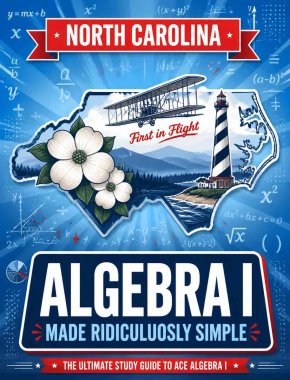
North Carolina Algebra I Made Ridiculously Simple: The Ultimate Step
A step-by-step Algebra 1 book that rebuilds every tested skill clearly and in order, built to match the standards.
- Best starting point for the math test
- Pairs with flashcards and worksheets
- Use it before full timed practice tests
- Organized for students who need examples before drills
Step-by-step lessons
Short explanations show the move before the student practices it.
✍Worked examples
Examples translate exam-style wording into clear math steps.
Targeted practice
Rebuild one skill at a time instead of jumping around.
Test-day bridge
After each topic, connect to formulas, flashcards, and practice questions.
How to use it
- Read one lesson and copy the worked example.
- Do a short worksheet set on the same topic.
- Review the matching flashcards or formulas.
- Try a mixed quiz and mark every miss.
Pair it with free tools
Choose the right Algebra 1 book


The Ultimate Algebra Bundle
The full prep library, study guide, workbook, and practice tests together.
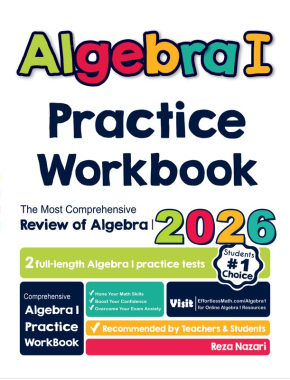
Algebra I Practice Workbook
Repeated practice by topic when a student needs more reps.
North Carolina Algebra I Made Ridiculously Simple
Built to match North Carolina Algebra 1 (standards-aligned), step by step.
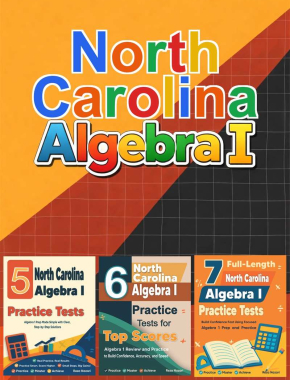
North Carolina Algebra I Preparation Bundle
North Carolina study guide, workbook, and full practice tests together.
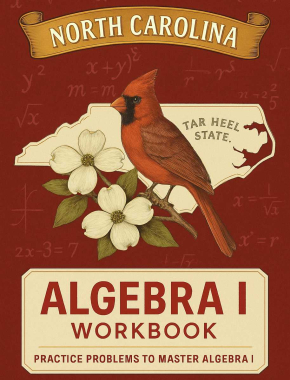
North Carolina Algebra I Workbook + 2 Full Length Practice Tests
Algebra 1 practice by topic, with answer keys.
North Carolina Algebra 1 FAQ
What is the Algebra 1 test?
The (Algebra 1 standards) is's Algebra 1 mathematics assessment. These free practice tests mirror its format with 40 questions and full solutions.
Can I use a calculator?
Most Algebra 1 end-of-course exams include a calculator section; check your state policy.
How long is each practice test?
Each test has a 100-minute timer and auto-submits at 0:00, then shows your score, a topic breakdown, and step-by-step solutions.
Is it free?
Yes, all six tests, lessons, and worksheets are free with no login. The study guide and bundle are optional next steps.
Algebra 1 in Other States
Explore Algebra 1 standards, practice tests, and worksheets for every state.
- Alabama
- Alaska
- Arizona
- Arkansas
- California
- Colorado
- Connecticut
- Delaware
- Florida
- Georgia
- Hawaii
- Idaho
- Illinois
- Indiana
- Iowa
- Kansas
- Kentucky
- Louisiana
- Maine
- Maryland
- Massachusetts
- Michigan
- Minnesota
- Mississippi
- Missouri
- Montana
- Nebraska
- Nevada
- New Hampshire
- New Jersey
- New Mexico
- New York
- North Carolina
- North Dakota
- Ohio
- Oklahoma
- Oregon
- Pennsylvania
- Rhode Island
- South Carolina
- South Dakota
- Tennessee
- Texas
- Utah
- Vermont
- Virginia
- Washington
- West Virginia
- Wisconsin
- Wyoming
- District of Columbia
Make This Your Starting Point
Take a timed practice test, find your weakest topic, and study it with the linked lessons, worksheets, and the study guide.
North Carolina Algebra 1: 10-Question Challenge
Ten questions that check the ideas North Carolina Algebra 1 students need to know cold. Try each one on paper first, then check yourself.
Subtract 2x from both sides: \(7x+8=-27\). Subtract \(8\): \(7x=-35\). Divide by \(7\): \(x=-5\).
Slope = \(\frac{-6}{3}=-2\). Use the point (0, 7): \(b=7--2(0)=7\).
Add the equations to eliminate \(y\): \(3x=18\), so \(x=6\). Then \(y=3-6=-3\).
Find two numbers whose product is \(5\) and sum is \(6\): \(5\) and \(1\). So the trinomial factors as \((x+5)(x+1)\).
Factor: \((x-6)(x-7)=0\). Set each factor to 0: \(x=6\) or \(x=7\).
Raise a power to a power by multiplying the exponents: \(4\times5=20\).
Subtract \(3\): \(5x\lt 15\). Divide by \(5\): \(x\lt 3\).
For \(y=ax^2+bx+c\), the vertex is at \(x=-\frac{b}{2a}\): \(x=-\frac{-2}{2(-1)}=-1\).
Choose another state
Algebra 1 in Every State
Select a state on the map to open its Algebra 1 page. You are viewing North Carolina.
All states A–Z
A USEFUL NEXT STEP
North Carolina Algebra 1: study questions
What can I study in this North Carolina Algebra 1 Online Center?
This North Carolina Algebra 1 Online Center includes practice, lessons, worksheets, flashcards and review tools. Topics on the page include Foundations of Algebra, Solving Linear Equations, Inequalities and Absolute Value.
Resources from Effortless Math · Editorial standards