LEARN · PRACTICE · EXPLORE
New Jersey Grade 8 Math
Solve linear systems in New Jersey Grade 8 math with a worked substitution example, domain checks, selected 2023 state references, lessons, and practice.
Focused lessons · Useful practice · Clear next steps
What do New Jersey 8th graders learn in math?
In 8th grade, New Jersey math centers on linear equations and functions, the Pythagorean theorem, exponents and scientific notation, transformations, and volume. Students take the NJSLA grade 8 math test in the spring. This page explains each New Jersey grade 8 math standard and pairs it with short lessons, skill quizzes, printable worksheets and a full-length practice test.
Printable New Jersey grade 8 math books:
Standards source: 2023 New Jersey mathematics standards.
Explore Independent Grade 8 Math Practice
Six independently published, timed New Jersey NJSLA-named Grade 8 math practice tests, 40 questions each, instant scoring, a topic-by-topic breakdown, and full step-by-step solutions. Each one opens right here in a popup. Calculator: Four-function calculator (on part). These are the practice sets’ own specifications; follow the school’s current assigned assessment pathway and official directions.
NJSLA Practice Test 1
An independently published practice set across a range of math topics.
Start Test 1 →
NJSLA Practice Test 2
Fresh questions and problem types to build accuracy.
Start Test 2 →
NJSLA Practice Test 3
Additional independent practice across a range of skills.
Start Test 3 →
NJSLA Practice Test 4
Another independently published, timed practice set.
Start Test 4 →
NJSLA Practice Test 5
A brand-new mixed set to test your readiness.
Start Test 5 →
NJSLA Practice Test 6
Another independent practice set; compare its feedback with classroom work.
Start Test 6 →
New Jersey Grade 8 Math Study Tools
A few minutes of quick review, flip through flashcards or read a selected formula reference. Both open right here.
New Jersey Grade 8 Math Skill Quizzes
Short, focused quizzes, pick one skill, answer 10 questions, get instant scoring and full solutions, then jump to the matching lesson. Each opens right here.
The Number System & Real Numbers
A quick 10-question check on The Number System & Real Numbers with instant scoring and step-by-step solutions.
Start Quiz →
Exponents & Scientific Notation
A quick 10-question check on Exponents & Scientific Notation with instant scoring and step-by-step solutions.
Start Quiz →
Equations & Inequalities
A quick 10-question check on Equations & Inequalities with instant scoring and step-by-step solutions.
Start Quiz →
Functions
A quick 10-question check on Functions with instant scoring and step-by-step solutions.
Start Quiz →
Geometry & Transformations
A quick 10-question check on Geometry & Transformations with instant scoring and step-by-step solutions.
Start Quiz →
Statistics & Probability
A quick 10-question check on Statistics & Probability with instant scoring and step-by-step solutions.
Start Quiz →
Financial Literacy
A quick 10-question check on Financial Literacy with instant scoring and step-by-step solutions.
Start Quiz →
Mixed Grade 8 Review
A quick 10-question check on Mixed Grade 8 Review with instant scoring and step-by-step solutions.
Start Quiz →
Classroom practice and state assessment information
The official 2026–2027 schedule lists NJSLA-A mathematics for Grades 3 through high school, including Grade 8. NJDOE describes the mathematics assessment as adaptive. Confirm the learner’s assigned pathway, tools, and school directions. Independently published practice may use its own timer, tools, question count, and scoring; these are not official administration specifications or a prediction of a state performance level. Read the official adaptive assessment overview for official guidance.
Use the worked activity and lesson directory to choose a skill. Confirm the directions of an independent practice resource before assigning it.
Find the point where two cost models agree
A system’s solution must satisfy both equations at the same time. The 2023 New Jersey standard includes solving linear systems by substitution and estimating solutions from graphs. This original example solves a two-equation system first, then uses a table to check the result.
Try this original activity
A classroom printing model has two invented offers for identical display sheets. A costs $8 to set up and $3 per sheet. B costs $2 to set up and $5 per sheet. Write equations for total cost C and number of sheets n. Use substitution to find when the costs agree. Assume nonnegative whole-sheet quantities and no other charges.
| Sheets n | A: 3n + 8 | B: 5n + 2 |
|---|---|---|
| 2 | $14 | $12 |
| 3 | $17 | $17 |
| 4 | $20 | $22 |
Work through the reasoning
The equations are C = 3n + 8 and C = 5n + 2. Substitute the first expression for C into the second equation: 3n + 8 = 5n + 2. Subtract 3n and then subtract 2 to obtain 6 = 2n, so n = 3. Substitute n = 3 into either equation to find C = 17. Check both: 3 × 3 + 8 = 17 and 5 × 3 + 2 = 17. The system’s solution is (n, C) = (3, 17), meaning three sheets cost seventeen dollars under either model. At two sheets A costs fourteen dollars and B twelve; at four sheets A costs twenty and B twenty-two. Those nearby values confirm that the equality occurs between the two different cost orderings. A graph would represent the solution by the intersection (3, 17), because that point belongs to both lines.
Check the common mistake
Finding n = 3 does not mean the shared total cost is three dollars. Interpret both coordinates with their units. Comparing only the per-sheet charge leaves out the starting charges and can select the wrong cheaper offer for a small order. A table can confirm this solution, but the substitution calculation explains exactly where equality comes from. The classroom offers are invented and are not current supplier prices. This activity models one linear system and does not cover every kind of system or all of Grade 8 algebra.
Try a related case
Change A’s setup charge to $9 while keeping both per-sheet rates and B’s setup charge. Substitution gives 3n + 9 = 5n + 2, hence n = 3.5. The extended lines intersect, but the stated whole-sheet purchasing model has no order with equal cost. Explain the difference between a mathematical intersection and an allowed quantity in the situation.
Selected 2023 New Jersey references for this activity
The 2023 New Jersey Student Learning Standards for Mathematics define grade-specific expectations. These selected references point to the activity’s focus; read the complete official Grade 8 page, its examples and clarifications, and the mathematical practices alongside the school’s teaching sequence.
| Selected reference | Activity focus | Official grade page |
|---|---|---|
| 8.EE.8 | Linear systems solved by substitution | Read the complete domain |
Sources checked October 6, 2026. These focus labels are independent paraphrases of selected expectations, not a complete state checklist or certified alignment of the lesson library.
Connect the explanation with practice
Use the lesson, worksheet, and quiz directory to choose a related skill. The existing resource links remain available; open each activity’s directions to understand its timer, tools, question count, and scoring.
The official 2026–2027 schedule lists NJSLA-A mathematics for Grades 3 through high school, including Grade 8. NJDOE describes the mathematics assessment as adaptive. Confirm the learner’s assigned pathway, tools, and school directions. Independently published practice may use its own timer, tools, question count, and scoring; these are not official administration specifications or a prediction of a state performance level. Read the official adaptive assessment overview.
Read the 2026–2027 statewide assessment schedule and confirm school directions. Keep one example of the student’s reasoning with the practice result. Choose a smaller model, a related question, or a new context according to the difficulty revealed in the worked activity.
New Jersey Grade 8 Math Topics
Choose a lesson, printable worksheet collection, or topic quiz. This broader library includes review and enrichment. Use the school’s current sequence and the complete New Jersey standards when choosing skills; these rows are not a certified full-course crosswalk.
Number Sense
- Rational and Irrational NumbersWorksheetsQuiz
- Turning Repeating Decimals into FractionsWorksheetsQuiz
- Estimating Irrational NumbersWorksheetsQuiz
- Estimating Expressions with Irrational NumbersWorksheetsQuiz
- Personal Financial LiteracyWorksheetsQuiz
- Prime Factorization with ExponentsWorksheetsQuiz
- Density of Real NumbersWorksheetsQuiz
Exponents and Scientific Notation
Equations and Inequalities
- Graphing Proportional RelationshipsWorksheetsQuiz
- Slope as Rate of ChangeWorksheetsQuiz
- Slope and the Equations of a LineWorksheetsQuiz
- Solving Linear Equations in One VariableWorksheetsQuiz
- Solving Systems of Two EquationsWorksheetsQuiz
- Solving Real Problems with SystemsWorksheetsQuiz
- Solving Linear InequalitiesWorksheetsQuiz
- Multiplying Linear Expressions and FactoringWorksheetsQuiz
- Graphing Linear Inequalities in Two VariablesWorksheetsQuiz
- Parallel and Perpendicular LinesWorksheetsQuiz
- Point Slope and Standard FormWorksheetsQuiz
- Literal EquationsWorksheetsQuiz
- Absolute Value Equations and InequalitiesWorksheetsQuiz
- Equations with Special SolutionsWorksheetsQuiz
Functions
- What is a FunctionWorksheetsQuiz
- Reading Function ValuesWorksheetsQuiz
- Comparing Two FunctionsWorksheetsQuiz
- Linear vs Nonlinear FunctionsWorksheetsQuiz
- Building Linear FunctionsWorksheetsQuiz
- Sketching and Describing Function GraphsWorksheetsQuiz
- Domain and Range of a FunctionWorksheetsQuiz
- Arithmetic SequencesWorksheetsQuiz
- Geometric SequencesWorksheetsQuiz
Geometry
- Rotations Reflections and TranslationsWorksheetsQuiz
- Congruent FiguresWorksheetsQuiz
- Transformations on the Coordinate PlaneWorksheetsQuiz
- Similarity and DilationsWorksheetsQuiz
- Angles in Triangles and Parallel LinesWorksheetsQuiz
- The Pythagorean TheoremWorksheetsQuiz
- Finding Distance with the Pythagorean TheoremWorksheetsQuiz
- Volume of CylindersWorksheetsQuiz
- Angle RelationshipsWorksheetsQuiz
- Surface Area of Prisms Cylinders and PyramidsWorksheetsQuiz
- Volume of PyramidsWorksheetsQuiz
- Composite Figures Area and PerimeterWorksheetsQuiz
- Interior Angles of PolygonsWorksheetsQuiz
- Triangle Inequality TheoremWorksheetsQuiz
- Surface Area of SpheresWorksheetsQuiz
- Arc Length and Area of SectorsWorksheetsQuiz
- Cross Sections of 3D FiguresWorksheetsQuiz
- Parallel Lines and TransversalsWorksheetsQuiz
- Volume of Cones and SpheresWorksheetsQuiz
Statistics and Probability
- Scatter Plots and Patterns in DataWorksheetsQuiz
- Fitting a Line to DataWorksheetsQuiz
- Using a Linear ModelWorksheetsQuiz
- Two Way Tables for Categorical DataWorksheetsQuiz
- Mean Absolute DeviationWorksheetsQuiz
- Probability of Simple EventsWorksheetsQuiz
- Counting Principle and PermutationsWorksheetsQuiz
- Box Plots and Interquartile RangeWorksheetsQuiz
- Random SamplingWorksheetsQuiz
- Effect of Data Changes on StatisticsWorksheetsQuiz
New Jersey Grade 8 Math Books and Resources
Each book has a job: start from scratch, drill weak skills, or build pacing with full tests. All of them pair with the free tools on this page.
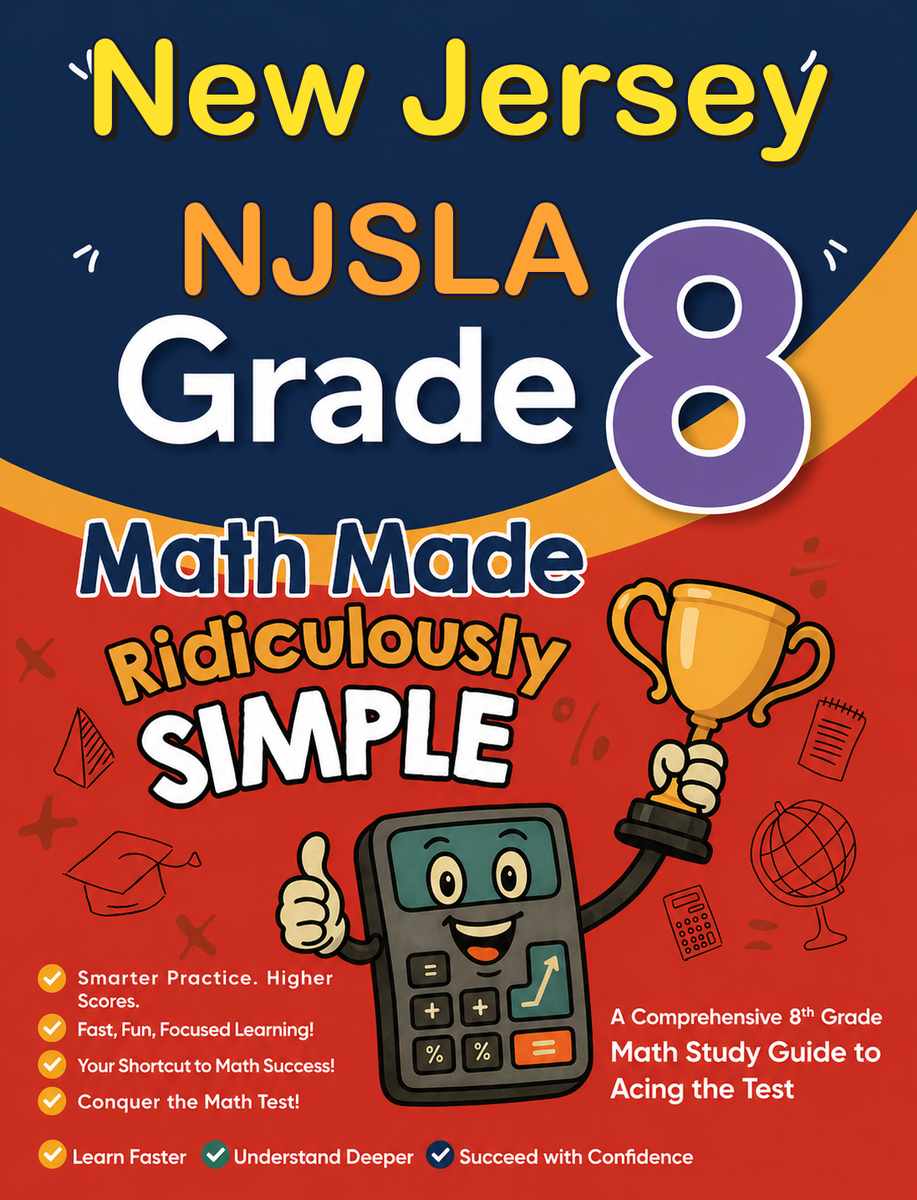
New Jersey NJSLA Grade 8 Math Made Ridiculously Simple
An independently published Grade 8 mathematics resource. Check its edition and contents against New Jersey’s adopted document and the school’s course before choosing preparation.
- Best starting point for the NJSLA math test
- Pairs with New Jersey flashcards and worksheets
- Use it before full timed practice tests
- Organized for students who need examples before drills
Step-by-step lessons
Short explanations show the move before the student practices it.
✍Worked examples
Check the listed book’s contents and edition against the learner’s course before choosing it.
Targeted practice
Rebuild one skill at a time instead of jumping around.
Test-day bridge
After each topic, connect to formulas, flashcards, and practice questions.
How to use it
- Read one lesson and copy the worked example.
- Do a short worksheet set on the same topic.
- Review the matching flashcards or formulas.
- Try a mixed quiz and mark every miss.
Pair it with free tools
Choose the right New Jersey Grade 8 math book
New Jersey NJSLA Grade 8 Math Made Ridiculously Simple
Choose a resource that fits the learner’s current Grade 8 mathematics work.
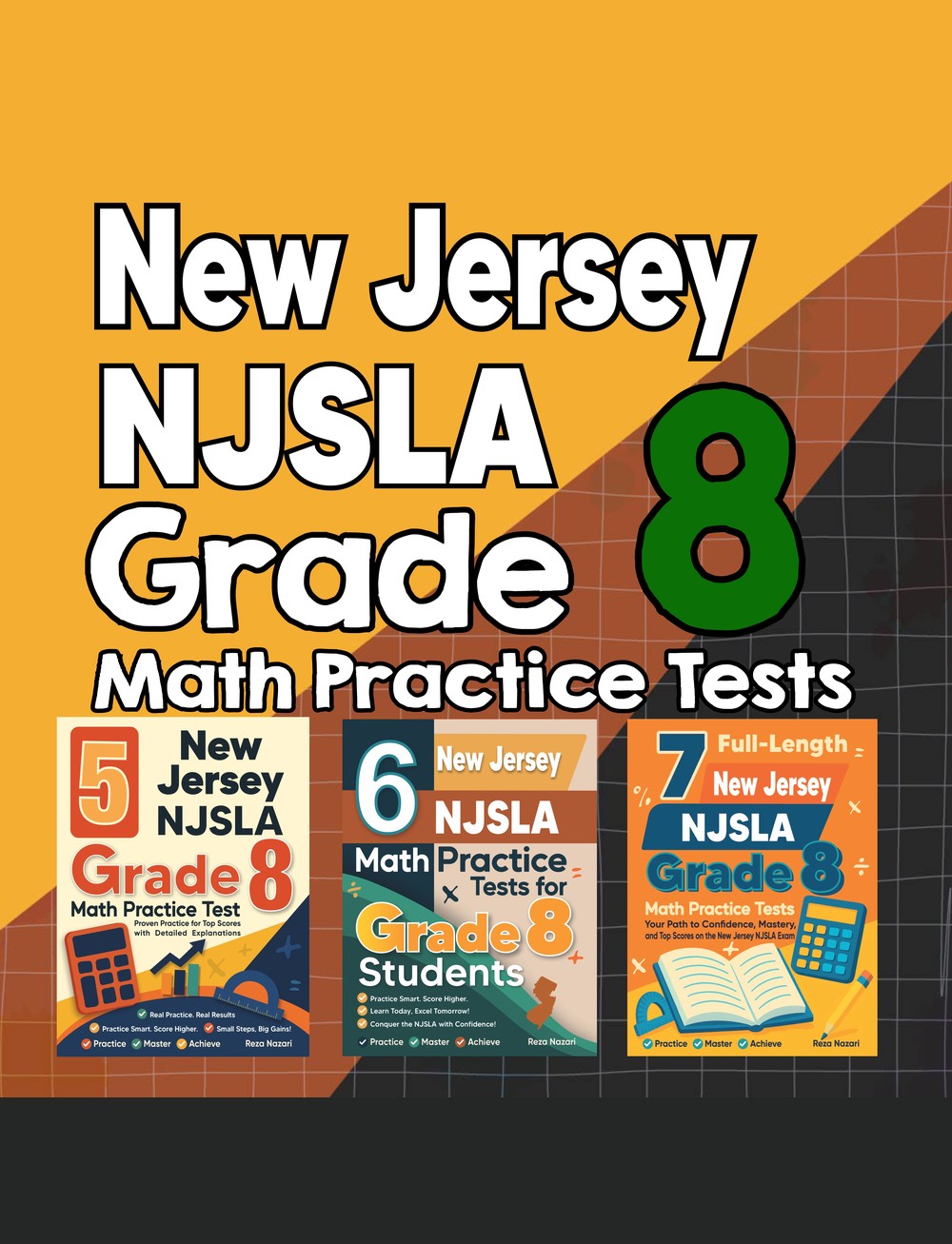
New Jersey NJSLA Grade 8 Math Preparation Bundle
The full prep library, study guide, workbook, and practice tests together.
7 New Jersey NJSLA Grade 8 Math Practice Tests
Use after topic review to build pacing and test stamina.
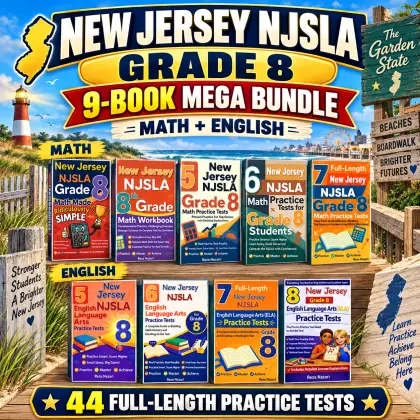
New Jersey NJSLA Grade 8 Math & ELA Mega Bundle
9 books and 44 full-length practice tests in one TPT bundle.
Read the complete 2023 New Jersey mathematics standards
The official standards directory links grade expectations and mathematical practices. Read the complete Grade 8 page, including examples and clarifications, alongside the school’s course.
The worked activity and the independent lesson library do not certify full curriculum alignment.
New Jersey Grade 8 math: useful study questions
Must a graph intersection be an allowed purchase quantity?
No. If the model allows only whole sheets, an intersection at 3.5 sheets does not describe an allowed order. Interpret the domain as well as solving the equations.
Which statewide mathematics assessment pathway applies to New Jersey Grade 8?
The official 2026–2027 schedule lists NJSLA-A mathematics for Grades 3 through high school, including Grade 8. NJDOE describes the mathematics assessment as adaptive. Confirm the learner’s assigned pathway, tools, and school directions. Independently published practice may use its own timer, tools, question count, and scoring; these are not official administration specifications or a prediction of a state performance level.
Grade 8 Math in Other States
Explore Grade 8 math standards, practice tests, and worksheets for every state.
- Alabama
- Alaska
- Arizona
- Arkansas
- California
- Colorado
- Connecticut
- Delaware
- Florida
- Georgia
- Hawaii
- Idaho
- Illinois
- Indiana
- Iowa
- Kansas
- Kentucky
- Louisiana
- Maine
- Maryland
- Massachusetts
- Michigan
- Minnesota
- Mississippi
- Missouri
- Montana
- Nebraska
- Nevada
- New Hampshire
- New Mexico
- New York
- North Carolina
- North Dakota
- Ohio
- Oklahoma
- Oregon
- Pennsylvania
- Rhode Island
- South Carolina
- South Dakota
- Tennessee
- Texas
- Utah
- Vermont
- Virginia
- Washington
- West Virginia
- Wisconsin
- Wyoming
- District of Columbia
Plan Your Next Grade 8 Math Task
Choose a related practice resource, compare its feedback with classroom explanations, and follow the school’s current learning and assessment guidance.
Start a practice testA USEFUL NEXT STEP
New Jersey Grade 8 Math: study questions
Must a graph intersection be an allowed purchase quantity?
No. If the model allows only whole sheets, an intersection at 3.5 sheets does not describe an allowed order. Interpret the domain as well as solving the equations.
Which statewide mathematics assessment pathway applies to New Jersey Grade 8?
The official 2026–2027 schedule lists NJSLA-A mathematics for Grades 3 through high school, including Grade 8. NJDOE describes the mathematics assessment as adaptive. Confirm the learner’s assigned pathway, tools, and school directions. Independently published practice may use its own timer, tools, question count, and scoring; these are not official administration specifications or a prediction of a state performance level.
Official source ↗Resources from Effortless Math · Editorial standards