CLEP College Algebra FREE Sample Practice Questions

3- A
Subtracting (2x) and adding 5 to both sides of (2x – 5 ≥ 3x – 1) gives (-4 ≥ x). Therefore, (x) is a solution to (2x – 5 ≥ 3x – 1) if and only if (x) is less than or equal to (-4) and x is NOT a solution to( 2x – 5 ≥ 3x – 1) if and only if (x) is greater than (-4). Of the choices given, only (-2) is greater than 9-4) and, therefore, cannot be a value of (x).
4- D
Given the two equations, substitute the numerical value of a into the second equation to solve for (x). (a=sqrt{3}, 4a=sqrt{4x})
Substituting the numerical value for an into the equation with x is as follows.
(4(sqrt{3})=sqrt{4x}),From here, distribute the 4. (4sqrt{3}=sqrt{4x})
Now square both sides of the equation. ((4sqrt{3})^2=(sqrt{4x})^2)
Remember to square both terms within the parentheses. Also, recall that squaring a square root sign cancels them out. (4^2 sqrt{3}^2=4x, 16(3)=4x, 48=4x, x=12)
5- C
First square both sides of the equation to get (4m-3=m^2)
Subtracting both sides by (4m-3) gives us the equation (m^2-4m+3=0)
Here you can solve the quadratic equation by factoring to get ((m-1)(m-3)=0)
For the phrase ((m-1)(m-3)) to equal zero, (m=1) or (m=3)

6- C
Let (x) be the number. Write the equation and solve for (x. (28-x)÷x= 3)
Multiply both sides by (x). ((28-x)= 3x), then add x both sides. (28=4x), now divide both sides by 4.( x=7)
7- B
The sum of supplement angles is 180. Let (x) be that angle. Therefore, (x+9x=180)
(10x=180), divide both sides by 10: (x=18)
8- B
tan(θ=frac{opposite}{adjacent})
tan(θ=frac{5}{12}⇒) we have the following right triangle. Then
(c=sqrt{5^2+12^2 }=sqrt{25+144}=sqrt{169}=13)
cos(θ=frac{adjacent}{hypotenuse}=frac{12}{13})
(img{https://appmanager.effortlessmath.com/public/images/questions/ppp.png
})
9- D
The amplitude in the graph of the equation (y=)acosb(x) is a. (a and b are constant)
In the equation (y=)cos(x), the amplitude is 2 and the period of the graph is (2π).
The only choice that has two times the amplitude of graph (y =) cos (x) is (y=2+2) cos (x)
They both have an amplitude of 2 and a period of (2π).
10- D
Substituting 6 for (x) and 14 for (y) in (y = nx+2) gives (14=(n)(6)+2),
which gives (n=2). Hence, (y=2x+2). Therefore, when (x = 10), the value of (y) is
(y=(2)(10)+2 = 22).
Looking for the best resource to help you succeed on the CLEP College Algebra test?
The Best Books to Ace the CLEP College Algebra Test
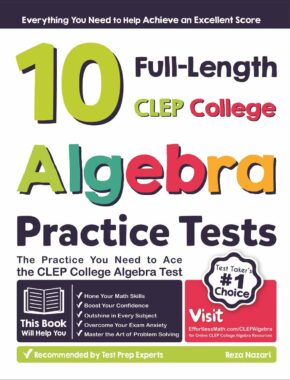
Official source: the full list of CLEP exams, what each one covers and how colleges award credit for them are published by the College Board at clep.collegeboard.org.

Related to This Article
More math articles
- The Best Grade 8 Math Book for Iowa Students
- Seventh Grade Writing: Argument, Informative, and Narrative Expectations Explained
- How to Multiply Three or More Mixed Numbers, Fractions & Whole Numbers?
- The Best Grade 8 Math Book for Wisconsin Students
- Everything You Need to Know about Indeterminate and Undefined Limits
- The Ultimate 7th Grade North Carolina EOG Math Course (+FREE Worksheets)
- Qualitative, Content, and Existing-Record Methods
- 10 Most Common 8th Grade OST Math Questions
- Best Laptops for Online Math Teaching
- 4 Reasons To Fall In Love With Math










What people say about "CLEP College Algebra Math Free Sample Practice Questions"?
No one replied yet.