Geometry Puzzle – Critical Thinking 18
The sum of more than two consecutive integers is 17. What is the LEAST number of integers? The clean answer is 17 — the consecutive integers from -7 to 9 sum to 17, and the cancellations from pairing negatives with positives make this the smallest possible run.
Key takeaways:
- Sum of \( n \) consecutive integers starting at \( a \) is \( \frac{n(2a + n - 1)}{2} \).
- For three consecutive POSITIVE integers, the sum is divisible by 3 (since the middle term is the mean).
- 17 is prime, so it has no factor of 3 — no three positive consecutive integers can sum to 17.
- Allow negatives: pairing -k with +k cancels, and the remaining positive tail can reach any target.
- Including the chain from -7 through 9 (17 terms) leaves 8 + 9 = 17 — the least number of consecutive integers that sums to 17 with the constraint \( n > 2 \).
This is another great Critical Thinking Puzzle and challenge to tease your brain and help you develop your creative thinking! For additional educational resources, . For additional educational resources
Challenge:
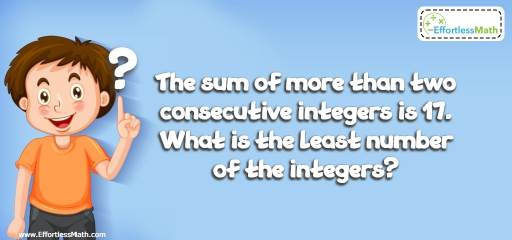
The sum of more than two consecutive integers is 17. What is the least number of the integers?
A- 3
B- 16
C- 17
D- 24
E- 28
The Absolute Best Book to Challenge Your Smart Student!

The correct answer is C.
Original price was: $27.99.$17.99Current price is: $17.99.
The sum of some consecutive integers is 17. Since, 17 is a prime number, then, we cannot find any positive consecutive integers whose sum is 17. Why?
Therefore, we need to consider negative numbers. We know that the sum of two consecutive positive numbers can be 17. Those numbers are 8 and 9.
We are looking for consecutive integers. The sum of negative and positive of a number is zero. For example, the sum of 1 and -1 is 0, or the sum of 2 and -2 is 0.
We found 8 and 9. The other numbers are:
9, 8, 7, 6, 5, 4, 3, 2, 1, 0, -1, -2, -3, -4, -5, -6, -7
The sum of above numbers is 17. Thus, the least number of the integers is 17.
The Absolute Best Books to Ace Algebra
Frequently Asked Questions
What does \”more than two consecutive integers\” mean?
At least three integers in a row — like 4, 5, 6 or -2, -1, 0, 1. The constraint rules out the trivial answer of two consecutive integers (8 and 9, which sum to 17).
Why can no three positive consecutive integers sum to 17?
Three consecutive integers have the form \( n-1, n, n+1 \), and their sum is \( 3n \) — always divisible by 3. Since 17 is not divisible by 3, no three positive consecutive integers sum to 17.
What about four, five, six consecutive positive integers?
Sum of four consecutive integers is \( 4n + 6 \); not equal to 17 for integer \( n \). Five gives \( 5n + 10 \); seven of those is 45, not 17. Walking through each small count from 3 up shows no positive run reaches 17 with this constraint.
How does allowing negative integers fix the problem?
When the run includes the same magnitude on both sides of zero, those pairs cancel: -3 + 3 = 0, -2 + 2 = 0, etc. The remaining terms can sum to any target. With -7 through 9, the -7 cancels +7, -6 cancels +6, all the way to -1 cancels +1, and zero contributes 0. What remains is 8 + 9 = 17.
Why is 17 (the count) the LEAST?
Smaller runs of consecutive integers that include negatives still fall short. Counting carefully through each possible run shows -7 to 9 is the smallest stretch satisfying both \”more than two integers\” and \”sum equals 17.\”
Can you give the general principle?
For any prime target \( p \) that is also odd and bigger than 2: there are no positive runs of three or more consecutive integers summing to \( p \), so you must include negatives. The minimal run depends on the target and grows quickly with \( p \).
What math standards does this puzzle exercise?
Sequences, sums, divisibility, and number-theoretic reasoning. Most directly: middle school operations with integers (signed addition) and arithmetic sequences (in Algebra I and beyond).
How do I check the sum of -7 to 9 quickly?
Use the pairing trick: -7 + 7 = 0, -6 + 6 = 0, …, -1 + 1 = 0, leaving 0 + 8 + 9 = 17. Or apply the consecutive-integer formula: with 17 terms starting at -7, sum = \( 17 \cdot ((-7) + 9)/2 = 17 \cdot 1 = 17 \).
Why is this a good critical-thinking problem?
It forces students past the obvious positive-only search. The shift to negative numbers is the cognitive leap — and once made, the problem is easy. That kind of \”expand the search space\” thinking is widely useful in math and beyond.
What grade level can tackle this?
Middle schoolers (Grade 6-8) once they are comfortable with signed-integer arithmetic. The formal sequence formula belongs to Algebra I or II, but the brute-force pattern is accessible earlier.
Related Lessons You May Like
- How to find prime and composite numbers
- How to add and subtract integers
- How to solve multi-step word problems
- How to classify triangles
- How to find the area of triangles
If your student enjoys puzzles like this, Pre-Algebra for Beginners covers the algebraic reasoning they tap. For deeper geometry exploration, Geometry for Beginners takes you further.

Related to This Article
More math articles
- Formal Organizations, Bureaucracy, and Concentrated Power
- SSAT Middle Level Math Flashcards (Free Online: Formulas, Terms & Concepts)
- Senate confirmation
- Economic Crises and Economic Freedom
- Race as a Social Construction
- Grade 3 Math: Perimeter
- Exploring the World of Geometry: The Intricacies of Similarity
- Rounding Decimals for 5th Grade: Nearest Tenth and Hundredth
- Mobilization
- How to Prepare for the TABE Math Test?






What people say about "Geometry Puzzle – Critical Thinking 18 - Effortless Math"?
No one replied yet.