Geometry Puzzle – Critical Thinking 17
This puzzle gives you a single condition: the volume of a cube equals one third of its total surface area. Translate that into algebra — V = (1/3) × SA — set up the cube formulas, and you can solve for the edge length in one short equation.
Key takeaways:
- For a cube of edge \( s \): volume \( V = s^3 \); total surface area \( SA = 6s^2 \).
- Translate the condition: \( V = \frac{1}{3} \cdot SA \) becomes \( s^3 = \frac{1}{3}(6s^2) = 2s^2 \).
- Divide both sides by \( s^2 \) (since \( s \neq 0 \)) to get \( s = 2 \).
- The cube has edge length 2 — and its volume (8) really is one third of its surface area (24).
- Critical-thinking puzzles like this reward translation skill, not heavy computation.
If you are a math teacher, you can move beyond the norm in your math classroom and challenge students to think critically with this kind of critical thinking challenge!
Challenge:
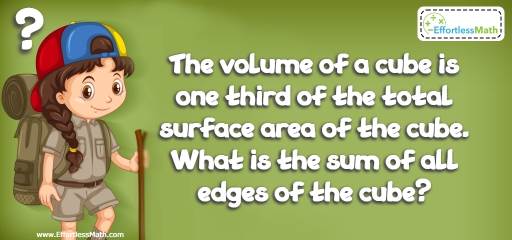
The volume of a cube is one-third of the total surface area of the cube. What is the sum of all edges of the cube?
The Absolute Best Book to Challenge Your Smart Student!

The correct answer is 24.
Original price was: $27.99.$17.99Current price is: $17.99.
A cube has 12 edges. The formula for the volume and surface area of a cube are:
V = S\(^3\) SA = 6S\(^2\)
The volume of a cube is one-third of the total surface area of the cube. Thus:
S\(^3= \frac{1}{3}\)6S\(^2\)
Remove S\(^2\) from both sides and solve for S.
S = \(\frac{1}{3}\)6 = 2
One side of the cube is 2. The sum of all edges is
2 × 12 = 24
The Absolute Best Books to Ace Algebra
Frequently Asked Questions
How do you solve \( s^3 = 2s^2 \) cleanly?
Divide both sides by \( s^2 \) — that’s valid because \( s \) is a positive edge length, so it’s not zero. You’re left with \( s = 2 \). Always note when you’re dividing by a variable that you’ve ruled out the zero case.
Why does the cube’s volume formula use \( s^3 \)?
A cube has equal length, width, and height. Volume is length × width × height, so \( V = s \cdot s \cdot s = s^3 \). The units come out cubed too — cubic centimeters, cubic inches.
Why is the surface area of a cube \( 6s^2 \)?
A cube has six faces, and each face is a square with area \( s^2 \). Multiply: total surface area = \( 6 \cdot s^2 \). Surface area is measured in square units, not cubic.
What if the puzzle said volume equals one half of the surface area instead?
Same approach. \( s^3 = \frac{1}{2}(6s^2) = 3s^2 \). Divide by \( s^2 \): \( s = 3 \). A cube of edge 3 has volume 27 and surface area 54 — and 27 is half of 54.
Can a cube ever have numerically equal volume and surface area?
Yes — when \( s = 6 \). Then \( V = 216 \) and \( SA = 216 \). The numbers match (in different units), which is a fun coincidence often used as another puzzle prompt.
Is there a smaller edge length that works for this puzzle?
For this exact condition (\( V = \frac{1}{3} SA \)), no. Once you divide \( s^3 = 2s^2 \) by \( s^2 \), you get the single positive solution \( s = 2 \). The other solution \( s = 0 \) isn’t a real cube.
Why do critical-thinking math problems matter?
They strengthen the translate-and-set-up skill that’s the most useful part of algebra. Real-world math is rarely \”solve this equation\” — it’s \”figure out which equation describes this situation,\” which is exactly what puzzles like this drill.
How can teachers use puzzles like this in class?
Hand it out as a warm-up before a volume-and-surface-area lesson, or use it as an anchor problem to revisit after the formulas are introduced. The conversation about WHY dividing by \( s^2 \) is allowed is often the most valuable part of the discussion.
What grade level is this puzzle aimed at?
The arithmetic suits middle school — Grade 6–8 — once students know cube volume, cube surface area, and basic equation solving. Strong elementary students can also tackle it with guidance.
Are there other puzzles in this critical-thinking series?
Yes — the Critical Thinking puzzles cover a range of topics, from number sense and combinatorics to geometry and algebra. They’re meant for quick, focused mental workouts and pair well with regular curriculum problems.
Related Lessons You May Like
- How to find volume and surface area of cubes
- How to calculate the volume of cubes and prisms
- How to find the area of rectangles
- How to solve multi-step word problems
- How to find equivalent fractions
If your student likes puzzles like this one, Geometry for Beginners works the same kinds of relationships inside a full geometry curriculum. For the algebra you’ll lean on for setting up the equations, Pre-Algebra for Beginners fills in the foundations gently.

Related to This Article
More math articles
- 5 Essential Strategies in Teaching Math
- Grade 3 Math: Quadrilaterals
- The Best Keyboards For Online Teaching
- Geometry Puzzle – Critical Thinking 19
- Health, Illness, and Medicine
- Scientific Notation, Units, and Formulas
- Full-Length ACT Math Practice Test-Answers and Explanations
- Grade 3 Math: Subtracting 3-Digit Numbers
- The Best Grade 2 Math Worksheets for New Mexico Students
- HiSET Math vs GED Math: A Side-by-Side Comparison


What people say about "Geometry Puzzle – Critical Thinking 17 - Effortless Math"?
No one replied yet.