The Ultimate AP Calculus BC Course
AP Calculus BC Study Course
The Ultimate AP Calculus BC Course brings the key topics into one organized review page, with lessons, worksheets, and practice links in one place.
TL;DR: A free AP Calculus BC course covering all 10 units, including everything in AB plus integration by parts, partial fractions, improper integrals, infinite series, polar coordinates, and parametric equations. Self-paced lessons with worked examples and free worksheets.
Key takeaways:
- Aligned to the College Board’s AP Calculus BC course framework (10 units).
- Covers everything in AB plus advanced integration, series, polar, and parametric topics.
- Each topic has a lesson plus a free worksheet with worked-out solutions.
- Roughly equivalent to two semesters of college calculus.
- BC students get an AB sub-score on the exam.
Unlock the secrets of Calculus BC with comprehensive explanations, in-depth examples, and extensive practice problems designed to master advanced concepts and ace your exams!
Dive deep into the world of Calculus BC with this expertly crafted textbook, tailored to guide students through the complex terrain of advanced calculus. Whether you’re preparing for challenging exams or seeking to solidify your understanding of differential equations, infinite series, and integration techniques, this book has it all. Detailed explanations are paired with in-depth examples to illustrate core concepts clearly. Each chapter offers a variety of problems, from basic drills to more intricate questions that stimulate critical thinking and analytical skills. The layout is student-friendly, featuring clear headings and key points highlighted for quick reference. Additionally, the book includes tips for solving typical exam questions and pitfalls to avoid, making it an essential resource for excelling in Calculus BC.
AP Calculus AB Complete Course
Limit and Continuity
- Limit Introduction
- Neighborhood
- Estimating Limits from Tables
- Functions with Undefined Limits (from table)
- Functions with Undefined Limits (from graphs)
- One Sided Limits
- Limit at Infinity
- Continuity at a Point
- Continuity over an Interval
- Removing Discontinuity
- Direct Substitution
- Limit Laws
- Limit Laws Combinations
- The Squeeze Theorem
- Indeterminate and Undefined
- Infinity Cases
- Trigonometric Limits
- Rationalizing Trigonometric Functions
- Algebraic Manipulation
- Redefining Function’s Value
- Rationalizing Infinite Limits
- The Intermediate Value Theorem
- Asymptotes
Derivative Basics
- Derivative Introduction
- Average and Instantaneous Rates of Change
- The Derivative of a Function
- Derivative of Trigonometric Functions
- Power Rule
- Product Rule
- Quotient Rule
- Chain Rule
- Derivative of Radicals
- Derivative of Logarithms and Exponential Functions
- Differentiability
- Differentiating Inverse Functions
- Derivative of Reciprocal Trigonometric Functions
Applications of Derivatives
- Optimization Problems
- L’Hôpital
- Implicit Relations
- Implicit Differentiation
- Related Rates
- Higher Order Derivatives
- Extreme Value Theorem
- Second Derivatives: Minimum vs. Maximum
- Curve Sketching Using Derivatives
- Mean Value Theorem
- Newton’s Method
Integrals
- What is Integral?
- Applications of Integrals
- Exponential Growth and Decay
- The Anti-Derivative
- Properties of Definite Integrals
- Riemann Sums
- Rules of Integration
- Power Rule
- Fundamental Theorem of Calculus
- Trigonometric Integrals
- Substitution Rule
- Integration by Parts
- Integral of Radicals
- Exponential and Logarithmic Integrals
- Improper Integrals
- Integrating Using Tables
- Long Division Method to Simplify Integrals
Applications of Integrals
- Average Value of a Function
- Arc Length
- Accumulation Problems
- Finding Area Between Curves
- Area Between Curves Expressed as x and y
- Introduction to Solids of Revolution
- Volume with Cross-section Method
- Disc Method
- Washer Method
- Shell Method
- Surface Area
- Modeling Particle Motion
- Partial Fraction Expansion
Differential Equations
- Introduction and Applications of DEs
- Classification of Differential Equations
- First-Order Ordinary Differential Equations
- Linear Differential Equations
- Separable Differential Equations
- Slope Fields
- Numerical Methods Introduction
- Euler’s Method for Numerical Solutions
- Modeling Change
- Simple Growth and Decay
- Population Models
- Logistic Models
Analytic Geometry
- Ellipses, Parabolas, and Hyperbolas
- Polar Coordinates
- Converting Between Polar and Rectangular Coordinates
- Graphing Polar Equations
- Derivative of Polar Coordinates
- Applications of Polar Coordinates
- Parametric Equations and Differentiating them
- Vector-valued Functions
- Basic Operations on Vectors
- Derivative of Vector-valued Functions
- Integrating Vector Valued Functions
- Velocity, Speed, and Acceleration Along a Curve
- The Total Change in Length
- Finding the Area Between Polar Curves
Sequences and Series
- Introduction to Sequences and Series
- Types of Sequences and Series
- Arithmetic Sequences
- Geometric Sequences
- Sigma Notation (Summation Notation)
- Arithmetic Series
- Geometric Series
- Alternating Series
- p-Series
- The n-th Term Test
- The Integral Test
- The Comparison Test
- Limit Comparison Test
- The Ratio Test
- Alternating Series Test
- Harmonic Series
- Power Series
- Absolute and Conditional Convergence
- Taylor Series
- Maclaurin Series
- Lagrange Error Bound
Frequently Asked Questions
How do you calculate the area of a circle?
To calculate the area of a circle, you need to use the formula Area = πr^2, where “r” represents the radius of the circle. The radius is the distance from the center of the circle to any point on its edge. By squaring the radius (multiplying it by itself) and then multiplying by π (approximately 3.14159), you’ll find the area in square units. This formula is crucial for solving many geometry problems and is also applicable in various real-world contexts, such as planning landscaping projects or designing round objects. For parents looking to help their children build a strong foundation in mathematics, exploring resources like the Top 10 Grade 3 Math Books Inspiring Young Mathematicians To Explore can be very beneficial.
How do you find the slope of a line?
To find the slope of a line, you need to determine the rate at which the line rises vertically for every unit it moves horizontally. This is calculated as the change in the y-coordinates divided by the change in the x-coordinates between any two points on the line, often represented as \( \frac{\Delta y}{\Delta x} \) or \( \frac{y2 – y1}{x2 – x1} \). In the context of AP Calculus BC, understanding how to find the slope is crucial as it forms the foundation for more complex concepts like derivatives, which measure how a function changes at any given point. For a more in-depth exploration of slopes and derivatives, check out our resources on AP Calculus BC practice materials.
What is the difference between area and volume?
Area and volume are both measures of space, but they are used in different dimensions. Area refers to the amount of space covered by a two-dimensional shape, such as a square or a circle, and is measured in square units (like square meters or square feet). Volume, on the other hand, measures the space occupied by a three-dimensional object, like a cube or a sphere, and is expressed in cubic units (such as cubic meters or cubic feet). Understanding these concepts is crucial for tackling advanced calculus problems, such as those found in the AP Calculus BC course, where you’ll often calculate areas under curves or volumes generated by rotating a shape around an axis.
Recommended EffortlessMath Books
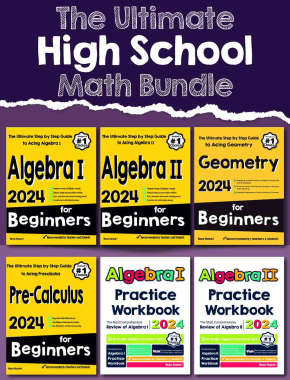
For full AP Calc BC prep with multiple practice tests, the AP Calculus BC Test Prep Bundle covers every topic with detailed answer explanations. For a workbook to learn the underlying calc, see the Calculus for Beginners.
Related EffortlessMath Lessons
If a topic on this page feels rusty, these short lessons go deeper:

Related to This Article
More math articles
- Political Parties, Campaigns, and Elections
- FREE 3rd Grade FSA Math Practice Test
- How to Find Independent and Dependent Variables in Tables and Graphs?
- Best Mobile Laptop Stands for Presentation in Schools
- Best Laptops For Online Math Teachers
- Grade 3 Math: Multiplication Facts (0-5)
- Grade 7 ELA Tests: A Clear Parent Guide to Reading, Writing, and Test-Day Readiness
- Top 10 Tips You MUST Know to Retake the ASVAB Math
- The 5 BEST Online Math Tutoring Tools
- Math for Travel: Currency, Distance, Time Zones, and Tipping for 2026








What people say about "The Ultimate AP Calculus BC Course - Effortless Math"?
No one replied yet.